Maintaining Sales Market Share Is Not Everything
Maintaining a 'Super Gap' Through Portfolio Diversification
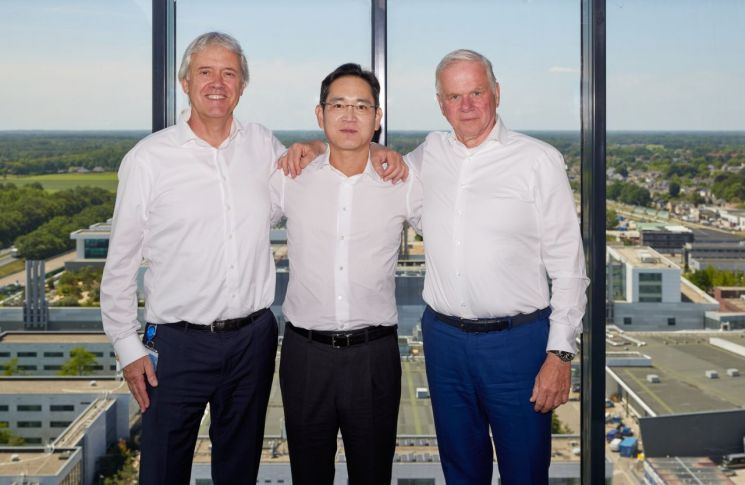 Vice Chairman Lee Jae-yong of Samsung Electronics took this photo on June 14 (local time) during his business trip to ASML, a Dutch company that manufactures EUV (extreme ultraviolet) lithography equipment. Standing beside Vice Chairman Lee, from left to right, are Peter Wennink, CEO of ASML, and Martin van den Brink, CTO of ASML. Industry insiders evaluate that Vice Chairman Lee is showing a consistent approach that matches his statement of "technology, technology, and more technology."
 (Photo by Samsung Electronics)
[Asia Economy Reporter Moon Chaeseok] Samsung Electronics has revealed that it has been fully committed to research and development (R&D) of server memory semiconductors over the past four years, drawing attention from the semiconductor industry. Although the R&D ratio relative to sales has slightly decreased, the overall expenditure has increased, and the results are gradually emerging in the field of server memory semiconductors.
According to Samsung Electronics' mid-year business report submitted to the Financial Supervisory Service on the 20th, the company's R&D expenses for the first half of the year amounted to KRW 12.1779 trillion, accounting for 7.9% of sales. A significant portion of this was used for server semiconductor development, steadily accumulating achievements in launching new memory products.
Looking at the detailed 'R&D performance' table published in Samsung Electronics' semiannual report, which shows the DS (semiconductor) division's memory semiconductor development status, it is clear how much effort Samsung has put into server development. Samsung has been disclosing detailed R&D performance tables since the semiannual report announced in August 2021.
Research and development of server products began to become clearly visible starting in 2019. Over the past four years, Samsung has disclosed that it has conducted R&D on memory semiconductor products or interfaces such as DRAM, SSD (Solid State Drive), CXL (Compute Express Link), and DDR (Double Data Rate)5 DRAM. The products have passed minimum standards certifying commercial product technology capabilities, including 'leading-edge process,' 'high capacity,' and 'low power consumption.'
In terms of leading-edge processes, the DDR5 DRAM, which underwent R&D from March 2020 to October last year and succeeded in mass production, applies a world-class leading-edge 14 nm (nanometer; 1 nm equals one-billionth of a meter) process. It was manufactured using EUV (Extreme Ultraviolet) lithography equipment, which is used for ultra-fine processes.
Regarding high capacity, the 512GB CXL DRAM, researched for one year from May last year to May this year and released as the industry's first, cannot be overlooked. It has about four times the capacity of existing DDR4. By directly integrating a power management semiconductor (PMIC) onto the substrate, power efficiency was improved by more than 30%, ensuring energy efficiency as well. The 6th generation V-NAND flash-based SSD, developed through research from August 2019 to December last year, can store up to 30.72TB (terabytes).
The industry views Samsung's R&D efforts as the secret to its 'super-gap management.' Samsung has not only maintained a DRAM market share of around 43% over the past four years but also succeeded in raising the 'level' of technology. In particular, whether Samsung Electronics supplies high-performance, low-power DRAM to server CPU (central processing unit) companies such as Intel and AMD is said to lead to 'technological hegemony' for memory semiconductor companies, including Samsung's DS division.
According to global market research firm Omdia, the proportion of DDR5 in total DRAM shipments is expected to expand about sevenfold from 3% in the third quarter to 22% in the fourth quarter of next year. The share of server DRAM sales in total DRAM sales is projected to increase about tenfold from 4% to 40% during the same period.
Han Jinman, Vice President of the Memory Business Strategy Marketing Office at Samsung Electronics' DS division, announced during the Q2 earnings conference call held on the 28th of last month that the quarterly sales record for server products was achieved. He stated, "As investments in new growth areas such as artificial intelligence (AI) and 5th generation mobile communications (5G), centered on major data center companies, continue to expand, we fundamentally expect demand in the server market to remain robust."
© The Asia Business Daily(www.asiae.co.kr). All rights reserved.

















