Prices Rise for Fresh Vegetables, Fruits, and All Crops
Imported Agricultural, Livestock, and Marine Products Cheaper Than Domestic Also See Price Increase
Government Operates Joint Task Force with Related Agencies for Stable Supply of Essential Goods
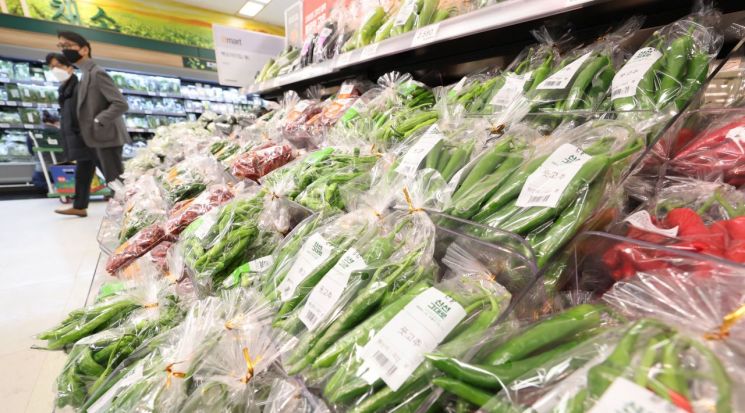 Prices have risen sharply ahead of Chuseok. The photo shows citizens shopping at a food section in a supermarket in Seoul.
 [Image source=Yonhap News]
[Asia Economy Reporter Park Hyun-joo] The consecutive heavy rains have caused a significant rise in agricultural product prices, deepening the worries of ordinary citizens ahead of Chuseok (September 9). The government is struggling to devise measures to stabilize prices, including operating a task force for stable supply and demand of essential goods.
Due to frequent rain and heatwaves causing poor crop yields, fresh vegetable prices have surged significantly. According to the Korea Agro-Fisheries & Food Trade Corporation (aT) Agricultural Product Distribution Information (KAMIS) on the 19th, the average retail price of one radish (standard product) was 3,180 won, up 895 won from 2,285 won a year ago. The price of 1kg of green onions (standard product) also rose by 1,074 won from 2,449 won a year ago to 3,523 won, an increase of about 44%.
The retail price of one head of cabbage (standard product) was 6,839 won, up 2,411 won from 4,428 won a year ago. In particular, highland cabbage suffered from drought during the sowing period and was hindered in growth by high temperatures and heavy rain during the growing season. Moreover, recent heavy rains in the metropolitan and central regions have reduced cultivation areas, causing prices to rise sharply. According to the Ministry of Agriculture, Food and Rural Affairs, as of 3 p.m. on the 14th, 1,457 hectares (㏊) of crops were flooded and 74,000 livestock died due to the heavy rains that began on the 8th.
Fruit prices for the ancestral rites table are also expected to burden ordinary citizens. The price of one watermelon (standard product) is 27,087 won, 5,748 won higher than the average year (21,339 won). It is 2,818 won more expensive than the same period last year (24,269 won). For 10 standard products, apples (Fuji) cost 30,787 won, 8,522 won more than the average year (22,265 won), and pears (Shingo) cost 41,394 won, 3,645 won more than the average year (37,749 won).
Prices of imported agricultural, livestock, and marine products, which are generally cheaper alternatives to domestic products, have also risen. According to the Korea Customs Service's "Major Agricultural, Livestock, and Marine Product Import Price Status," the import price of beef last month fell 7.7% compared to June but was 22.0% higher than a year ago. Prices of marine products such as frozen croaker (29.4%), frozen pollock (21.0%), frozen squid (20.9%), frozen mackerel (17.0%), and pollock (14.1%), as well as agricultural products like dried radish (50.1%), frozen chestnuts (35.1%), and chestnuts (8.3%), also increased compared to a year ago.
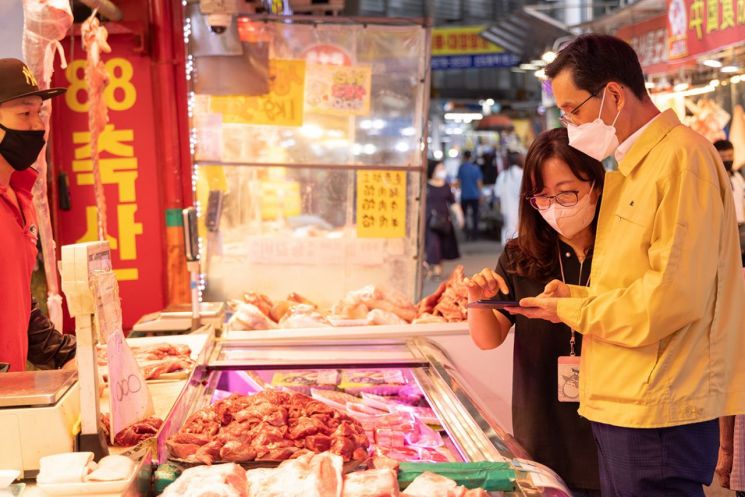 The government has decided to operate a joint task force with related agencies to stabilize the supply and demand of essential agricultural and livestock products in order to control prices. The photo shows Han Hoon, Commissioner of the Korea National Statistical Office (right), visiting Namguro Market in Seoul on the 18th to check prices of major essential items for Chuseok.
 [Image source=Yonhap News] Photo by Han Hoon
As agricultural and livestock product prices rise ahead of Chuseok, the government has also taken steps to address the issue. Bang Ki-seon, First Vice Minister of Strategy and Finance, stated at the emergency economic vice minister meeting that "a joint task force for stable supply and demand of 20 essential goods will be operated to monitor daily supply and price trends and respond immediately by releasing additional stockpiles if any abnormal signs are detected." He also emphasized, "Since yesterday, large supermarkets nationwide have started a Chuseok agricultural and marine product discount event in full swing. We will do our best to ensure that the price reduction effect is felt through a record-high 65 billion won worth of discount coupons and additional discounts by the distribution industry."
The Statistics Korea also announced that it will conduct a daily price survey for 15 days starting today for the Chuseok holiday. The survey covers a total of 35 items, including 23 agricultural and livestock products such as beef, croaker, and fruits; 5 processed foods such as flour and tofu; 3 petroleum products; and 4 personal services such as dining out for pork belly and chicken.
© The Asia Business Daily(www.asiae.co.kr). All rights reserved.


















