General Hong is the Idol and Symbol of Pride for the Goryeoin
Over 7,000 Goryeoin Reside in Gwangju Goryeoin Village
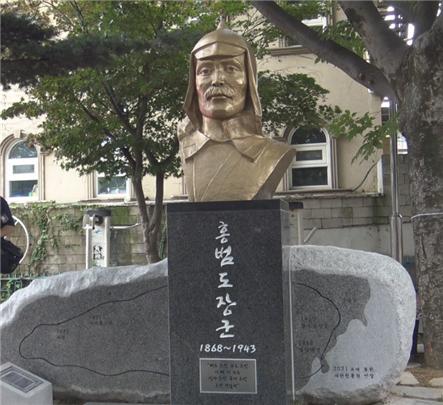
A bust of General Hong Beom-do erected in Damoa Children's Park, Wolgok-dong, Gwangju Metropolitan City
On August 15th at 5 p.m., a unveiling ceremony for the bust of anti-Japanese independence activist General Hong Beom-do was held at Damoa Children's Park in Wolgok-dong, Gwangsan-gu, Gwangju Metropolitan City. About 100 people attended, including Kang Gi-jung, Mayor of Gwangju Metropolitan City; Hong Woo-pyo, Chairman of the Namyang Hong Clan National Association and a descendant of General Hong Beom-do; Shin Jo-ya, representative of the (Corporation) Koryoin Village; as well as citizens and descendants of Koryoin. The subtitle of the unveiling ceremony was "Becoming the Wind from Kazakhstan to Wolgok." Along with a performance of "Gwangbokgun Arirang," the bust (sculpted by Kim Hee-sang) depicting General Hong wearing a "Bujonnopka" military cap was revealed. The bust was modeled after the one of the general located in Kyzylorda, Kazakhstan.
Why was General Hong Beom-do's bust erected in Gwangju? The trigger was the "General Hong Beom-do Special Exhibition" held last August at the "Wolgok Koryoin Culture Center" (Director Kim Byung-hak) located in the Wolgok-dong Koryoin Village. The special exhibition commemorating the repatriation of General Hong's remains displayed 15 original photos and materials related to General Hong collected by Director Kim during his stay in Kazakhstan, along with about 10 photo copies. Among the photos was a commemorative photo of General Hong taken with his family near Lake Khanka in the Russian Far East in 1929.
Among these was also a petition sent in 1994 by Hong Ye-katerina (1925~?), granddaughter of General Hong Beom-do, to the head of the Central Cemetery in Kyzylorda, Kazakhstan, and the Hong Beom-do Foundation, stating, "Please repatriate grandfather's remains only to the Republic of Korea. We do not wish for them to be repatriated to any country other than the Republic of Korea."
Pastor Lee Cheon-young, who has devoted himself to the settlement of Koryoin in Gwangju from the early days, explained, "General Hong Beom-do is a proud ancestor to the Koryoin." Through this explanation, we can understand that the connection between General Hong Beom-do and Gwangju is not coincidental. The Koryoin Village in Wolgok-dong, Gwangju, was established around March 2001 by Mr. Shin Jo-ya. Among the approximately 80,000 Koryoin residing in Korea, about 7,000 live in this Koryoin Village.
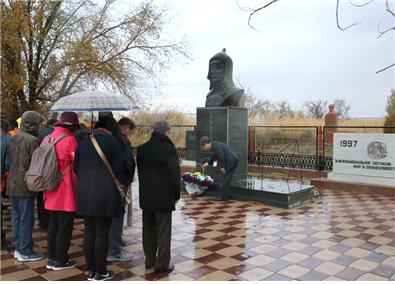
The bust of General Hong Beom-do in Kyzylorda, Kazakhstan (photo by Lee Chan-gu)
Once discriminated against and treated coldly as illegal immigrants and unfamiliar foreigners, the Koryoin were able to raise their heads after the revision of the Overseas Koreans Act in 2008. Specifically, the law was amended to include "overseas Koreans who emigrated before the establishment of the Republic of Korea government (1948) (including their direct descendants)" and to require "the government to provide necessary support so that overseas Koreans are not subjected to unfair regulations and treatment within the Republic of Korea." Only after this amendment were they legally recognized and treated as compatriots. Furthermore, on this Liberation Day, descendants of independence activists acquired nationality. At the "Independence Activist Descendants Nationality Certificate Award Ceremony" held at the Republic of Korea Provisional Government Memorial Hall, Uga? Yegor (8), residing in the Koryoin Village, was granted Korean nationality as the great-grandson of independence activist Park No-sun (1896?1971), who led armed anti-Japanese struggles in the Maritime Province.
After the war in Ukraine, about 430 Koryoin who fled abroad entered the Gwangju Koryoin Village. About 590 have applied for entry to Korea and are waiting. The problem is the airfare they must pay. The airfare is subsidized by domestic donations, and according to Pastor Lee Cheon-young, about 300 to 400 people are expected to enter sequentially. The remaining 200 applicants realistically cannot enter Korea unless airfare is resolved. Like our ancestors who wandered in search of their homeland during the Japanese invasion, might they not sadly ask where their true homeland is? Recently, the Korean Red Cross estimated that about 30,000 Koryoin (with about 13,000 actually registered) live in Ukraine and is promoting aid for Koryoin who have fled but lost their homes.
When the author visited Kazakhstan in October 2017, the Central Asian Koryoin he met said that General Hong Beom-do is their idol and a symbol of pride. In this sense, the bust of General Hong Beom-do erected in Gwangju holds great significance as a symbol of identity for Koryoin in Central Asia as descendants of Korea who shared the anti-Japanese independence movement, as well as domestically. Could it be an expression of pride that Koryoin, like General Hong Beom-do, participated in and contributed to the glory that the Republic of Korea enjoys today?
Meanwhile, the government repatriated General Hong Beom-do's remains from Kyzylorda, Kazakhstan, to Korea one year ago. The remains arrived in Seoul on August 15th, Liberation Day last year, and on the morning of August 18th, a burial ceremony was held at the Independence Patriots' Cemetery, Section 3, at the National Cemetery in Daejeon.
At that time, the government conducted the repatriation and burial ceremony with the highest honors. The president dispatched a special envoy team to confirm the remains with the Kazakh government and prepare for the transport. Especially, when the special transport plane carrying the general's remains entered Korean airspace, six Air Force fighter jets escorted it, honoring the general's achievements. It was truly a solemn return. Subsequently, the Ministry of Patriots and Veterans Affairs held a two-day national memorial event.
Dr. Lee Chan-gu, Barun History Academy
[Who is General Hong Beom-do]
Born in Pyongyang, General Hong participated in the Eulmi Uprising in 1895 and the Jeongmi Uprising in 1907. After Japan deprived Korea of sovereignty, he fled to the Russian Far East in 1911 and engaged in armed independence struggles. As a member of the Korean Northern Army, he achieved great victories in the Battle of Bongodong in June 1920 and the Battle of Cheongsanri in October of the same year. In 1937, due to Stalin's forced relocation policy of Koryoin, he settled in Kazakhstan, where he worked anonymously as a security guard at the Koryo Theater and died in hardship in 1943. The Korean government repatriated his remains on Liberation Day 2021, 78 years later, awarding him the Order of Merit for National Foundation, the highest grade, and interred him at the Independence Patriots' Cemetery in Daejeon National Cemetery.
[Koryoin Villages in Korea]
There are several nationwide, including Ansan, Incheon, Asan, and Gimhae, with one in Wolgok-dong, Gwangju. About 7,000 people live in the Wolgok-dong village. The village was formed when Mr. Shin Jo-ya, who came to Korea in 2001, settled in Gwangju with the help of Pastor Lee Cheon-young, leading Central Asian Koryoin to settle here. There are cooperatives, multicultural schools, clinics, and the "Wolgok Koryoin Culture Center." It is known that about 500,000 Koryoin live worldwide, with 80,000 to 90,000 residing in Korea alone.
© The Asia Business Daily(www.asiae.co.kr). All rights reserved.
![Clutching a Stolen Dior Bag, Saying "I Hate Being Poor but Real"... The Grotesque Con of a "Human Knockoff" [Slate]](https://cwcontent.asiae.co.kr/asiaresize/183/2026021902243444107_1771435474.jpg)

















