Establishment of SK-Lotte Joint Venture... 30% Share in Hydrogen Production
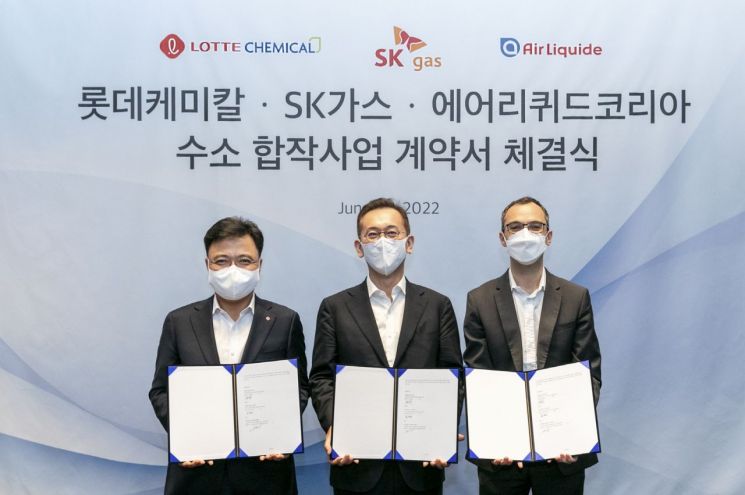 SK Gas and Lotte Chemical held a contract signing ceremony in June for the establishment of a hydrogen joint venture.
 [Photo by Lotte Chemical]
[Asia Economy Sejong=Reporter Lee Jun-hyung] Competition authorities have approved the establishment of a hydrogen joint venture between SK Gas and Lotte Chemical. The 'hydrogen alliance' between the two companies is expected to accelerate.
The Korea Fair Trade Commission (KFTC) announced on the 19th that it approved the establishment of a joint venture between SK Gas and Lotte Chemical. Earlier, SK Gas and Lotte Chemical had announced in June that they would create a joint venture to jointly promote their hydrogen business. The joint venture ownership stakes are 45% each for SK Gas and Lotte Chemical. The French industrial gas company Air Liquide's Korean branch will invest the remaining 10%. SK Gas and Lotte Chemical plan to complete the joint venture establishment process by next month.
The KFTC judged that concerns about competition restrictions due to the establishment of the joint venture are minimal. SK Group and Lotte Group's market shares in hydrogen production are 25% and 5%, respectively. Even combining the hydrogen production capacities of both companies, the market share change is only around 5%. The KFTC viewed this increase in market share as insufficient to cause competition restrictions.
The fact that there are several competitors with hydrogen production capacity also influenced the approval of the joint venture. The joint venture will receive byproduct hydrogen produced at SK and Lotte's petrochemical plants located in Ulsan and Yeosu. However, petrochemical companies such as S-Oil, GS Caltex, Hyundai Oilbank, and LG Chem can also produce significant amounts of byproduct hydrogen. Even if the joint venture increases its utilization of byproduct hydrogen produced by SK and Lotte in the future, other fuel cell companies can procure hydrogen through multiple alternative supply sources.
Under current law, there are limits on the joint venture's ability to adjust prices. According to the "Act on the Promotion of Hydrogen Economy and Hydrogen Safety Management (Hydrogen Act)," the joint venture cannot stop or reduce hydrogen production without justifiable reasons. It also cannot raise or lower prices to an extent that affects domestic hydrogen supply stability. A KFTC official explained, "There are regulatory restrictions under the Hydrogen Act on actions related to price and production volume, which impose significant constraints on excluding competitors or implementing sudden price hikes."
The situation is similar in the fuel cell and hydrogen charging station markets where the joint venture will newly enter. The KFTC judged that the fuel cell and hydrogen charging station markets have active new entrants and numerous alternative hydrogen supply sources, making market foreclosure effects unlikely. Additionally, even combining SK and Lotte's fuel cell capacity, the expected market share does not reach 15%, according to the KFTC.
The KFTC believes that the establishment of the hydrogen joint venture between SK and Lotte can promote market competition. A KFTC official stated, "The hydrogen industry involves large-scale investments across various fields, and corporate mergers such as joint venture establishments will continue to occur. We will promptly review renewable energy-related corporate mergers to support the growth of an eco-friendly energy ecosystem."
© The Asia Business Daily(www.asiae.co.kr). All rights reserved.

















