Why Did TV Prices Only Slightly Drop Despite Panel Price Collapse in the First Half of the Year?
[Asia Economy Reporter Park Sun-mi] Although TV panel prices plummeted in the first half of this year to the extent that the display industry turned to losses, the price fluctuations of TV products sold by Samsung Electronics and LG Electronics were only around ±4% on average. Despite the slump in TV sales due to weakened consumer sentiment and the sharp drop in prices of key raw materials such as TV panels, consumers did not significantly benefit from price advantages when purchasing TVs.
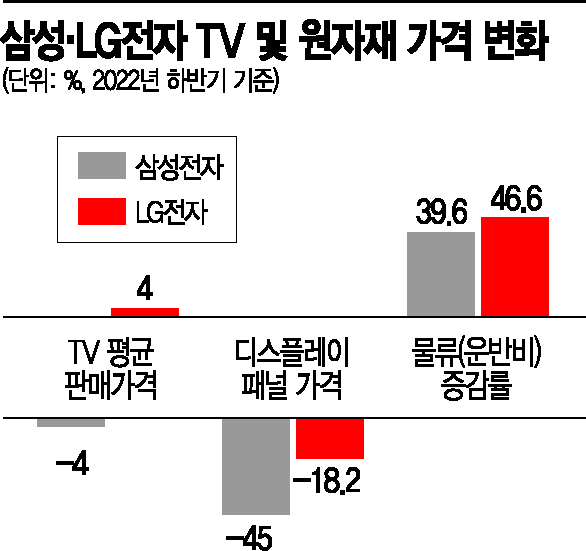
According to the electronics industry on the 18th, Samsung Electronics' average TV selling price in the first half of this year fell by about 4% compared to the previous year. LG Electronics, on the other hand, saw its average TV selling price rise. Although it did not reach last year's increase of 26.4%, it rose by 4% in the first half of this year, showing a higher price increase rate than other home appliances such as refrigerators and washing machines (3%) and air conditioners (-5.9%).
Unlike the average 4% fluctuation in TV prices, the prices of panels, the core components of TVs, fell by double digits. Samsung Electronics sources display panels for TV and monitors from CSOT, AUO, BOE, etc., and the prices of TV and monitor display panels supplied in the first half of this year dropped by about 45%. LG Electronics also saw the prices of TV display panels (LCD TV panels) supplied from LG Display and BOE fall by 18.2% compared to last year.
An industry insider explained, "Although display panels account for the largest portion of raw materials in TVs, the prices of all raw materials except panels surged sharply," adding, "The significant increase in product transportation costs in the first half of the year also affected pricing."
In fact, LG Electronics' semiconductor chip purchasing costs for TV finished products in the first half of this year surged by 42.6% compared to the same period last year. Last year, the increase was only 2.8%. Resin purchasing costs also rose by 20.3%.
Due to the global logistics crisis and supply chain disruptions, the rise in product transportation costs is even greater. Samsung Electronics and LG Electronics' transportation costs in the first half of the year increased to 1.8417 trillion won and 2.1202 trillion won, respectively, with growth rates of 39.6% and 46.6%.
Premium Strategy Also Plays a Role
As consumer sentiment weakens and TV product sales face setbacks, the industry's aggressive implementation of a 'premium strategy' to defend profitability is also a reason why TV selling prices have not dropped significantly.
The TV market is enduring a harsh winter. Market research firm Omdia forecasts that the overall TV market demand this year will shrink to 208.79 million units, falling short of last year's 213.54 million units, due to factors such as the Russia-Ukraine war, expanded instability in raw material supply, and worsening inflation. Samsung Electronics and LG Electronics' TV production line operating rates in the second quarter were 63.7% and 72.5%, respectively, down from 84.3% and 87.8% in the first quarter.
Samsung Electronics stated in a conference call held immediately after announcing its second-quarter earnings last month, "The TV market in the second half has opportunities due to the peak season and sports events, but from a macroeconomic perspective, there are many variables making demand forecasting difficult," adding, "We will focus on expanding the market centered on high-value-added products and securing profitability by leading the premium market."
LG Electronics also said in its business report that in response to the slowdown in TV consumption, "We are focusing on qualitative growth and profitability improvement by building a high-end brand image and product differentiation centered on premium products such as OLED TVs and UHD TVs," and "This year, we plan to lead the TV premium market by continuously expanding premium product sales through OLED TVs and QNED TVs applying Quantum NanoCell technology."
© The Asia Business Daily(www.asiae.co.kr). All rights reserved.


















