Weekly Apartment Price Trends for the 3rd Week of August
Seoul Apartment Prices Fall for 12 Consecutive Weeks
Seocho-gu Turns to Decline After 25 Weeks
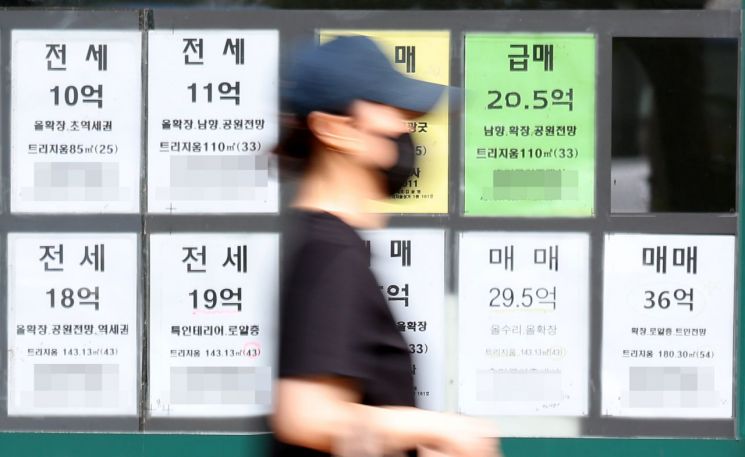
As the decline in Seoul apartment prices gradually accelerates, even the Seocho-gu apartment prices, which had been rising alone, have turned to a downward trend.
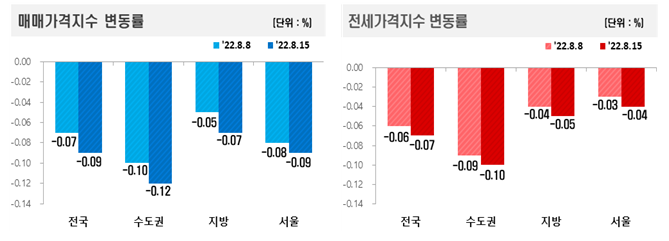
According to the weekly apartment price trend data for the third week of August released by the Korea Real Estate Board on the 18th, Seoul apartment prices fell further from -0.08% last week to -0.09%. Although some asking prices have dropped, transaction volumes are still at a low level.
In particular, the apartment prices in Seocho-gu, which had maintained the 'Seocho Invincibility' trend, turned downward as weakness was seen mainly in Umyeon-dong and Seocho-dong. This is the first time in 25 weeks since the third week of February that apartment prices in Seocho-gu have declined.
The downward trend is steepening across all areas of Seoul. Yongsan-gu, which recorded a flat trend last week, also turned downward with -0.01%.
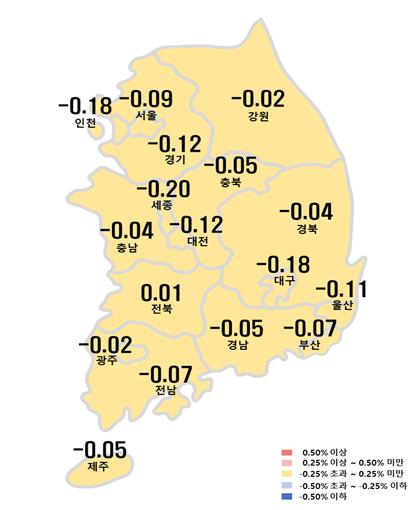
Nowon-gu (-0.21%) fell mainly in Sanggye-dong and Wolgye-dong, Dobong-gu (-0.20%) in Dobong-dong and Ssangmun-dong, and Eunpyeong-gu (-0.18%) in Susaek-dong and Nokbeon-dong, with the decline widening. Guro-gu (-0.09%) fell mainly in Sindorim-dong and Guro-dong, Geumcheon-gu (-0.08%) in Gasan-dong and Siheung-dong, and Songpa-gu (-0.07%) mainly in large complexes in Jamsil-dong, showing an expanded decline compared to last week.
The Real Estate Board analyzed, "Due to the holiday and summer vacation season and heavy rain, buyer inquiries have been quiet, and despite downward adjustments in asking prices, transactions are not being completed, resulting in a continued decrease in transaction volume and an expanded decline in Seoul area."
Incheon (-0.18%) and Gyeonggi (-0.12%) also saw larger declines compared to last week (-0.15%, -0.10%).
The five major metropolitan cities (-0.08% → -0.10%) and Sejong (-0.18% → -0.20%) are also continuing their downward trends.
Accordingly, nationwide apartment prices recorded -0.09%, expanding the decline from last week (-0.07%).
Among the 176 announced cities, counties, and districts, the number of areas with price increases (29 → 22) and stable prices (9 → 3) decreased, while the number of areas with price declines (138 → 151) increased.
Following the government's supply measures announced on the 16th, apartment listings have further increased.
According to Asil, a real estate big data company, apartment listings in Apgujeong-dong, Gangnam-gu, a representative redevelopment promotion complex in Seoul, increased by 6.2% in two days compared to the 16th. Other major redevelopment promotion complexes, Sanggye-dong in Nowon-gu and Mok-dong in Yangcheon-gu, saw listings increase by 2.4% and 1.8%, respectively.
Since the supply measures did not include specific action plans for the Redevelopment Excess Profit Recovery System (재초환), safety inspections, and the first-generation new towns, apartment listings in major redevelopment complexes and first-generation new towns in Seoul are also increasing.
Due to the recent sharp interest rate hikes leading to increased interest burdens and growing concerns about economic recession, apartment listings in major redevelopment promotion complexes in Seoul are increasing, and prices are being adjusted downward.
Jeonse prices are also declining.
Both Seoul (-0.03% → -0.04%) and provincial areas (-0.04% → -0.05%) have seen an expanded decline, and nationwide apartment jeonse prices recorded -0.07%, widening the decline from last week (-0.06%).
The Real Estate Board analyzed, "With the burden of jeonse loan interest increasing, demand for half-jeonse and monthly rent is rising, while the summer off-season reduces demand, causing continued inventory accumulation and ongoing downward adjustments in asking prices."
© The Asia Business Daily(www.asiae.co.kr). All rights reserved.
![Clutching a Stolen Dior Bag, Saying "I Hate Being Poor but Real"... The Grotesque Con of a "Human Knockoff" [Slate]](https://cwcontent.asiae.co.kr/asiaresize/183/2026021902243444107_1771435474.jpg)












