Sampyo Remicon Factory Ends 45 Years of Operation
Pre-Negotiation System Initiates Development Talks with Landowners
Service Results by June Next Year... Construction Targeted for Second Half of 2024
Estimated 600 Billion KRW Public Contribution Secured through Land Use Upgrade
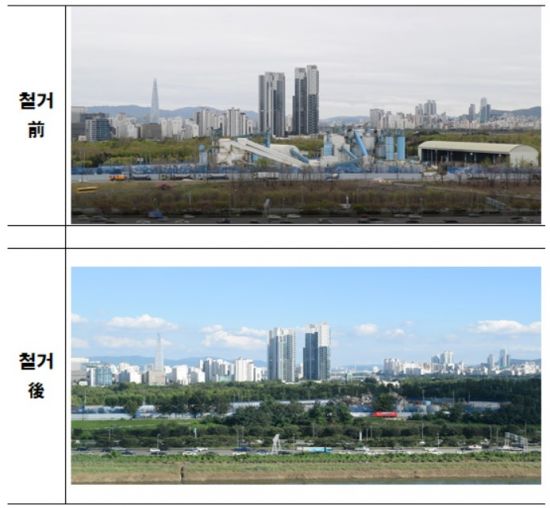
[Asia Economy Reporter Kim Hyemin] The Sampyo Remicon factory in Seongsu-dong, Seoul, has disappeared into history after 45 years. The demolition was finally completed on the 16th. The Seoul Metropolitan Government has begun full-scale discussions on development directions with Sampyo Industrial, the landowner.
On the 18th, Seoul City held a joint inspection meeting at the Sampyo Remicon factory site in Seongsu-dong with officials from Seongdong-gu, Sampyo Industrial representatives, and related experts, confirming the 'irreversible cessation of factory operations.'
With the demolition completed, Seoul City will officially start discussions on utilizing the site (28,804㎡) through a preliminary negotiation process for urban planning changes (hereafter referred to as preliminary negotiations). The city plans to finalize the preliminary negotiation target site with the landowner Sampyo Industrial within this year and aims to begin construction in the second half of 2024. Earlier, in June, the city commissioned a study to establish a development strategy for the area. The results of the study will be released in June next year.
The preliminary negotiation system is a process where public authorities, as permit issuers, and private developers negotiate in advance to establish detailed development plans and change urban planning for large-scale development sites of 5,000㎡ or more. This development method enhances the business feasibility for private developers by upgrading land use zones, while securing some of the development profits as public contributions, promoting both efficient land use and public interest simultaneously.
Through preliminary negotiations, the city plans to support the site’s rebirth as a representative landmark attracting not only Seoul citizens but also tourists from around the world, as well as a youth cultural complex linked with Seoul Forest. Earlier, Seoul Mayor Oh Se-hoon revealed plans to build the world’s largest Ferris wheel and identified this area as one of the candidate sites.
The current land use designation of the site is a Type 1 General Residential Area. By upgrading it to a commercial area, the estimated public contribution secured is about 600 billion KRW. The city plans to use these funds for enhancing Seoul Forest, creating youth cultural hubs, improving metropolitan transportation systems, and expanding local necessary facilities.
Hong Seon-gi, Director of the Public Development Planning Division, stated, "We will review this area as an important strategic site to strengthen the youth advanced innovation axis and secure future growth engines for Seoul, as presented in the 2040 Seoul Plan. We will transform it into a youth cultural waterfront hub linked with Seoul Forest so that it can be reborn as a representative landmark of Seoul."
© The Asia Business Daily(www.asiae.co.kr). All rights reserved.
!["The Woman Who Threw Herself into the Water Clutching a Stolen Dior Bag"...A Grotesque Success Story That Shakes the Korean Psyche [Slate]](https://cwcontent.asiae.co.kr/asiaresize/183/2026021902243444107_1771435474.jpg)
















