"Quality of Life Gaps Between Regions" in Culture, Health, and Childcare
Korea Research Institute for Human Settlements: "Need to Enhance Balanced Development Policies"
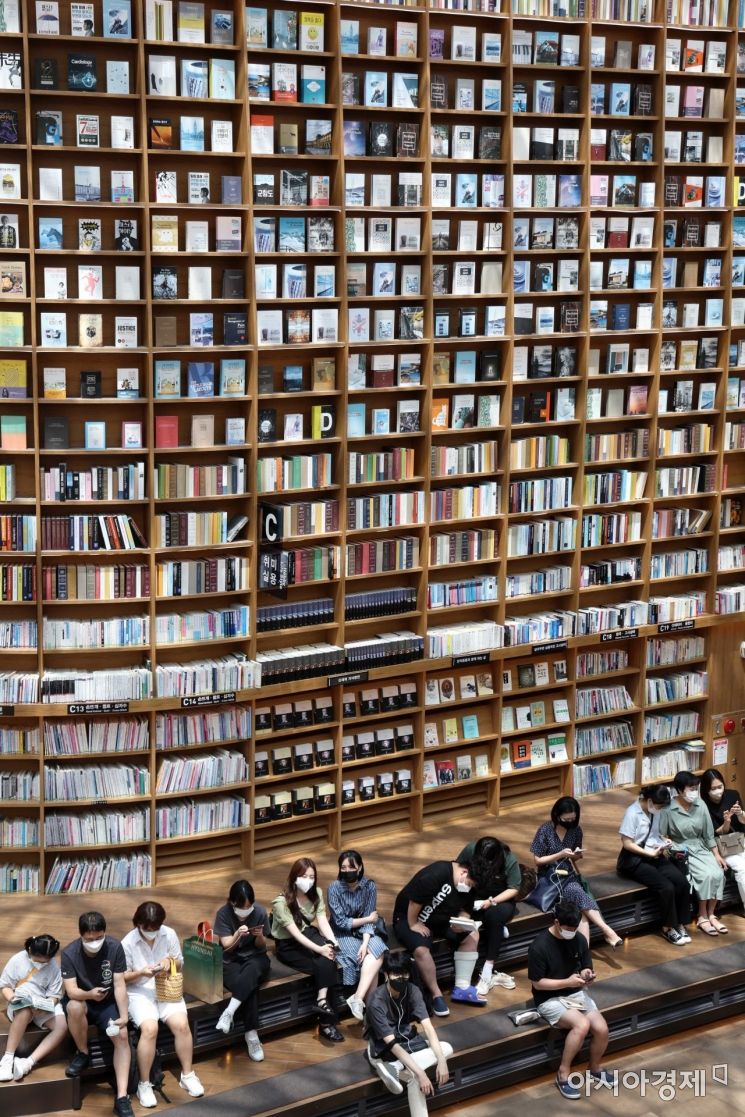 On the 4th, as the sweltering heat continued, citizens were reading books at the Starfield COEX Mall Byeolmadang Library in Gangnam-gu, Seoul. Photo by Mun Ho-nam munonam@
Accessibility to libraries, hospitals, and childcare facilities still shows significant disparities across regions.
On the 18th, the Korea Research Institute for Human Settlements published the 10th issue of the "Balanced Development Monitoring & Issue Brief," focusing on "Quality of Life Disparities Between Regions," which includes the status of cultural, health, and childcare sectors across regions.
According to the report, the gap between the metropolitan area and non-metropolitan areas is particularly large in cultural facilities.
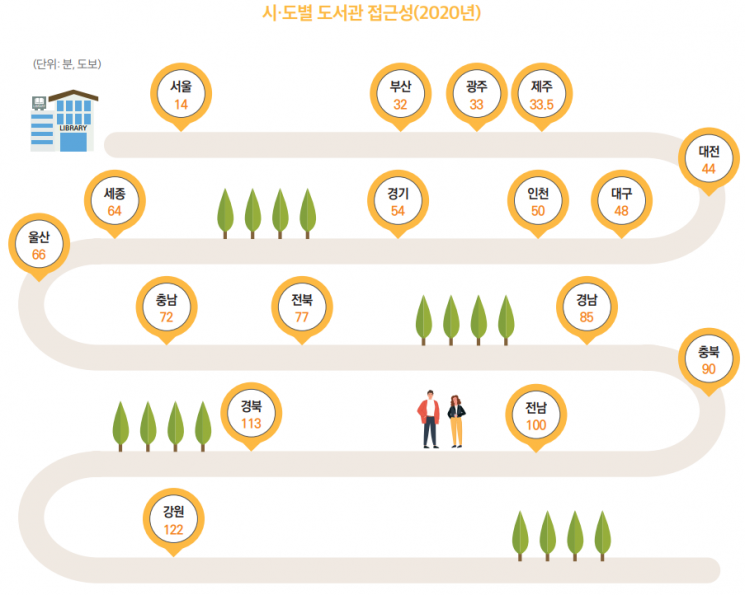
In particular, accessibility to libraries was high in special and metropolitan cities but low in provincial areas, showing a considerable gap.
The region with the highest library accessibility was Seoul (14 minutes on foot), which was more than twice as accessible as the second-ranked Busan (32 minutes). The regions with the lowest accessibility were Gangwon (122 minutes on foot), Gyeongbuk (113 minutes), and Jeonnam (100 minutes), in that order.
While the proportion of cultural infrastructure facilities located in the metropolitan area remains at a certain level, recently (2014?2021), art museums and libraries, which have shown high growth rates, have a metropolitan area share higher than the average.
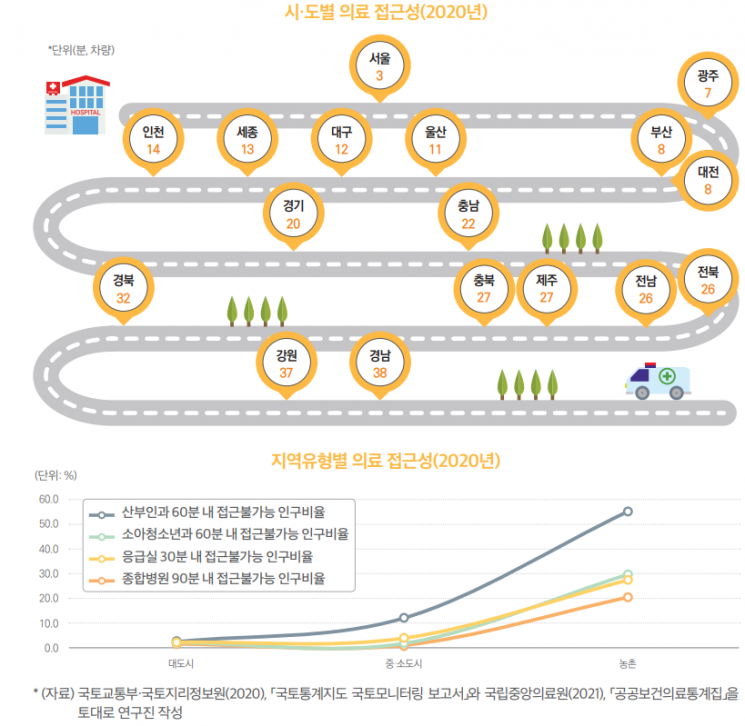
In the health sector, disparities in medical accessibility between regions were clearly evident. Seoul overwhelmingly had the highest medical accessibility, while rural areas such as Gyeongnam, Gangwon, and Gyeongbuk had very low medical accessibility.
Analysis of medical accessibility by city and province showed that Seoul (3 minutes), Gwangju (7 minutes), and Busan and Daejeon (each 8 minutes) can reach general hospitals within 10 minutes by car, whereas Gyeongnam (38 minutes), Gangwon (37 minutes), and Gyeongbuk (32 minutes) require more than 30 minutes of driving to arrive.
In rural areas, the proportion of the population that finds it difficult to quickly access medical services such as obstetrics and emergency rooms is very high compared to large and medium-sized cities, clearly showing disparities in medical accessibility by regional type.
The disparity in emergency patient mortality rates between regions was severe. The average number of deaths before arrival at the emergency room was around 25 to 30, but the variation by city and province ranged widely from 60 to 70.
By city and province, Chungbuk (80 deaths in 2020) had the highest number of deaths before arrival at the emergency room, except for 2016, with regions like Gangwon and Chungnam also showing high numbers, while Sejong (3 deaths in 2020) consistently maintained a low number.
Disparities in childcare were also evident across regions.
Although public childcare institutions are increasing, the growth rate in the metropolitan area is higher than in non-metropolitan areas.
From 2010 to 2021, the average annual growth rate of public childcare institutions was 6.9%, showing steady growth, with the metropolitan area (8.8%) increasing at a higher rate than non-metropolitan areas (5.9%).
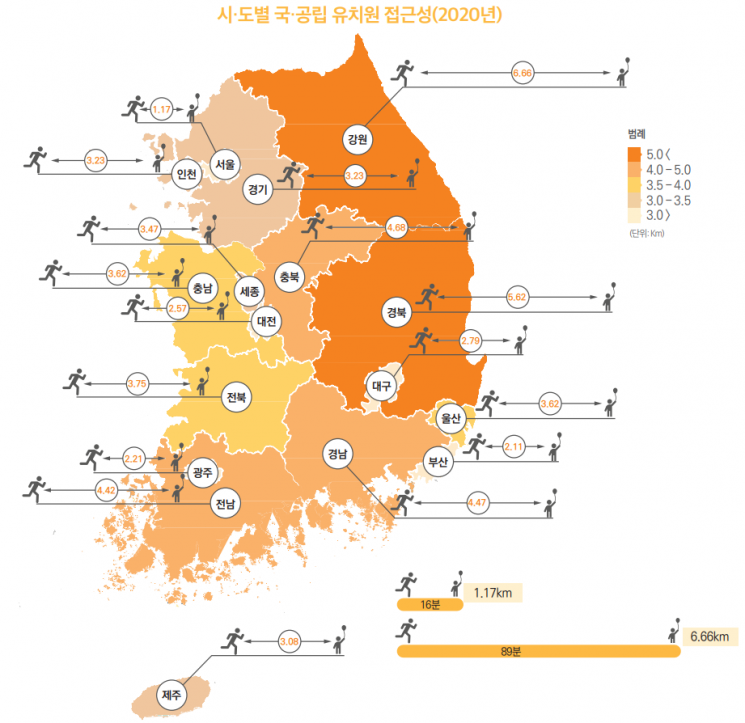
Accessibility to public childcare institutions was highest in Seoul and lowest in Gangwon.
Accessibility to childcare institutions by city and province ranked highest in Seoul (16 minutes), Busan (28 minutes), and Gwangju (29 minutes), and lowest in Gangwon (89 minutes), Gyeongbuk (75 minutes), and Chungbuk (62 minutes), showing a significant gap.
In large cities, as the standard distance (0.5, 1.0, 1.5 km) increases, most of the population can be serviced, but Gangwon's service rate was notably lower compared to other regions.
Given that disparities between regions are significant not only in population, income, and employment but also in various fields directly related to quality of life such as culture, health, and childcare, there is a call to enhance balanced development policies from diverse perspectives.
The institute pointed out, "There is a clear concentration of cultural infrastructure facilities (libraries and art museums) and cultural event-related indicators (professional arts corporations and groups, number of performances, sales, etc.) in the metropolitan area, which requires policy attention."
It added, "Disparities in medical accessibility between regions are very pronounced, and the related disparities in emergency patient mortality rates are at a serious level, so urgent policy measures are needed to improve this."
Finally, the institute stated, "Accessibility to infant and toddler childcare institutions still shows an overwhelming advantage in Seoul," emphasizing that "balanced development policies are needed to improve access to childcare facilities in local areas."
© The Asia Business Daily(www.asiae.co.kr). All rights reserved.
![Clutching a Stolen Dior Bag, Saying "I Hate Being Poor but Real"... The Grotesque Con of a "Human Knockoff" [Slate]](https://cwcontent.asiae.co.kr/asiaresize/183/2026021902243444107_1771435474.jpg)


















