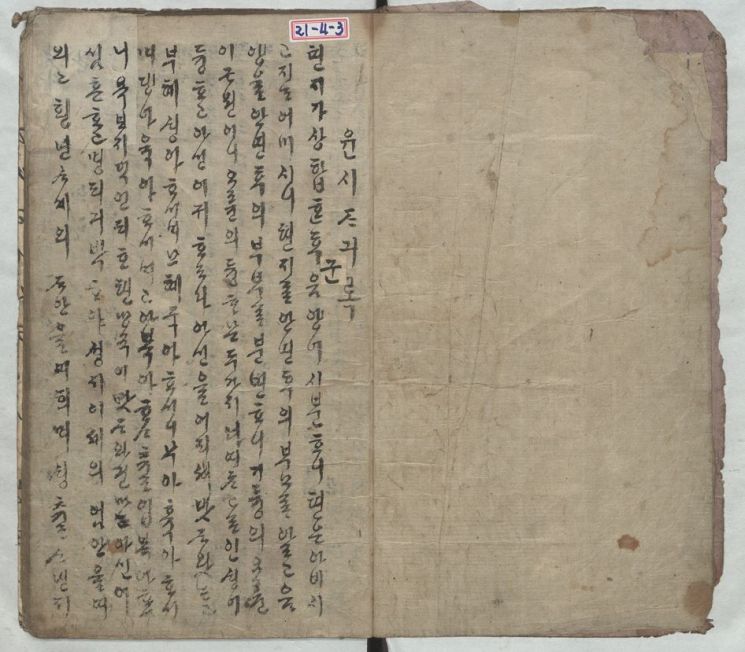
[Asia Economy (Suwon) = Reporter Lee Young-gyu] Seven items, including the memoir of a Joseon Dynasty aristocratic woman titled 'Yunssi Jagirok' and old documents related to King Yeongjo and King Jeongjo, have been newly designated as cultural assets of Gyeonggi Province.
Gyeonggi Province recently held a meeting of the Gyeonggi Cultural Heritage Committee and confirmed seven items as Gyeonggi cultural assets on the 18th: ▲Yunssi Jagirok ▲Jeongjo’s handwritten reply to Woo Ha-young’s memorial ▲Yeongjo’s calligraphy and Hong I-won’s royal court poem scroll ▲Goyang Wongaksa Temple’s Avalokitesvara Bodhisattva painting ▲Namyangju Gyeonseongam Temple’s Yeongsan Hoesang painting ▲Namyangju Gyeonseongam Temple’s Hyeonwangdo painting ▲Namyangju Gyeonseongam Temple’s Sinjungdo painting.
Among the three items housed at Hwaseong City History Museum?'Yunssi Jagirok,' 'Jeongjo’s handwritten reply to Woo Ha-young’s memorial,' and 'Yeongjo’s calligraphy and Hong I-won’s royal court poem scroll'?'Yunssi Jagirok' is the memoir of the Haepyeong Yun family.
The Haepyeong Yun family member was born in 1834, married at 17, but lost her husband at 24 and lived a life of chastity thereafter. The memoir is written in Hangul and divided into four parts: childhood, marriage, her husband’s illness and early death, and the reasons she must live on. It is highly valued for providing an in-depth view of the life and consciousness of premodern women, especially since extant female memoirs are extremely rare. Its rarity is further emphasized by the fact that female memoirs are scarcely found in East Asia outside Korea, and it is also considered valuable for the preservation and study of Hangul calligraphy history.
'Jeongjo’s handwritten reply to Woo Ha-young’s memorial' is the largest known Jeongjo autograph, over 6 meters long and about 500 characters in length. It is a work that stands out for its elegant and spirited brushwork, characteristic of Jeongjo’s typical handwriting. In March 1796, when a white rainbow phenomenon piercing the sun appeared in the sky, Jeongjo sought opinions from officials and the public. At that time, scholar Woo Ha-young submitted a memorial containing 13 policy proposals, to which Jeongjo personally responded with a detailed handwritten reply. This document is an important resource that reveals Jeongjo’s political awareness of actively incorporating public opinion for smooth governance and the life of late Joseon intellectuals interested in reforming social contradictions and corruption.
'Yeongjo’s calligraphy and Hong I-won’s royal court poem scroll' consists of one piece of calligraphy titled 'Yuhwae (諭懷)' personally written by King Yeongjo on July 24, 1768, when he was 80 years old, and a poem composed by 81-year-old aristocrat Hong I-won at the royal court, along with 20 poems and prefaces written by Hong’s acquaintances responding to his poem using the rhyme scheme. This collection is valued for symbolically showing how the king’s grace was conveyed to the public and for encapsulating various literary styles of the 18th century, offering insight into contemporary poetry and calligraphy.
'Goyang Wongaksa Avalokitesvara Bodhisattva painting' is a work by Suryongdang Gijeon, a monk-painter from Haeinsa Temple who mainly worked in Gyeongsang Province in the late 19th century and is recognized for establishing an independent painting style. The painting creatively incorporates dharani (Buddha’s teachings in the form of mantras) as iconography. Notably, it breaks the conventional belief that dharani inscriptions are recorded only on the back of paintings by actively inscribing them on the front, harmoniously integrating them with the artwork rather than making them feel separate. The work is highly praised for its artistic quality and has been well preserved without damage to the inscription.
The three paintings stored at Gyeonseongam Temple in Namyangju?'Yeongsan Hoesangdo,' 'Hyeonwangdo,' and 'Sinjungdo'?were collectively created during the temple’s renovation in 1882. The inscriptions clearly indicate the production date, enshrinement location, painter, and donors. It is also valuable for revealing that the donors included the siblings of Gyeongbin Kimssi, who was close to Queen Dowager Sinjeong, despite being concubines. The iconography and expression style of these paintings well represent the style of 19th-century Buddhist paintings in the Gyeonggi region, earning recognition for their cultural value in Buddhist history and art history.
Hong Seong-deok, head of the Cultural Heritage Division of the province, said, "These rare memoirs revealing the lives and thoughts of Joseon Dynasty women, works showing the governance awareness and activities of Kings Yeongjo and Jeongjo, and creative Buddhist paintings all represent the diverse cultural traditions held by Gyeonggi Province. We will strive to widely publicize their value and share them with the residents."
© The Asia Business Daily(www.asiae.co.kr). All rights reserved.

















