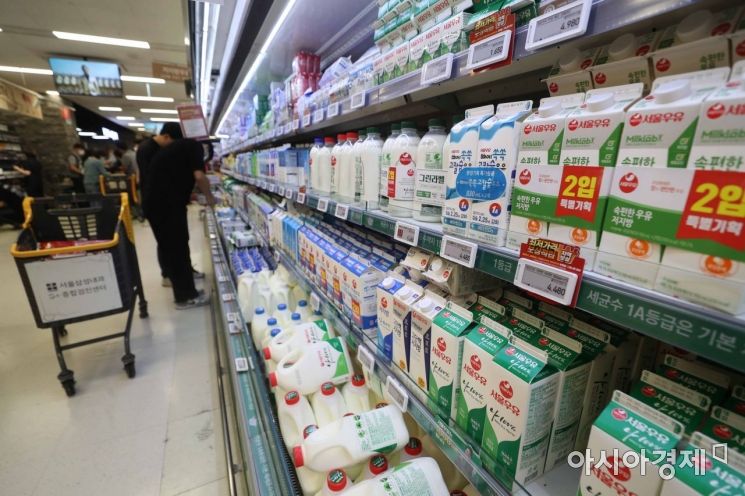
 Dairy companies are consecutively raising the prices of dairy products. Namyang Dairy Products increased the prices of milk products by an average of 4.9% on the 14th. Seoul Milk also raised the prices of milk products by an average of 5.4% on the 1st. The photo shows a customer selecting products at a milk display in a large supermarket in Seoul on the 15th. Photo by Mun Ho-nam munonam@
[Asia Economy Reporter Eunmo Koo] Seoul Milk Cooperative, the number one dairy company, has decided to provide 'Farm Management Stabilization Funds' to dairy farmers. Seoul Milk stated that the support fund is to alleviate the burden of feed prices on dairy farmers, but it is expected to effectively raise the raw milk price, which may influence price adjustments by other dairy companies.
According to the government and the dairy industry on the 17th, Seoul Milk held a general assembly meeting the day before and decided to provide farm management stabilization funds worth 3 billion KRW per month to dairy farmers.
Seoul Milk explained that due to the increase in feed prices, the production cost burden on dairy farmers has grown, and since the raw milk price for this year has not yet been finalized, the situation is difficult, so they decided to provide this support to assist dairy farmers.
However, the dairy industry views this support fund as effectively raising the raw milk price by 58 KRW per liter for farms supplying raw milk to Seoul Milk. Other companies expressed surprise at Seoul Milk's decision, as the raw milk price for this year has not yet been determined.
The adjustment of raw milk prices is decided annually through negotiations at the 'Raw Milk Base Price Adjustment Negotiation Committee' (Negotiation Committee), which includes dairy farmers, dairy companies, and academic experts. However, since the dairy industry is currently not participating in the negotiations, discussions on this year's raw milk price have not progressed.
The dairy industry has stated that they will not participate in negotiations unless the dairy system reform, which centers on a 'differential pricing system' applying different raw milk prices based on usage, is implemented. However, the dairy farming sector opposes the introduction of this system, arguing that farmers' incomes may decrease, leading to a conflict with the dairy industry.
Seoul Milk is not participating in the Negotiation Committee and is in a position to set prices autonomously, but other companies must apply the standard price. The Ministry of Agriculture, Food and Rural Affairs, which has been strongly promoting the introduction of the dairy system reform plan, is now facing difficulties as variables have arisen in the discussion process. The ministry plans to announce its official position on this matter on the 18th.
Meanwhile, some predict that Seoul Milk's payment of the support fund could ultimately lead to product price increases. Typically, consumer prices apply a multiplier of 10 times the raw milk price increase, so if Seoul Milk raised the price by 58 KRW per liter, consumer prices could rise by about 580 KRW per liter.
There are also claims that the rise in raw milk prices could trigger 'milkflation,' leading to price increases in bread, ice cream, and other products. As of last year, the average domestic raw milk price was 1,094 KRW per liter. This year's price increase negotiations are expected to be in the range of 47 to 58 KRW per liter.
© The Asia Business Daily(www.asiae.co.kr). All rights reserved.

















