POSTECH-UNIST Joint Research Team, "Found Clue to Unveil Origin of Life"
Global Academic Attention, "Expected to Apply in Research on Causes and Treatments of Incurable Diseases"
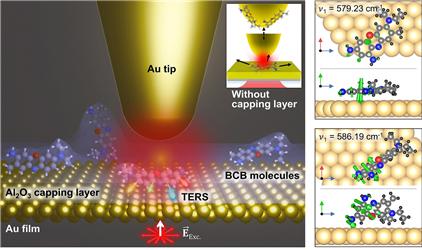 (Left) Illustration depicting the observation of molecules trapped between gold and aluminum oxide layers using a tip-enhanced nanoscope. (Right) Visualization showing how the vibrational modes of molecules change according to their orientation.
[Asia Economy Yeongnam Reporting Headquarters Reporter Kim Yong-woo] A method has been developed to observe the movement of single molecules measuring one ten-billionth of a meter, whose shape was impossible to discern at room temperature. This remarkable research, which allows us to see the 'shape' of the smallest units known to science, is even being praised as a clue to uncovering the 'origin of life.'
Single molecules of about 1 nanometer (nm) in size exist very unstably at room temperature. Considering how quickly approximately 100 nm-sized coronavirus particles diffuse in the air, one can imagine how difficult it is to observe single molecules.
Recently, a domestic research team found a way to stably observe such single molecules at room temperature by covering them with a thin insulating layer like a blanket. This has brought the dream of chemists who wanted to see the detailed shape of single molecules closer to reality.
The research team led by Professor Park Kyung-duk of the Department of Physics at Pohang University of Science and Technology (POSTECH) and integrated course student Kang Min-gu, in collaboration with Professor Seo Young-duk of the Department of Chemistry at Ulsan National Institute of Science and Technology (UNIST), succeeded in visualizing the conformational changes of single molecules at room temperature for the first time in the world.
This means it is now possible to closely examine the conformation of a single molecule, the fundamental unit of all matter including humans.
Molecules exposed to air constantly undergo chemical reactions with their surroundings and move continuously. Because of this, it is very difficult to detect the Raman scattering signals known as 'molecular fingerprints,' and even if signals are barely detected by freezing molecules below -200°C, there were limitations in identifying the unique characteristics of single molecules.
The research team placed single molecules on a substrate coated with a gold thin film and then tightly covered them with a very thin layer of aluminum oxide (Al2O3) like a blanket.
The molecules trapped between the gold and aluminum oxide layers were isolated from the surrounding environment, preventing chemical reactions and suppressing movement. The single molecules were effectively immobilized.
These fixed molecules were observed using an ultra-high sensitivity probe-enhanced nano-microscope developed by the research team. Thanks to the optical antenna effect of the sharp metal probe, the nano-microscope could accurately detect the faint optical signals of single molecules.
Moreover, this method far surpassed the resolution limit of conventional optical microscopes (about 500 nm), clearly distinguishing whether a 1 nm-sized single molecule was lying down or standing up by observing its conformational changes.
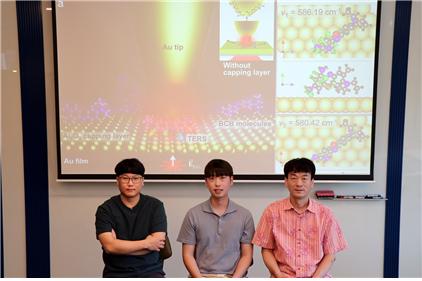 Research team photo. (From left) Professor Kyungduk Park of POSTECH, Kang Mingu from the integrated program, Professor Youngduk Seo of UNIST.
Kang Min-gu of POSTECH said, “If the James Webb Telescope observes the farthest reaches to reveal the origin of the universe, our single-molecule microscope observes the smallest things to find clues to the origin of life.”
This research achievement is attracting global academic attention as it could provide clues to identifying causes and developing treatments for intractable diseases.
This is because it has become possible to thoroughly examine the molecular conformation of proteins or DNA, which cause diseases, at the nanometer scale. Furthermore, the method of covering samples with a thin layer is very simple and can be applied at room temperature or high temperatures, making its potential applications limitless.
The study involved Professor Lee Geun-sik and researchers Elham Oleiki and Joo Hee-tae from UNIST, Dr. Kim Hyun-woo and Dr. Eom Tae-young from the Korea Research Institute of Chemical Technology, and integrated course students Koo Yeon-jung and Lee Hyung-woo from the Department of Physics at POSTECH.
Published recently in the international journal Nature Communications, this research was supported by the National Research Foundation of Korea.
© The Asia Business Daily(www.asiae.co.kr). All rights reserved.


















