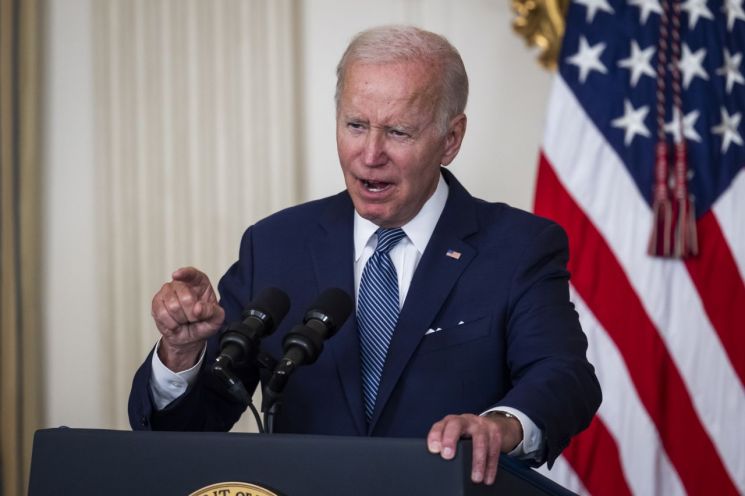
[Asia Economy New York=Special Correspondent Joselgina] U.S. President Joe Biden signed the so-called 'Inflation Reduction Act (IRA)' on the 16th (local time), securing $790 billion in funding over the next decade to invest heavily in climate change response and other areas.
The act focuses on injecting large-scale funds into climate change response, energy security, and lowering drug prices, while raising revenue by imposing a minimum 15% corporate tax on large corporations. President Biden and the Democrats claim that this act, a scaled-down version of the 'Build Back Better Act (BBB),' will reduce the federal deficit and curb soaring inflation, hence the name 'Inflation Reduction Act.'
◆Key Details... Focus on Climate Change and Healthcare
At the bill signing ceremony held at the White House, President Biden stated, "This law is about tomorrow and what can bring progress and prosperity to American families," adding, "It shows America and Americans that democracy still works in the United States." He emphasized that the IRA will be historic legislation that lowers healthcare costs for millions of Americans and helps address the climate crisis.
The IRA is considered a scaled-down version of the BBB, which President Biden has pursued since the beginning of his term. It includes a total spending plan of $740 billion, comprising $440 billion in policy implementation and $300 billion in deficit reduction. It is particularly regarded as a groundbreaking investment budget for climate change and healthcare.
Specifically, about $375 billion will be invested in climate response policies to reduce greenhouse gas emissions by 2030, including expanding wind and solar power production and providing tax credits for electric vehicle purchases. This includes tax credits of up to $4,000 for qualified used electric vehicles and up to $7,500 for new electric vehicles to promote their adoption.
Additionally, the act allocates a budget related to nationwide health insurance aimed at lowering prescription drug prices. The Medicare program, a healthcare insurance system for seniors, will be enabled to negotiate drug prices with pharmaceutical companies, aiming to save $288 billion over ten years.
To raise funds, the bill includes provisions to impose a minimum corporate tax on large corporations and strengthen IRS tax audits. A 15% minimum effective tax rate will be applied to corporations earning over $1 billion annually, aiming to collect an additional $258 billion in corporate taxes over ten years. Initially, proposals to tax hedge fund performance fees were included but were removed during negotiations. Instead, a 1% excise tax on corporate stock buybacks was newly introduced.
◆Why is the Bill Named Inflation Reduction?
Looking at the main contents, the bill highlights key elements of so-called Bidenomics, such as climate change response, healthcare coverage, and strengthening supply chains to revitalize American manufacturing. However, the reason the bill is not named after its original starting point, the BBB, or focused solely on climate change and supply chains, is closely related to the severity of inflation in the U.S. recently.
With the midterm elections approaching in November, inflation, which surged to the 9% range earlier this year, is the biggest headache for President Biden at present. As living costs, from gasoline to food, soared this year, satire blaming 'Biden' poured in, directly weakening his support base. A poll released by Quinnipiac University at the end of last month showed President Biden's approval rating at 31%, hitting an all-time low.
Opposition to economic policies was particularly high across sectors. Only 28% supported President Biden's economic policies. More than seven out of ten Americans opposed Biden's 2024 presidential run, and even over half of Democratic supporters did not want him to seek re-election.
Recently, average gasoline prices in the U.S. have fallen below $4 per gallon, showing signs of stabilization, but public opinion still holds President Biden responsible for inflation. With the Federal Reserve's interest rate hikes continuing since March and uncertainty about whether inflation has peaked, President Biden and the Democrats judged that emphasizing the inflation mitigation effects of the IRA would be politically advantageous.
President Biden and the Democrats emphasize that the bill collects more taxes from large corporations to fund support for low-income groups, reduces medical costs including drug prices, and lowers upward inflationary pressure by cutting government spending, all under the banner of 'inflation reduction.' The Democrats have claimed that the bill will reduce the federal deficit by more than $300 billion.
◆Is There Real Inflation Reduction Effect?..."Almost Zero"
However, questions remain about whether the bill will effectively lower soaring U.S. inflation.
According to budget model analysis from the Wharton School, the bill's impact on the Personal Consumption Expenditures (PCE) price index shows a 0.05 percentage point increase until 2024, followed by a 0.25 percentage point decrease in the late 2020s. Statistically, this is almost indistinguishable from zero. Moody's also estimated the impact on the Consumer Price Index (CPI) to be only 0.033 percentage points annually. JP Morgan viewed the prescription drug price reform section as having minimal short-term CPI impact. Ultimately, price stability tends to be more influenced by the Fed's monetary policy.
The Republican Party has also argued that the impact on inflation is minimal and that imposing corporate taxes will reduce business investment, leading to slower growth and recession. Contrary to the bill's name, they claim that large-scale fiscal policies could actually fuel inflation. Earlier, Senate Minority Leader Mitch McConnell stated, "Raising hundreds of billions of dollars in taxes during a recession will cost jobs," and accused the Democrats of spending trillions to prove they don't care about the middle-class economy.
However, the reduction in the federal deficit is expected to improve fiscal soundness. Bloomberg News reported that although the deficit reduction from implementing this bill is small relative to the overall deficit size, it is significant as Congress's first effort to reduce the deficit in 11 years.
◆"Political Victory" - Will It Create Momentum for Midterms?
With the IRA passing Congress and the President signing it just months before the midterm elections, it is being hailed as a "political victory" for President Biden. It could serve as a positive factor for the Democrats seeking a turnaround in the November midterms.
President Biden, who was on summer vacation in South Carolina, made a special trip to the White House for the signing ceremony, showing how important he regarded this bill. After the event, he headed to his home in Wilmington, Delaware. Upon returning from vacation, he plans to embark on the 'Building the Better America Tour' with cabinet members, visiting 23 states over the coming weeks to maximize promotion of this bill and recent policy achievements. For President Biden, whose approval ratings plummeted due to worsening economic conditions, this is essentially an effort to solidify his support base and rally votes through policy promotion.
© The Asia Business Daily(www.asiae.co.kr). All rights reserved.
!["The Woman Who Threw Herself into the Water Clutching a Stolen Dior Bag"...A Grotesque Success Story That Shakes the Korean Psyche [Slate]](https://cwcontent.asiae.co.kr/asiaresize/183/2026021902243444107_1771435474.jpg)
















