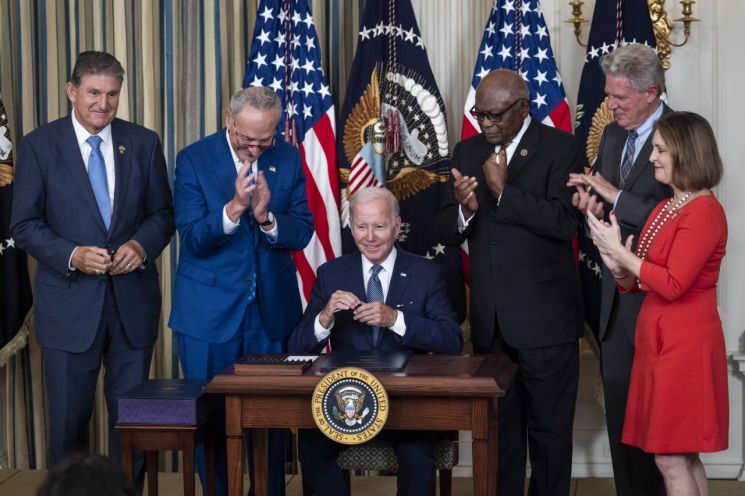
[Asia Economy New York=Special Correspondent Joeslgina] On the 16th (local time), U.S. President Joe Biden signed the so-called Inflation Reduction Act, which secures $790 billion in funding over the next decade to inject large-scale funds into climate change response and other areas.
In his signing ceremony speech, President Biden emphasized that the Inflation Reduction Act is "one of the most significant laws in our history." The act includes a total spending plan of $740 billion, consisting of $440 billion in policy implementation and $300 billion in deficit reduction. Notably, more than 80% of the fiscal spending focuses on strengthening climate response measures such as electric vehicle promotion, clean manufacturing, fuel, and vehicle-related tax credits.
However, as the U.S. seeks to exclude China from the global supply chain, it has imposed restrictions not only on production locations but also on the sources of key parts and minerals, increasing the likelihood that Korean companies will be excluded from the benefits. To receive an electric vehicle subsidy of up to $7,500, the electric vehicle must be produced in the U.S. Currently, Hyundai Ioniq 5 and Kia EV6, which are sold in the U.S., are entirely produced in Korea and thus are not eligible for the benefits.
Even if production is relocated to the U.S., Chinese-made key minerals and battery parts cannot be used. This is because minerals used in electric vehicle batteries must be mined and processed at least 40% in the U.S. or countries that have free trade agreements (FTA) with the U.S. to qualify for subsidies.
With Chinese-made batteries excluded, Korean battery companies are expected to enjoy short-term benefits, but they face the long-term challenge of reducing dependence on Chinese minerals. The share of Chinese-made materials in the production of cathode and anode materials for electric vehicle batteries worldwide reaches as high as 70-80%. Sooyoung Park, a researcher at Shin Young Securities, pointed out, "While the electric vehicle and eco-friendly sectors may seem groundbreaking at first glance, the strict requirements for recognizing U.S.-made raw materials, components, and parts make it difficult for companies outside the U.S. to benefit."
Local media expect that detailed conditions and exact implementation methods will only be available around the end of this year when the enforcement decree is released.
Domestic companies, facing an emergency, are devising countermeasures. The Korea Automobile Manufacturers Association, in a statement submitted to the U.S. House of Representatives on the 10th, argued that "according to the Korea-U.S. Free Trade Agreement (FTA), which requires equal treatment of Korean and U.S. products, tax benefits should also apply to Korean electric vehicles equipped with batteries containing parts manufactured or assembled in Korea."
© The Asia Business Daily(www.asiae.co.kr). All rights reserved.

















