Liquor Chang urges "economic recovery with a desperate heart"
China may face fiscal deterioration as a bigger issue than economic growth
[Asia Economy Senior Reporter Cho Young-shin] Chinese Premier Li Keqiang held an emergency economic policy meeting with the Party Secretaries and Governors of six provinces, including Guangdong and Zhejiang. This appears to be a hurried response after key economic indicators such as industrial production and retail sales for July were reported below expectations.
The combined share of China’s Gross Domestic Product (GDP) from the six provinces, including Guangdong and Zhejiang, reaches 45%. Therefore, this also negatively impacts the central government’s finances.
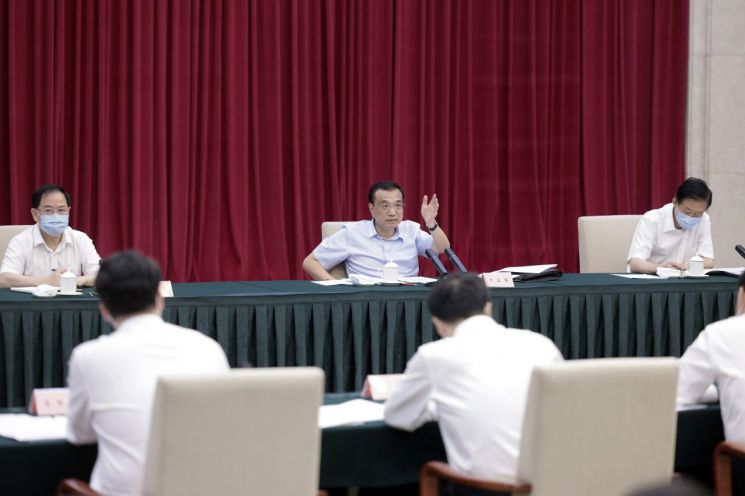
According to state-run Xinhua News Agency on the 17th, Premier Li discussed the economic situation of China at a meeting held the previous day in Shenzhen, Guangdong Province, attended by local government leaders from Guangdong, Zhejiang, Jiangsu, Shandong, Henan, and Sichuan provinces.
At the meeting, Premier Li assessed the current Chinese economy, stating, "Although the economic recovery continues, it remains a difficult period with significant uncertainties." He emphasized, "We must urgently promote economic recovery and development and firmly ensure the safety of people’s livelihoods."
He described the six provinces as "pillars accounting for 45% of China’s GDP" and urged them to "actively demonstrate initiative to reasonably strengthen the intensity of macro policies such as employment stability." This statement is interpreted as taking into account the record-high youth unemployment rate (ages 16?24) of 19.9% as of the end of July.
It is known that market participants (enterprises and other economic entities) and employment contributions from these six provinces account for more than 40% of the entire country.
Premier Li also pointed out weak domestic demand (consumption). He said that provinces with large economies and populations should take the lead in promoting consumption. To revive the rigid real estate (housing) market, more measures need to be found," suggesting a relaxation of real estate market regulations.
He also encouraged the issuance of local special bonds. Premier Li noted that there is still room within the local special bond issuance quota and instructed to expedite projects so that more physical work can be carried out during the third quarter (July to September).
Premier Li’s decision to hold an economic policy meeting specifically targeting these six provinces is related to the central government’s finances. As of 2019, Guangdong Province ranked first nationwide with a net fiscal contribution to the central government (the difference between local fiscal revenue and central government transfers) of 830.7 billion yuan (approximately 161 trillion won). Following Guangdong were Shanghai (820.2 billion yuan), Beijing (731 billion yuan), Jiangsu (409.1 billion yuan), Zhejiang (327.4 billion yuan), and Shandong (215.2 billion yuan).
The central government uses net fiscal contributions to support underdeveloped central and western regions. The economic conditions of these six large-scale provinces structurally affect the central and western regions.
This year, the Chinese government announced a fiscal deficit rate of "around 2.8% (3.6% in 2020, 3.2% in 2021)." In the March Two Sessions (National People's Congress and Chinese People's Political Consultative Conference) work report, Premier Li stated plans to expand fiscal revenue through growth and thereby increase fiscal expenditure.
In the first half of this year (January to June), it is reported that general public budget revenues in Guangdong, Zhejiang, Jiangsu, and Shandong provinces decreased by 8.2% to 17.9%.
Some analysts suggest that the Chinese leadership should be more concerned about fiscal deterioration than failing to meet this year’s economic growth target (within 5.5%), indicating that the economic situation is not favorable.
© The Asia Business Daily(www.asiae.co.kr). All rights reserved.

















