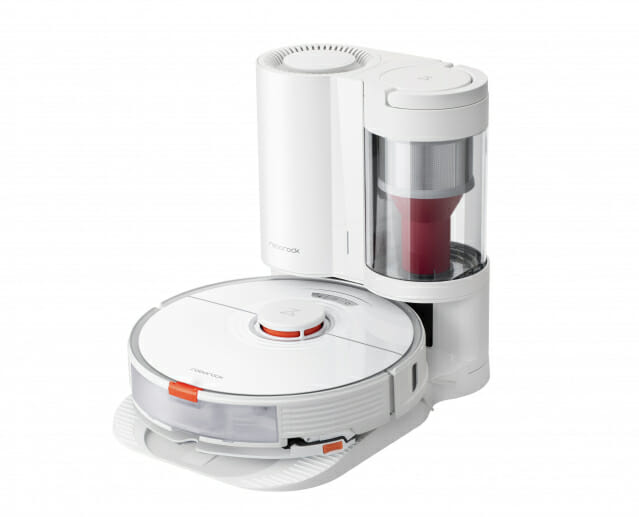
[Asia Economy Reporter Donghyun Choi] The performance of robot vacuum cleaner companies is rapidly growing. As artificial intelligence (AI) technology advances and the stay-at-home trend becomes the new normal, robot vacuum cleaners have rapidly emerged as essential home appliances that will end the era of brooms and vacuum cleaners.
According to the home appliance industry on the 18th, cleaning appliance company Roborock recorded sales of 56 billion KRW in the first half of this year, a 267% increase compared to the same period last year. This is the highest performance since the Chinese brand Roborock entered the domestic market in 2020.
Roborock's main products are the 'Roborock S7 Plus' and 'Roborock S7 MaxV Ultra,' which are all-in-one products. Roborock succeeded in differentiating itself in the domestic market with all-in-one robot vacuum cleaners equipped with both suction and mopping functions. Major domestic companies such as Samsung Electronics and LG Electronics do not have all-in-one products. Roborock capitalized on this point in the domestic market and secured the number one position with a 46.1% market share in the all-in-one robot vacuum cleaner segment as of the first half of this year.
Roborock attributes its rapid market capture to continuous investment in research and development (R&D). Roborock spends more than 7% of its annual sales on R&D. Last year alone, it invested approximately 78.6 billion KRW in research and development. Kim Seoyoung, Roborock's marketing manager, said, "Thanks to aggressive R&D investment, we have enhanced our research and development capabilities and technological competitiveness, achieving high performance despite fierce competition. We expect to continue good results in the second half of the year compared to previous years."
Thanks to Roborock's strong performance, domestic black box manufacturer Thinkware also surpassed 150 billion KRW in sales for the first time in its history in the first half of this year. Thinkware is responsible for Roborock's domestic distribution and after-sales service. In the second quarter alone, Thinkware recorded sales of 89.8 billion KRW, of which environmental home appliances such as robot vacuum cleaners accounted for 28.1 billion KRW, a remarkable 235.6% increase compared to the same period last year.
Among domestic companies, Eugene Robot, which released the all-in-one robot vacuum cleaner 'iCLEBO G5' in 2019, has also entered a recovery phase this year. Eugene Robot's sales in the first half of this year were 21.96 billion KRW, a 93.7% increase compared to the same period last year, and operating profit turned positive at 3.11 billion KRW. While Roborock promotes premium products priced around 1.5 million KRW, Eugene Robot is expanding its base in the domestic market with so-called 'cost-effective' products priced in the tens of thousands of KRW.
According to market research firm GfK, the domestic robot vacuum cleaner market recorded sales of 200 billion KRW last year and is expected to exceed 300 billion KRW this year. The current competitive landscape in the domestic robot vacuum cleaner market shows Chinese companies such as Roborock and Ecovacs pushing out existing strong players like Samsung Electronics and LG Electronics.
Ecovacs, a Chinese company and the number one player in the Asian robot vacuum cleaner market, established a Korean office in March and has begun full-scale market penetration. Ecovacs has been selling products through a distributor in Korea since 2017, and in 2021 appointed actor Hyun Bin as its exclusive model. This year, it appointed former Logitech Korea CEO Jeong Cheolgyo as its first branch manager, demonstrating aggressive moves. Ecovacs' main products are premium all-in-one robot vacuum cleaners such as the 'Deebot X1 Family' and 'Deebot T10 Family.'
The popularity of robot vacuum cleaners is no exception overseas. Amazon announced earlier this month that it will acquire iRobot, which holds a 75% market share in the U.S. robot vacuum cleaner market, for $1.7 billion (approximately 2.2 trillion KRW). Jo Eunae, a researcher at Ebest Investment & Securities, said, "The global robot vacuum cleaner market is expected to grow at an average annual rate of 23% from 2020 to 2028," adding, "Demand will further increase due to changes in consumer trends, growing interest in home hygiene, and the rise of single-person households."
© The Asia Business Daily(www.asiae.co.kr). All rights reserved.

















