[Asia Economy Reporter Jeong Hyunjin] While the United States is busy competing with China for technological supremacy and trying to prevent the leakage of advanced technology, it has been revealed that most sensitive technology-related exports have actually been approved, according to a report by The Wall Street Journal (WSJ) on the 16th (local time). Criticism has been raised that the U.S. Department of Commerce, which leads export control policies, prioritized trade interests over national security.
"U.S. Approval Rate for Technology Exports to China at 94%"
Based on data from the U.S. Department of Commerce, WSJ reported that in 2020, less than 0.5% of the $125 billion (approximately 164.125 trillion KRW) worth of U.S. exports to China required prior government approval for technology-related items. Of these, 94%?equivalent to 2,652 applications for technology exports to China?were approved. Although the approval rate dropped to 88% last year, WSJ explained that due to differences in data adjustment processes, it is difficult to directly compare and conclude that the rate actually decreased.
WSJ stated, "As a result, the U.S. has continuously exported semiconductors, aerospace components, artificial intelligence (AI) technologies, and more to China," and noted that some critics pointed out that such sales under previous U.S. administrations may have contributed to China's military technological advancements. WSJ added that the issue of U.S. export controls, which has long been a concern, is now at the center of debate over how much trade should be maintained with the strongest adversary.
In fact, pressure to curb China's semiconductor rise has continued from the Donald Trump administration to the current Joe Biden administration, but according to trade data compiled by the United Nations (UN), the scale of semiconductor equipment imports from the U.S. to China expanded from $2.6 billion in 2017 to $6.9 billion last year. Recently, the Biden administration is considering measures to prevent U.S. semiconductor equipment from being exported to China.
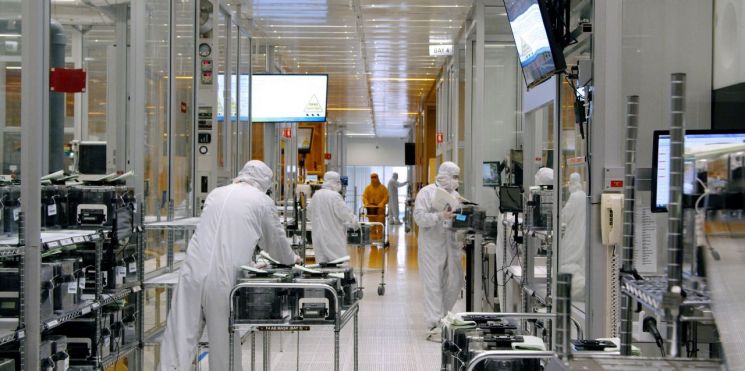
Currently, approval of U.S. technology exports to China is jointly decided by related departments including the Department of Commerce, Department of Defense, Department of State, and Department of Energy, but the Department of Commerce’s Bureau of Industry and Security (BIS) is known to play a leading role. The U.S. Department of Commerce stated that the focus is on a long-term and strategic competitive relationship with China and that export control decisions are made in cooperation with related departments.
"China is the Greatest Threat Facing the U.S... Lack of Consensus on Economic Relations"
Experts have criticized the U.S. Department of Commerce for inappropriately prioritizing U.S. trade interests over national security, WSJ reported. In this regard, Steve Kunen, who was responsible for analyzing export controls to China at the Department of Defense, reportedly resigned, stating that the high approval rate for licenses of technology with potential military use is evidence of policy failure.
Mira Ricardel, who led export control operations at the Department of Commerce during the Trump administration, told WSJ, "China is the greatest threat we face," and pointed out, "There is a lack of consensus within the U.S. government on how U.S.-China relations should be economically structured."
Matthew Pottinger, former Deputy National Security Advisor at the White House during the Trump administration, also criticized, "(BIS) struggles to reconcile the Department of Commerce’s goal of promoting exports with the mission of protecting U.S. national security. The dilemma regarding China is the most severe." WSJ reported, citing sources, that Pottinger once convened a special meeting with BIS officials at the White House Situation Room at the end of 2019 to criticize them for actions that contradicted the Trump administration’s China policy.
In response to such criticism, Thea Roseman Kendler, Deputy Assistant Secretary for Export Administration at the Department of Commerce, rebutted, "We are promoting U.S. technological leadership," and said that although related departments can raise objections to export approval decisions, such cases are rare. During fiscal year 2021, there were more than 41,000 approval requests, but only 57 objections were raised.
WSJ pointed out that some worry if the U.S. strictly regulates technology exports to China, allies such as Germany, Japan, and South Korea might fill the gap. Kevin Wolf, a senior official at the Department of Commerce during the Barack Obama administration, said, "For export controls to be effective, allies need to apply the same regulations as we do." However, WSJ added that such cooperation takes a long time to coordinate, and there are voices calling for immediate action.
© The Asia Business Daily(www.asiae.co.kr). All rights reserved.



















