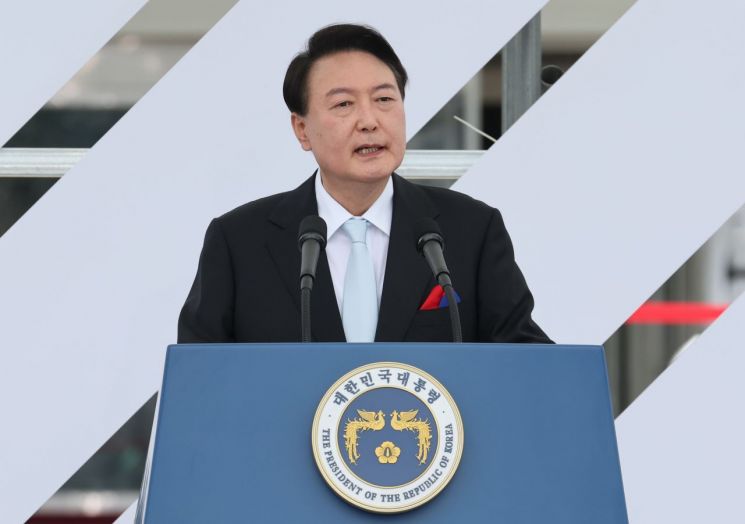
[Asia Economy Reporter Ki-min Lee] North Korea and unification experts have offered mixed evaluations regarding the bold initiative of the Yoon Seok-yeol administration. While some view it as an upgraded plan encompassing detailed steps in the areas of livelihood and economic cooperation, others argue that it remains similar to past administrations’ proposals, limited to economic suggestions.
On the 17th, North Korea and unification experts such as Son Ki-woong, Director of the Korea Peace Cooperation Institute, Yang Moo-jin, Professor at the Graduate School of North Korean Studies, and Nam Sung-wook, Professor of North Korean Diplomacy at Korea University, mentioned in phone interviews with Asia Economy the similarities between President Yoon’s bold initiative announced in the Liberation Day speech and the Lee Myung-bak administration’s “Denuclearization and Opening 3000” policy.
Director Son viewed the bold initiative as similar to but improved from the Denuclearization and Opening 3000. The Denuclearization and Opening 3000 was a plan to raise North Korea’s per capita income to $3,000 within 10 years through investment, contingent on North Korea’s denuclearization and market opening.
In contrast, the newly proposed bold initiative is more specific and aligned with the stages of North Korea’s denuclearization implementation, offering ▲ large-scale food supply ▲ support for power generation and transmission infrastructure ▲ modernization of ports and airports ▲ technical support to improve agricultural productivity ▲ modernization support for hospitals and medical infrastructure ▲ international investment and financial support, all designed not to provoke North Korea.
Director Son said, “The policy name ‘Denuclearization and Opening 3000’ itself revealed that economic support would be provided if North Korea gave up its nuclear weapons. That caused conflicts from the start.” He added, “The working-level officials had experience from the Lee Myung-bak administration. Through trial and error, this time they smartly avoided provoking North Korea.” The bold initiative is structured so that denuclearization and compensation occur simultaneously rather than compensation following denuclearization, thus placing less burden on North Korea.
He also emphasized that while previous policies such as the Moon Jae-in administration’s “Korean Peninsula Driver” theory and “New Economic Map of the Korean Peninsula” were pursued separately from the U.S. and failed, this time the plan was developed in consultation with the U.S. to increase feasibility. Director Son predicted, “President Yoon said in his speech that the plan would be implemented with countries that pursue universal values. It is expected that the policy can be promoted in solidarity with the U.S., Japan, and others.”
Despite some improvements over the past Denuclearization and Opening 3000, there were criticisms that the bold initiative is still not at a level North Korea would accept. Professor Yang evaluated, “There are traces of thought and consideration in the failed Denuclearization and Opening 3000 and the Moon administration’s peace process, which had preconceived notions,” but also pointed out that “the plan proposes economic compensation in stages aligned with North Korea’s denuclearization steps?nuclear declaration, inspection, and dismantlement?and if economic compensation follows the order of denuclearization, North Korea would likely accept it as compensation after denuclearization.”
Experts forecast that North Korea will not respond immediately to President Yoon’s bold initiative. Director Son said, “The current situation has become a strongman-to-strongman standoff, and with the Ukraine war ongoing, U.S. President Joe Biden is unlikely to rush to achieve results in North Korea-U.S. relations before the November midterm elections.” He added, “We need to wait until after the U.S. midterm elections, which will determine Biden’s re-election prospects.” He also advised that bipartisan cooperation and public support are essential to advance the policy.
There was also a forecast that for North Korea to accept South Korea’s proposals, not only economic proposals but also changes in perception must precede, otherwise North Korea will not engage in dialogue. Professor Yang said, “For North Korea to agree, military and political stability must be guaranteed, but there is no mention of that. When inter-Korean and North Korea-U.S. relations are poor, economic issues become secondary.” He pointed out, “Hostile policies must be abolished and trust relationships established first.” He added, “To this end, it is necessary to emphasize that we are partners moving toward peace and unification and propose talks between working-level officials and authorities from both Koreas.”
Professor Nam also said, “President Yoon’s bold initiative is ultimately economic compensation, but the likelihood of North Korea’s positive response is low.” Regarding the presidential office official’s explanation the previous day that political and military plans are also prepared and will be proposed once negotiations begin, he said, “If North Korea does not respond, it will face limits and difficulties,” and added, “Even bringing up political and military plans first would be sensitive to the conservative supporters of the current administration.”
He analyzed, “The U.S. also has a stance not to move ahead on sanctions relief,” and “It will be difficult for North Korea to respond to the bold initiative.” Although U.S. State Department spokesperson Ned Price strongly supported the bold initiative on the 15th (local time), he drew a line regarding sanctions relief on North Korea, saying, “At this point, it is purely a hypothetical question.”
© The Asia Business Daily(www.asiae.co.kr). All rights reserved.

















