Announcement of Major Changes in Cultural Heritage Management System, Protection Scope Expanded to Non-Designated Cultural Properties
Systematic Management of Changwon Paengnamu and Tidal Flats... Expected Increase in Production Induction Effect and Job Creation
This year, the Cultural Heritage Administration's core task is to innovate the cultural heritage management system. They aim to reform the legal framework and related systems to transition to a future-oriented national heritage system. The term ‘문화재 (Cultural Heritage)’ will be changed to ‘유산 (Heritage).’ For example, intangible cultural heritage will be replaced with intangible heritage, and folk cultural heritage with folk heritage. National treasures, treasures, natural monuments, and scenic sites will remain as they are but will be collectively referred to as national heritage in accordance with the UNESCO international standards. Choi Eung-cheon, the head of the Cultural Heritage Administration, stated, "We plan to expand the protection system from designated cultural heritage to a comprehensive protection system that includes non-designated cultural heritage, to protect and utilize disappearing non-designated historical and cultural resources."
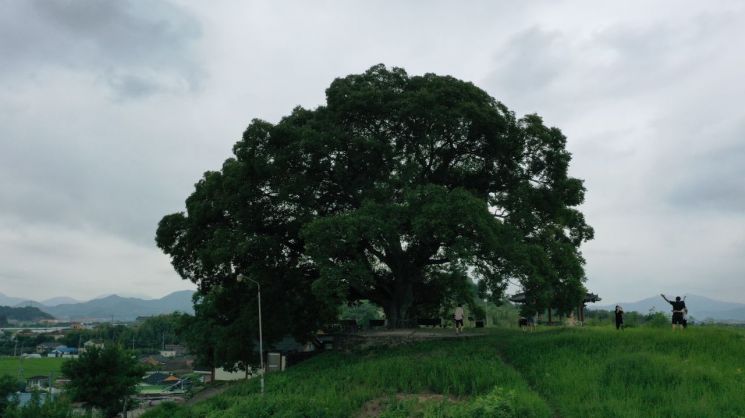
There are quite a few non-designated historical and cultural resources left neglected in blind spots. One such example is the Zelkova tree in Bukburi, Changwon, which recently became famous as the backdrop of the drama Extraordinary Attorney Woo. Since it is not designated as a natural monument, it could not receive management such as protection and maintenance projects or convenience facility improvements under the Cultural Heritage Protection Act. The ‘Korean Tidal Flats,’ which were registered as a UNESCO World Heritage site last year, also face difficulties in establishing a protection system because they are non-designated cultural heritage.
On the 11th, National Assembly member Bae Hyun-jin of the Culture, Sports and Tourism Committee, who hosted a policy forum for the introduction of the national heritage system, explained, "Under the newly introduced national heritage system, non-designated cultural heritage will also be recognized as future heritage and receive protection from the state," adding, "Efficient national heritage management will be possible through a classification system that meets UNESCO standards."
There are two more expected effects. At the forum, Jo Il-hyeong of the Korea Cultural Heritage Policy Institute presented an ‘Analysis of Policy Effects from the Introduction of the National Heritage System.’ This report derived economic and social expected effects through public perception surveys and input-output analysis. According to the report, the introduction of the national heritage system improved economic efficiency even without additional resources. The production inducement coefficient for culture and travel-related services increased by approximately 3.09% (KRW 63.85 billion), the value-added inducement coefficient by about 3.69% (KRW 39.06 billion), and the employment inducement coefficient by about 2.42% (520 jobs).
The effect of additional resource input was calculated assuming KRW 13.45 billion (KRW 315 per person). As a result, the production inducement effect was KRW 23.16 billion, the value-added inducement effect was KRW 11.87 billion, and the employment inducement effect was 240 jobs. Researcher Jo stated, "With the introduction of the national heritage system, effects of up to KRW 87 billion, KRW 50.9 billion, and 7,600 jobs can be expected, respectively," and explained, "Assuming a steady increase in policy resources, the effects over the next five years are expected to reach up to KRW 350.3 billion, KRW 212 billion, and 29,050 jobs, respectively."
The economic benefits calculated by applying coefficients by project using the input-output table were also significant. Due to the expansion of preservation, transmission, enjoyment, utilization, and globalization of national heritage, the production inducement effect over the next five years was estimated at KRW 415.1 billion, the value-added inducement effect at KRW 193.8 billion, and the employment inducement effect at 2,702 jobs.
Projects expected to expand in scope or strengthen functions include digital restoration of Hwangnyongsa and Mireuksa Temples, establishment of a digital database for the Tripitaka Koreana, support for residents in regulated areas around national heritage sites, establishment of the Tamna History and Culture Center, establishment of the National Joseon Dynasty Annals Exhibition Hall, regional cultural heritage utilization projects, certification systems for educational programs, expansion of World Heritage registrations, and hosting of the World Heritage General Assembly. Researcher Jo stated, "If the policy paradigm shifts from cultural heritage to heritage and the preservation, management, and utilization policies in the areas of cultural heritage, intangible heritage, and natural heritage expand, the economic ripple effects on the domestic industry as a whole will increase further."
The social effects were broadly categorized into expanded opportunities for cultural enjoyment, improved public convenience, promotion of regional co-prosperity, and strengthening of national status and identity. A survey conducted from the 20th to 24th of last month targeting 1,000 adult men and women aged 19 to 69 showed average scores (out of 5.0) of 3.65, 3.51, 3.75, and 3.88, respectively. Researcher Jo noted, "All items scored higher than the median value of 3.0," and expressed hope that "if the national heritage system is introduced and operated and the public’s perceived level improves, the recognition of positive effects will increase further."
© The Asia Business Daily(www.asiae.co.kr). All rights reserved.

















