Loan Interest Rate Changes to Fixed Amid Rising Rates
Banks Frown Over Decreased Interest Income and Operational Confusion
Due to Changed Criteria, Loan Target Size Shrinks... "Less Performance Pressure Expected"

[Asia Economy Reporter Minwoo Lee] As the government announces various financial policies such as the Anshim Conversion Loan and refinancing loans for self-employed and small business owners, banks are showing signs of discomfort. This is because lowering the interest rates on existing loans reduces interest income and also increases the workload at frontline branches. However, unlike similar policies in the past, some argue that the actual burden will not be significant due to the limited conditions and smaller scale.
According to the financial sector on the 17th, six major commercial banks including the Korea Housing Finance Corporation, KB Kookmin, Shinhan, Hana, Woori, NH Nonghyup, and IBK Industrial Bank began providing information about the Anshim Conversion Loan on their websites. Following the government's announcement on the 10th about converting variable-rate loans to fixed-rate loans in the 3% range, they have started full-scale promotion ahead of the application opening on the 15th of next month.
Banks Wearing a Frown... "Interest Income Decreases and Risks Increase"
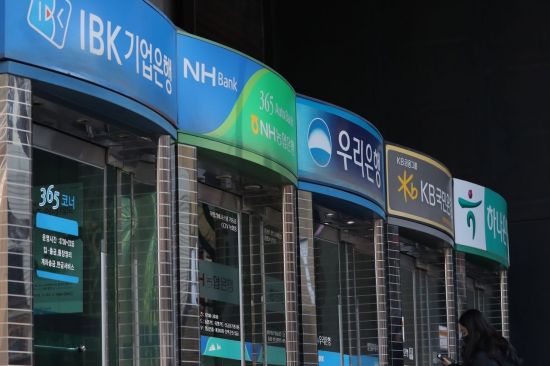
Banks are in an uncomfortable position. Despite the rising interest rate environment, they are giving up variable-rate income and taking on fixed-rate loan bonds proposed by the government. The Anshim Conversion Loan involves the government purchasing variable-rate loan bonds from commercial banks through the Korea Housing Finance Corporation. Then, the banks repurchase asset-backed securities (MBS) issued by the Housing Finance Corporation. From the banks' perspective, variable-rate loans are converted into long-term fixed-rate bonds issued by the Housing Finance Corporation. Waivers of prepayment penalties and the undefined mandatory holding period for MBS also pose burdens.
Confusion at branch offices is also a concern. When the Anshim Conversion Loan was implemented in 2015 and 2019, customers flocked to frontline branches, causing operational confusion.
They are also reluctant about the refinancing loans for small business owners and self-employed scheduled for October. First-tier banks argue that the risk increases as low-credit borrowers enter, and mechanical refinancing itself does not align with natural market operations. Second-tier financial institutions are also burdened by profit reductions as borrowers move to commercial banks.
Different Standards from the Past... Actual Burden is Small
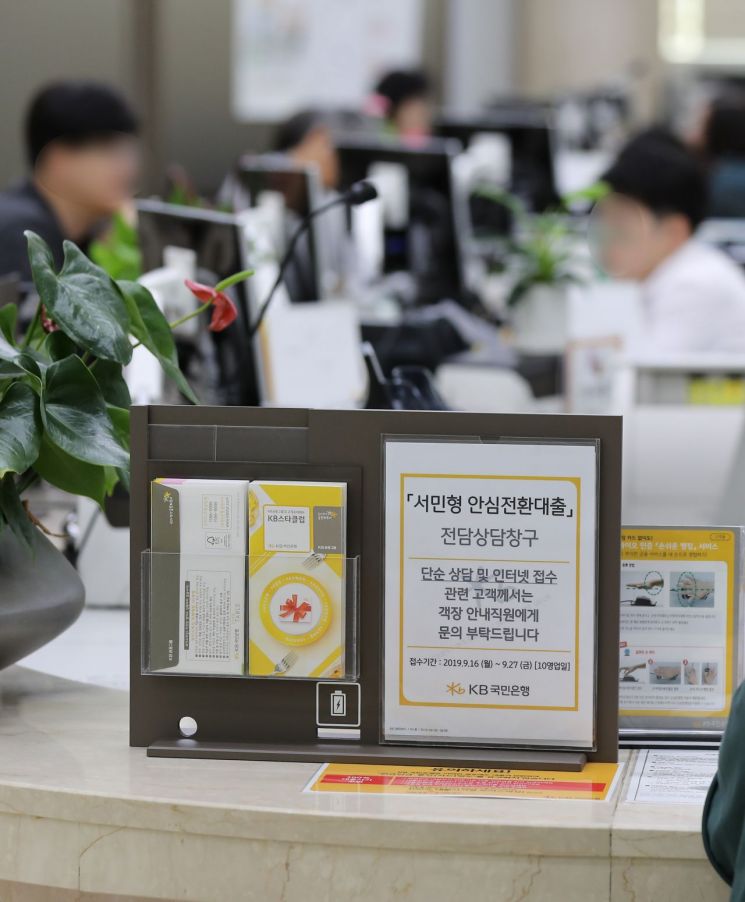 On the morning of September 16, 2019, when the 'Saemin-type Safe Conversion Loan,' which converts variable and quasi-fixed rate mortgage loans into long-term fixed-rate loans, was implemented, customers were receiving consultations from bank employees at a bank in Yeouido, Jung-gu, Seoul.
 [Image source=Yonhap News]
However, some criticize this as an exaggeration. Since both the standards and scale have changed from the past, the demand and ripple effects are expected to differ as well.
First, the eligibility criteria for the Anshim Conversion Loan have become much stricter than before. The housing price limit has been lowered from 900 million KRW in 2015 to 400 million KRW this time. As a result, most homeowners in Seoul and the metropolitan area are expected to be excluded. According to Real Estate 114, only 1.2% of apartments in Seoul are priced below 400 million KRW. Income conditions have also been newly established. Only borrowers with a combined annual income of 70 million KRW or less are eligible, and the per-person loan limit has been reduced from 500 million KRW in 2015 to 250 million KRW. Additionally, unlike in the past, loans from second-tier financial institutions are also included in the Anshim Conversion Loan eligibility, so the burden on commercial banks is expected to be small.
Concerns about refinancing loans for self-employed and small business owners may also be unfounded. Since the loan scale and interest rate reduction are relatively small, the burden may not be significant. The refinancing program targets business loans such as facility and operating funds received from financial institutions, and the interest rate must be 7% or higher at the time of application. According to the Korea Federation of Banks, as of June, the proportion of personal business loans with interest rates above 7% among the six major commercial banks is in single digits except for IBK Industrial Bank (16.9%). Hana Bank was only 0.8%, followed by NH Nonghyup Bank (2.6%), Woori Bank (3.7%), KB Kookmin Bank (3.9%), and Shinhan Bank (5.1%).
The financial authorities also judged that most of these borrowers temporarily moved to second-tier financial institutions due to the COVID-19 situation and basically have repayment ability. Therefore, they believe it is appropriate for the banking sector to accept this.
Concerns about financial companies' performance burdens in the market are also low. The KRX Bank Index has been steadily rising. After hitting a yearly low of 579.55 on July 15, when financial companies were announcing their first-half results, it rose about 12.6% to 652.56 on August 12. Choi Jungwook, a researcher at Hana Securities, explained, "Since the refinancing interest rate for loans above 7% is around 5.5-6.0%, it will not be a significant burden for banks. Although risks may increase if loans from other banks flow in, the 90% guarantee ratio means the negative impact will not be large."
© The Asia Business Daily(www.asiae.co.kr). All rights reserved.
![From Bar Hostess to Organ Seller to High Society... The Grotesque Con of a "Human Counterfeit" [Slate]](https://cwcontent.asiae.co.kr/asiaresize/183/2026021902243444107_1771435474.jpg)


















