[Financial Innovation from the Head of Bank Research Institute]
Jung Joong-ho, Head of Hana Bank Hana Financial Management Research Institute
 Interview_Jungho Jung, Head of Hana Financial Research Institute at Hana Bank./Photo by Hyunmin Kim kimhyun81@
[Asia Economy Reporter Sim Nayoung] Jung Joong-ho, Director of Hana Bank Hana Financial Management Research Institute, emphasized in an interview with Asia Economy on the 12th that "to resolve the 'tilted playing field issue' between banks and big tech, big tech should be included in financial regulations," and added, "When non-financial companies try to enter banking operations such as payment settlements, we should adopt Japan's method of licensing classification and regulation in Korea as well."
Director Jung said, "Innovation is a bet on uncertainty," and stated, "Instead of allowing banks to perform tasks outside their core operations through a positive system, switching to a negative system is necessary for the separation of finance and industry to lead to innovation." He pointed out Japan's banks' 'Inventory finance' and 'Pet insurance' as promising areas for banks to enter.
Japan's Principle of Same Function, Same Regulation Between Banks and Big Tech
Should Be Introduced in Korea
▲The term 'separation of finance and industry' (Eunsan Separation) is more accurate than 'separation of finance and capital' (Geumsan Separation). The point of Eunsan Separation presented by the Financial Services Commission (FSC) starts from the question of how to level the 'tilted playing field' caused by various asymmetric regulations arising from the growth of big tech due to the development of digital finance and their continuous entry into financial or quasi-financial businesses. From that perspective, they gave banks the opportunity to introduce innovative services by allowing their entry into industrial (non-financial) sectors.
There was a reason why the law originally prohibited the combination of finance and industry. Considering that, when banks combine with industries, they must not funnel funds to subsidiaries or supply funds to insolvent subsidiaries. If an accident occurs in a bank, the cost is transferred to society as a whole. It is necessary to find a balance in easing Eunsan Separation regulations while reviewing financial stability and consumer protection issues.
Since this issue arises due to competition from big tech, the discussion should not be limited to easing regulations on banks alone. The discussion must expand to regulate big tech as well. To resolve the tilted playing field problem, regulating big tech is also necessary.
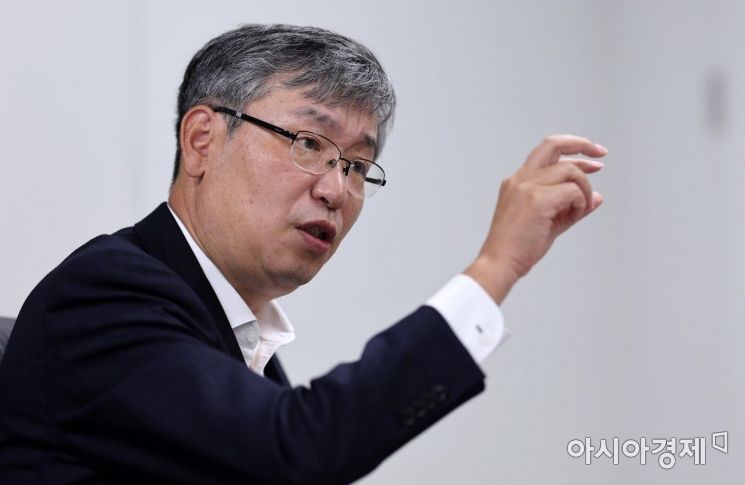 Interview_Jungho Jung, Head of Hana Financial Research Institute at Hana Bank./Photo by Hyunmin Kim kimhyun81@
▲There is a need to benchmark Japan. Japan completely revised its financial-related legislation in 2017. The trigger was the establishment plan of the 'Amazon Bank Japan.' Japan had no regulations against industrial capital entering finance. When Amazon Japan announced plans to establish Amazon Bank, Japanese financial authorities began to deliberate.
Japan judged that if big tech manages financial companies, the impact on industry would be significant, so they amended laws to regulate this. The first law they amended was the 'Payment Services Act.' This law explicitly defines 'fund transfer business,' which is a traditional banking operation. As simple payment service providers began to engage in fund transfer business, licenses were classified into three types?Type 1, 2, and 3?based on the amount of funds handled in transfers and other operations. Type 3 is for small amounts, and Type 1 allows large amounts. However, the level of regulation intensifies as the license grade increases. Simple payment service providers can obtain a Type 3 license.
In Japan, it is clear that the same function must be subject to the same regulation. In Korea, banks are still heavily regulated, while fintech companies can conduct financial business (such as fund transfers) under the Electronic Financial Transactions Act without being included in the financial framework. There is a need to introduce Japan's differentiated regulatory system in Korea as well.
▲Under the Bank Act, banks are allowed to perform 15 ancillary tasks outside their core banking operations, such as debt guarantees and bill acceptance. This is a positive system. When the government eases the separation of finance and industry, it tells banks to propose any additional tasks they want to perform beyond the current 15. However, banks are confused about how specifically or abstractly they should express these desires. For example, they cannot simply demand, "Let us engage in retail business."
The Financial Services Commission is revising the Bank Act for the next 10 years, so banks should plan their business for the next decade and request permission from authorities accordingly. It is impossible to predict how the world will change. Big tech, not being financial companies, can do more than banks even if banks are allowed to perform many tasks. The fact that big tech is not regulated like banks is also a problem.
Ultimately, banks' ancillary tasks should be defined by a negative system. Innovation is a 'bet on uncertainty.' Increasing the number of tasks banks can perform slightly does not align with innovation. Banks' soundness, financial stability, and consumer protection must be maintained while transitioning to a negative system. The core of Eunsan Separation is what banks can do. If innovation-friendly, banks should be allowed to do anything in principle, with clear standards for what is prohibited. This will lead to the emergence of services that are currently unimaginable.
 Interview_Jungho Jung, Head of Hana Financial Research Institute at Hana Bank./Photo by Hyunmin Kim kimhyun81@
Inventory Finance and Pet Insurance Are Promising
Online Platforms Comparing Deposit Products Should First Be Offered to Financial Companies
▲Japanese banks engage in a business called Inventory Finance. When the economy worsens, manufacturers accumulate a lot of inventory and face cash flow problems. Banks purchase this inventory. This provides cash to the companies, easing their management. Banks store the inventory for a certain period and sell it when customers appear. They earn revenue through fees or similar methods in the process. This business can contribute to the virtuous cycle of the national economy.
The 'Petconomy' business is also promising. Currently, pet insurance is not well activated because, first, animal identity verification is difficult, and second, the method of setting medical fees is not standardized across hospitals. According to a survey by the research institute, pet owners spend an average of up to 300,000 KRW per month on their pets, with many respondents saying they can spend between 500,000 and 1,000,000 KRW. If microchips are attached to all pets according to the government animal protection management system and medical fees are standardized, the pet insurance market will grow, and banks can enter this business.
▲It is true that consumers benefit when they can easily compare deposit products online at a glance and interest rate competition among banks intensifies. The problem is that if big tech monopolizes this online platform, the financial contact point for the public becomes big tech, and customers will no longer look to banks. From the banks' perspective, they lose their relationship with financial consumers and their channel dominance completely. What banks fear most is becoming an Original Equipment Manufacturer (OEM), merely producing financial products and supplying them to online platforms.
However, banks must handle this response themselves. The online platform should not be blocked. There is a way: when the authorities first open the online financial product intermediary platform, they should allow only financial companies to participate, and after a certain period, open it to non-financial companies. Then, existing financial companies will try to jointly create the platform first, allowing a smooth transition. If everyone is allowed in without restrictions from the start, big tech is likely to dominate the platform. Financial authorities must consider the banks' position, which could be reduced to OEMs. Otherwise, the separation of manufacturing and sales?where banks make financial products and big tech sells them?could seriously harm the competitive landscape.
Interview by: Jung Jaehyung, Head of Finance Department
Summary by: Reporter Sim Nayoung
© The Asia Business Daily(www.asiae.co.kr). All rights reserved.



















