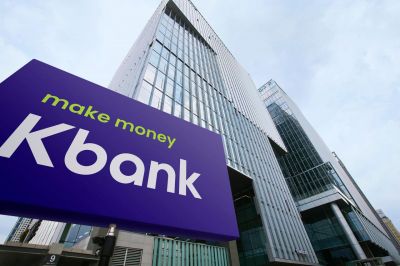
[Asia Economy Reporter Bu Aeri] K-Bank recorded a net profit of 45.7 billion KRW in the first half of the year, marking the highest figure in its history.
According to K-Bank on the 16th, this represents a significant improvement compared to the operating loss of 8.4 billion KRW during the same period last year.
The net profit for the first half of the year exceeds twice the full-year net profit of 22.5 billion KRW from last year.
K-Bank explained that the number of customers and loan and deposit volumes continuously grew, and by expanding the loan portfolio and diversifying fee income, they established a more balanced revenue structure.
The number of K-Bank customers increased by 660,000 from 7.17 million at the end of last year to 7.83 million at the end of the first half.
Loans, which were 7.09 trillion KRW at the end of last year, rose by 1.64 trillion KRW to 8.73 trillion KRW at the end of the first half. Deposits increased by 860 billion KRW from 11.32 trillion KRW to 12.18 trillion KRW during the same period.
Accordingly, K-Bank's interest income in the first half reached a record high of 172.1 billion KRW. The rise in the base interest rate and an increase in mid-to-low credit loans drove this growth.
In the first half, K-Bank expanded its apartment mortgage loans and jeonse (long-term rental deposit) loans, increasing the proportion of secured loans from 13.7% at the end of the first half last year to 21.1% at the end of this first half. They also newly introduced the 'Sajangnim Loan' targeting individual business owners.
K-Bank's non-interest income (fee income) for the first half recorded 4.1 billion KRW.
The proportion of linked loan income fees more than doubled compared to the same period last year, and they additionally earned credit card sales fees by launching new affiliated credit cards such as the 'K-Bank SIMPLE Card (July 2021)' and the 'K-Bank Lotte Card (April 2022)'.
The operating expense ratio (CIR), which was 61% at the end of last year, decreased to 39% at the end of the first half. CIR is an indicator comparing selling and administrative expenses to operating profit in financial companies; the lower it is, the higher the productivity and management efficiency.
At the end of the first half, the net interest margin (NIM) was 2.41%, and the delinquency rate was 0.52%. The total capital ratio under the Basel Committee on Banking Supervision (BIS) was 15.86%.
The proportion of mid-to-low credit loans in K-Bank's portfolio was 24% at the end of the first half, up 7.4 percentage points compared to the end of last year.
K-Bank's interest income in the second quarter was 89.7 billion KRW, and non-interest income was 2.2 billion KRW.
However, the net profit for the second quarter slightly decreased to 21.3 billion KRW from 24.5 billion KRW in the previous quarter. K-Bank explained that this was due to an additional provision of 4.3 billion KRW set aside following an upward revision of future outlook coefficients in preparation for economic changes.
K-Bank stated, "Despite difficult conditions such as intensified competition, we were able to achieve the highest performance in the first half by striving to provide products and services that customers want. In the second half, we will strengthen our profit base through new product launches and enhancing loan and deposit competitiveness, and we will grow our competitiveness as a digital financial platform by actively expanding partnerships."
© The Asia Business Daily(www.asiae.co.kr). All rights reserved.
![User Who Sold Erroneously Deposited Bitcoins to Repay Debt and Fund Entertainment... What Did the Supreme Court Decide in 2021? [Legal Issue Check]](https://cwcontent.asiae.co.kr/asiaresize/183/2026020910431234020_1770601391.png)
















