Seoul 0.89 Vehicles per Household... Incheon 0.93 Vehicles per Household
Nationwide Average Vehicle Ownership per Household is About 2.5 Vehicles
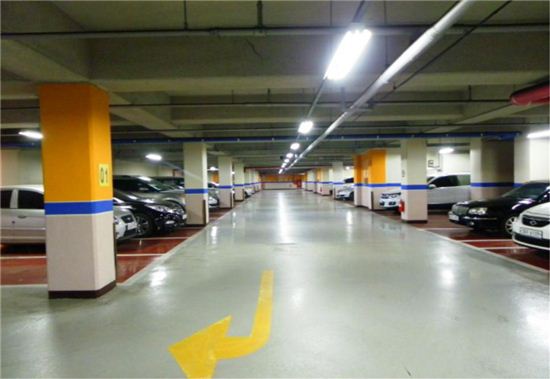 The photo is not related to the article content. Photo by Asia Economy DB
[Asia Economy Reporter Yoo Byung-don] Choi (36), who lives in an officetel in Yangpyeong-dong, Yeongdeungpo-gu, Seoul, has recently been involved in a dispute with neighbors after purchasing a car. This officetel houses 10 households, with parking spaces available for 10 cars, roughly one space per household. When Choi tried to park, he unexpectedly encountered a problem. One household was operating two vehicles, increasing the total number of cars from 10 to 11. Since Choi started parking, that household has continuously requested him to move his car, claiming, "This was originally our parking spot." Choi countered, saying, "Each household has the right to one parking space." Unable to reach an agreement, the 10 households are now engaged in a parking war over a single spot.
Recently, an online community stirred controversy over a resident who parked an electric scooter in an apartment underground parking lot with a warning sign stating, "Legal action will be taken if moved without permission." The resident explained, "I work night shifts, and when I come home, there is nowhere to park, causing me severe stress," adding, "Many vehicles are illegally occupying spots, and the management office's negligence in managing parking spaces made me angry." In April, a case gained attention where the management office placed eight 'warning stickers' on a vehicle that double-parked in an apartment's above-ground parking lot without leaving contact information, causing inconvenience to other vehicles.
Conflicts arising in parking lots of apartments and other multi-family housing continue unabated. Most cases stem from a shortage of parking spaces.
According to the Ministry of Land, Infrastructure and Transport on the 16th, as of 2020, the number of apartment households in Seoul was 1,668,791, while the number of parking spaces was 1,486,591.3, averaging only 0.89 spaces per household. In Incheon, there were 578,896 households but only 536,075 parking spaces, averaging 0.93 spaces per household. Nationwide, there are about 10.01 million households and nearly 25 million registered vehicles, estimating about 2.5 vehicles per household. This clearly shows a severe shortage of apartment parking spaces.
For newly built large-scale apartments in Seoul over the past two years, most provide only 1.1 to 1.2 parking spaces per household. Considering many households own two to three or more vehicles, the perceived availability of parking spaces is even lower.
Given this situation, conflicts over parking issues among residents continue in many apartments. In an apartment residents' association in Gangseo-gu, Seoul, there was a proposal to impose increased parking fees for households registering three or more vehicles, but it was scrapped due to opposition from some residents. Recently, an apartment in Seo-gu, Incheon, decided to allow free parking for one vehicle per household, charge 20,000 KRW for a second vehicle, and 200,000 KRW for a third. However, opposition from some residents has cast doubt on whether this will be implemented.
Under current law, the parking installation standard requires an average of at least one parking space per household (0.7 spaces if the exclusive area per household is 60㎡ or less), unchanged since the 1996 revision. There is no way to compel construction companies to increase the number of parking spaces. Local governments can only encourage maximizing parking spaces during the multi-family housing approval process.
In March, the Anti-Corruption and Civil Rights Commission announced plans to prepare amendments to related laws by February 2023 to increase the statutory parking spaces in multi-family housing to at least one per household. This follows about 76,000 complaints related to private parking conflicts in apartments and similar housing submitted to the National Petition Board over the past four years. The amendments aim to strengthen the standard to at least one legal parking space per household and enable crackdowns on illegal parking within multi-family housing parking lots.
© The Asia Business Daily(www.asiae.co.kr). All rights reserved.
![Clutching a Stolen Dior Bag, Saying "I Hate Being Poor but Real"... The Grotesque Con of a "Human Knockoff" [Slate]](https://cwcontent.asiae.co.kr/asiaresize/183/2026021902243444107_1771435474.jpg)















