ESG Best Practices Series Part 4
Breaking Down Leadership, Education, and Departmental Barriers
Understanding and Empathy Needed from Employees
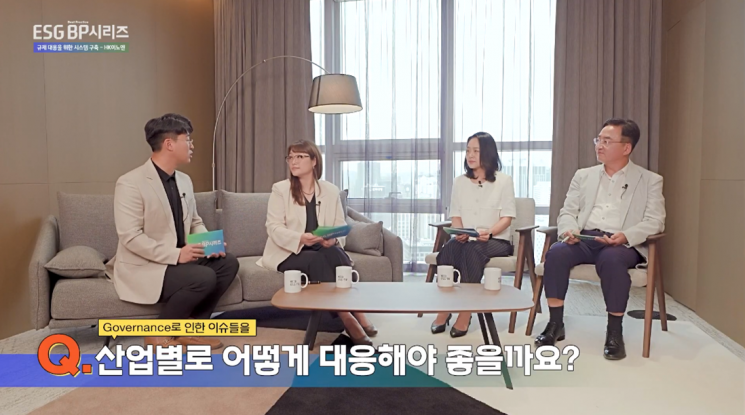
[Asia Economy Reporter Choi Seoyoon] The Korea Chamber of Commerce and Industry (KCCI) unveiled new content for the ESG B.P (Best Practice) series ‘G’ (Governance), featuring excellent ESG management cases from small and medium-sized enterprises (SMEs) and mid-sized companies, on the 16th.
The ESG B.P series, introduced through KCCI’s ESG platform ‘Eussuk,’ was launched at the end of last year to share real ESG management cases of domestic SMEs and mid-sized companies, aiming to enhance understanding of ESG and provide practical assistance to companies beginning ESG management. This ‘G’ edition is the fourth theme following the comprehensive, environment, and social editions.
Kim Kiho, Executive Director of the global pharmaceutical and bio company HK Innoen, and Lee Youngju, Team Leader of the specialty chemical company Isu Chemical, appeared as guests to discuss the ‘G’ area of companies with Lee Junhee, Head of the ESG Group at the law firm Jipyung.
The ESG officers from the companies featured in this series presented three key elements for internalizing governance. They pointed out that a strong leadership from the CEO is essential to establish an internal ESG committee and a CP (Compliance Program) committee to build an ESG promotion system. They emphasized the need for systematic and diverse ESG training for internal employees to foster creative ideas through sufficient training. They also added that eliminating invisible barriers (Silos) between departments and setting KPIs for common goals together is necessary to ensure collaboration among all related departments from the start to the end of new projects.
Executive Director Kim Kiho said, “The pharmaceutical and bio industry deals with life, so it is heavily regulated not only domestically but also internationally. Due to these industry characteristics, compliance management is very important, so we have held the in-house CP committee over 80 times to overcome perception gaps among members.” In fact, HK Innoen has been continuously striving to internalize ESG since 2015 through a committee at the management level (C-Level).
Team Leader Lee Youngju emphasized, “Above all, it took a long time to explain what ESG management is and to build consensus on it. To practice ESG management, not only the CEO’s leadership but also the understanding and empathy of employees are necessary driving forces.”
Since the implementation of the carbon emissions trading system, Isu Chemical has been leading ESG practices with an innovative idea to reduce carbon emissions by 15% compared to before through a strategy of purchasing by-product hydrogen from other companies instead of producing hydrogen directly, while exploring ways to reduce carbon emissions between its headquarters and factories.
Group Head Lee Junhee said, “Sensing and monitoring are important to establish a mid- to long-term roadmap for governance. Especially, achieving good results through organic cooperation between departments company-wide and properly disclosing to external stakeholders can be seen as broad governance, which is the core of internalizing ESG management.”
Woo Taehee, Vice Chairman of KCCI, stated, “Unlike E (Environment) and S (Social), the relatively ambiguous G area was addressed in this edition. We expect that SMEs will be able to more easily understand and practice ESG in the future by referring to excellent cases on how to start and develop governance in ESG management.”
© The Asia Business Daily(www.asiae.co.kr). All rights reserved.
!["The Woman Who Threw Herself into the Water Clutching a Stolen Dior Bag"...A Grotesque Success Story That Shakes the Korean Psyche [Slate]](https://cwcontent.asiae.co.kr/asiaresize/183/2026021902243444107_1771435474.jpg)
















