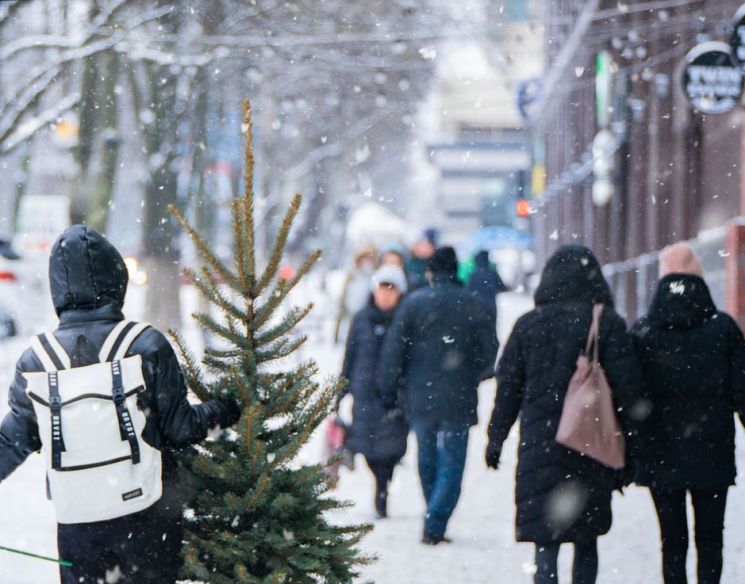
[Asia Economy Reporter Hwang Sumi] The energy crisis across European countries, triggered by Russia's weaponization of gas, appears to be intensifying. Despite record-breaking heatwaves, countries that previously limited air conditioner temperatures are now issuing guidelines for winter heating.
According to a recent report by The Wall Street Journal (WSJ), the Spanish government has passed a law prohibiting public institutions, shopping malls, cinemas, and airports from lowering air conditioner temperatures below 27 degrees Celsius. Some regions in France are imposing fines on stores that operate air conditioners with doors open.
Additionally, the Netherlands is running a campaign encouraging people to finish showers within five minutes. Berlin, Germany, has decided to turn off lighting at public landmarks, including over 1,400 sites such as the Victory Column, Berlin Cathedral, and Charlottenburg Palace.
Indoor heating temperatures for the upcoming winter will also be restricted. According to the German daily S?ddeutsche Zeitung (SZ), Robert Habeck, Germany’s Vice Chancellor and Minister for Economic Affairs and Climate Action, stated, "Under the Energy Security Act, an order will be issued to limit heating temperatures in public buildings to a maximum of 19 degrees Celsius."
The situation is similar in Spain and Italy. According to WSJ, Spain has limited heating temperatures in public transportation, stores, offices, and theaters to 18 degrees Celsius by government decree. By the end of September, all buildings with heating facilities are required to install automatic door-closing devices. Italy has set the heating temperature in public buildings at 21 degrees Celsius.
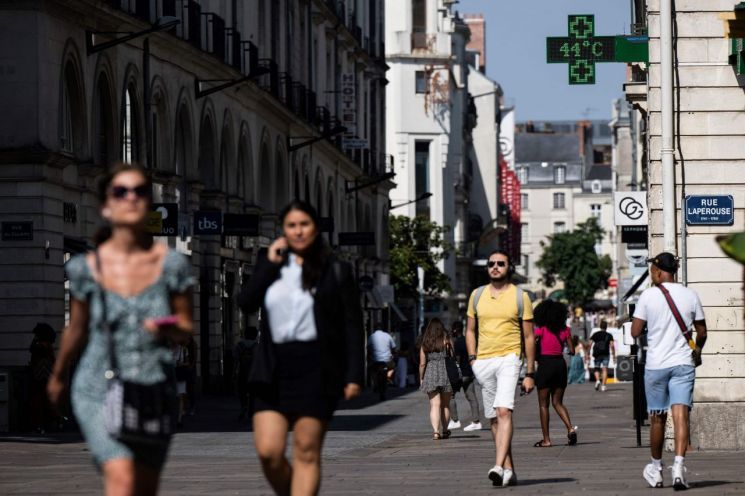 On the 18th of last month (local time), pedestrians are passing by a pharmacy sign in Nantes, western France, displaying a temperature of 44 degrees. [Image source=Yonhap News]
These European energy-saving policies are analyzed as a response to Russia drastically reducing gas and oil supplies following its invasion of Ukraine. Last month, Russia’s state-owned gas company Gazprom announced it would reduce gas supplies to Europe via Nord Stream 1 to 20% of usual levels. Russia’s weaponization of gas has brought Europe its worst energy crisis. In response, the European Union (EU) has implemented emergency measures, including mandating member states to reduce natural gas usage by 15% until next spring.
Meanwhile, analyses suggest that Europe is facing an "energy price shock" due to Russia’s reduction in natural gas supply. According to The Economist, the International Monetary Fund (IMF) estimates that energy price increases will cause average households in Nordic countries like Finland to bear about 4% more of their existing household expenditures.
In Estonia, one of the Baltic states, the top 20% of households are expected to spend about 15% more, while the bottom 20% could see increases up to 25%. The rise in household expenditures due to gas price increases is generally more pronounced among low-income groups.
It is also assessed that relatively poorer Eastern European countries are more vulnerable to surging energy prices. In fact, the UK, which heavily depends on natural gas, is expected to see household expenditures rise by up to 15%, Italy by up to 10%, and Germany and Spain by more than 5%. France is projected to have an increase of less than 5%.
© The Asia Business Daily(www.asiae.co.kr). All rights reserved.
!["The Woman Who Threw Herself into the Water Clutching a Stolen Dior Bag"...A Grotesque Success Story That Shakes the Korean Psyche [Slate]](https://cwcontent.asiae.co.kr/asiaresize/183/2026021902243444107_1771435474.jpg)

















