Sharp Rise in Holiday Goods Prices One Month Before Chuseok
Prices Continue to Climb Amid Heatwave and Heavy Rain
Table Setting Costs Expected to Reach 300,000 Won
Government Pledges to Lower Prices to Last Year's Chuseok Levels
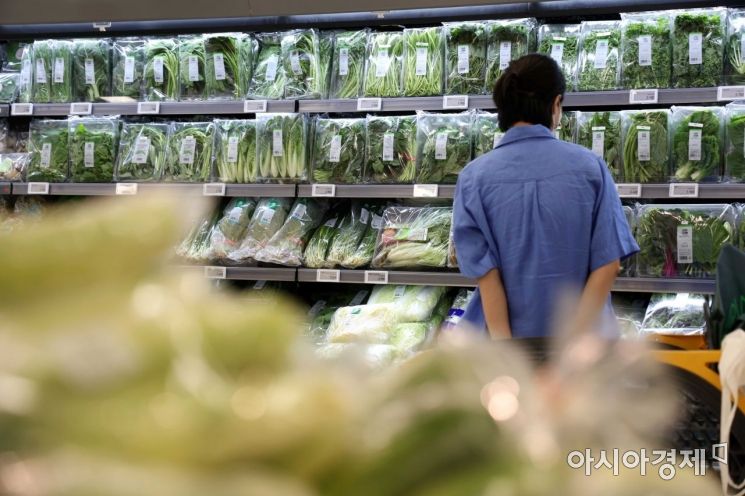 Ahead of Chuseok, there is an emergency regarding the price of food on the table. According to the National Statistical Portal (KOSIS) of Statistics Korea, the food and non-alcoholic beverage price index in July was 113.12 (2020=100), an 8.0% increase compared to a year ago. Food prices rose the most in one year and five months since February last year. In particular, prices of processed foods such as edible oils (34.7%) and fresh foods such as vegetables and seaweed (24.4%) increased significantly. On the 7th, citizens were shopping at a large supermarket in Seoul. Photo by Moon Honam munonam@
[Asia Economy Reporter Song Seung-yoon] No Jin-ah (34), a housewife living in Yeonsu-gu, Incheon, has been deeply worried lately as Chuseok approaches. In her third year of marriage, she is preparing a ceremonial table for the first time, but the soaring prices have made her concerned about expenses. The prices of all the foods to be placed on the ceremonial table have surged, and when considering the cost of gifts as well, her heart feels heavy. No said, "A total of five families are scheduled to gather at our house for Chuseok, and while work is one thing, just thinking about the costs makes me sigh already," adding, "If I include the cost of preparing the ceremonial table, gifts, and pocket money, I think I will have to spend over 1 million won just for Chuseok."
With Chuseok just a month away, the worsening weather conditions such as heatwaves and heavy rains have caused prices of seasonal products like fruits and vegetables to skyrocket, increasing the burden on consumers. The resurgence of COVID-19 and continued inflation have made the idea of a 'bountiful Hangawi' a thing of the past.
According to industry sources on the 14th, the early Chuseok combined with recent heavy rains has caused the cost of preparing the ceremonial table this year to rise significantly compared to last year, expected to exceed 300,000 won. The Korea Agro-Fisheries & Food Trade Corporation (aT) reported that last year's average cost for a ceremonial table for four people was 297,804 won.
In fact, according to the agricultural product distribution information from the Korea Agro-Fisheries & Food Trade Corporation, most of the 13 items designated by the government as Chuseok seasonal products (radish, apple, pear, chicken, chestnut, egg, jujube, beef, pork, garlic, onion, potato) have recently surged compared to the same period last year. For radish, the wholesale price for 20 kg was 21,200 won as of the 5th of this month, up 38.9% from 15,256 won a year ago, and then surged again by over 40% to 29,700 won on the 10th, just five days later. The price of zucchini, which was 22,252 won for 20 pieces, slightly increased to 24,780 won by the 5th, then jumped 58% year-on-year to 35,160 won on the 10th. Cucumbers also fell slightly from 28,100 won to 23,800 won for 10 kg by the 5th, but then rose more than 56% to 37,250 won on the 10th.
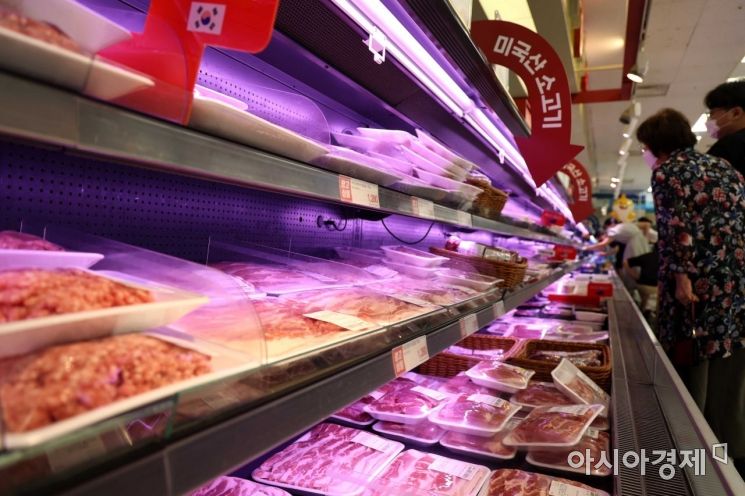 Ahead of Chuseok, there is an emergency regarding the price of food on the table. According to the National Statistical Portal (KOSIS) of Statistics Korea, the food and non-alcoholic beverage price index in July was 113.12 (2020=100), up 8.0% from a year earlier. Food prices rose the most in one year and five months since February last year. In particular, prices of processed foods such as edible oils (34.7%) and fresh foods such as vegetables and seaweed (24.4%) increased significantly. Citizens are shopping at a large supermarket in downtown Seoul on the 7th. Photo by Moon Honam munonam@
Additionally, napa cabbage rose over 106% from 10,254 won to 21,180 won for 10 kg compared to a year ago. Green onions increased more than 81% from 1,725 won to 3,132 won per kg, and onions surged over 76% from 13,053 won to 23,100 won for 15 kg. Carrots also became more than 50% more expensive, rising from 27,780 won to 41,780 won per 20 kg, and water parsley increased over 14% from 44,778 won to 61,275 won for 7.5 kg. The overall poor crop conditions due to drought, heatwaves, and monsoon rains continuing until early July, combined with recent heavy rains mainly in the metropolitan and central regions, have greatly contributed to this situation.
Especially for apples, which have high consumption during the Chuseok peak season, prices are expected to continue rising. The Korea Rural Economic Institute forecasted in its 'Agricultural Outlook August Report - Fruits' that the wholesale price of apples (Hongro variety) during this year's Chuseok peak season (August 27 to September 9) will be between 36,000 and 39,000 won per 5 kg, and pears (Shingo variety) will be between 27,000 and 32,000 won per 7.5 kg. Furthermore, cooking oil and flour, widely used in Chuseok dishes such as pancakes and fried foods, are also continuing to rise. According to the recent 'July Consumer Price Trends' released by Statistics Korea, cooking oil prices surged 55.6% year-on-year among processed foods, and flour rose 36.4%.
Given this situation, the government has decided to lower the average prices of 20 major seasonal products such as napa cabbage, radish, pork, and pollock to last year's Chuseok levels before the holiday. The supply volume of seasonal products will also be increased to a record high of 230,000 tons (1.4 times the usual amount). Discount coupons for agricultural, livestock, and fishery products will be distributed at an unprecedented scale. For agricultural products like napa cabbage, radish, onion, and garlic, government stockpiles will be released, and supply will be increased through emergency imports. For potatoes, 700 tons of state-imported stock and 4,000 tons of government stock will be used to focus shipments of 50 to 100 tons daily for three weeks before Chuseok. A 0% tariff quota will be applied to potatoes and modified starch until the end of the year, and a continuous market monitoring system will be established for cooking oil and flour. For beef and pork, tariff quota volumes will be imported promptly, and slaughter fees (100,000 won per Hanwoo head and 10,000 won per pig) will be supported. For fishery products like pollock and mackerel, all stockpiled quantities will be released.
© The Asia Business Daily(www.asiae.co.kr). All rights reserved.
![Clutching a Stolen Dior Bag, Saying "I Hate Being Poor but Real"... The Grotesque Con of a "Human Knockoff" [Slate]](https://cwcontent.asiae.co.kr/asiaresize/183/2026021902243444107_1771435474.jpg)












