Seoul Industrial Water Supply Started in 1939... Declined Gradually After Peak Industrialization in the 1970s
Last Industrial Water Facility in Seoul Faces Frequent Leaks and Sharp Demand Drop After Over 50 Years of Use
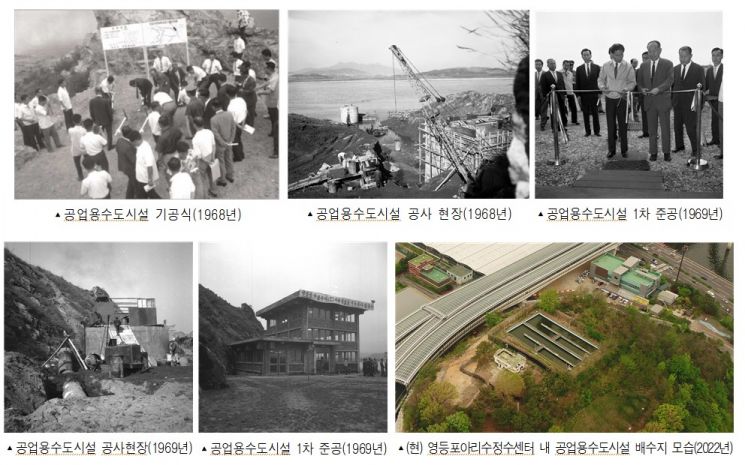
[Asia Economy Reporter Lim Cheol-young] The last industrial water supply facility remaining in Seoul will be completely shut down by 2025. The history of Seoul's industrial water pipelines, which began in 1939 during the Japanese colonial period and led South Korea's modern industrialization after liberation, will disappear into the annals of history after about 90 years.
On the 14th, Seoul City announced that the last industrial water supply facility in Seoul, built in 1969 in the Yeongdeungpo-gu area, has become outdated after more than 50 years of use, prompting a large-scale renovation, and due to a sharp decline in usage caused by changes in the industrial environment, it has been decided to close it by 2025.
‘Industrial water,’ unfamiliar to the general public, refers to water supplied to industrial complexes either as raw water or after a simple purification process, unlike regular tap water which undergoes a complete purification process. Since it is supplied directly from the Han River through intake points without going through a complex purification process, it is characterized by a much lower price compared to tap water.
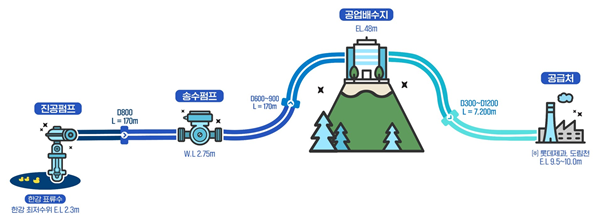
The last industrial water supply facility remaining in Seoul was first completed in 1969 near the Yanghwa-dong reservoir, where the current Yeongdeungpo Arisu Water Purification Center is located, with a daily capacity of 50,000 tons. It supplied industrial water by pumping Han River water to nearby factory-dense areas such as Yangpyeong-dong, Mullae-dong, Dangsan-dong, Yeongdeungpo-dong, Guro-dong, and Dorim-dong.
Along with the 1960s-1970s Five-Year Economic Development Plan, the government established the Korea Export Industrial Complex in Guro-dong, and Seoul City built an industrial water facility with a daily capacity of 50,000 tons within the Yeongdeungpo Water Purification Plant in 1969 to foster the local economy, expanding the facility to a daily capacity of 130,000 tons by 1977.
At its peak during the 1970s industrialization, Seoul’s industrial water supply provided 71,000 tons per day to 48 companies in 1974. However, due to changes in the industrial environment, most factories relocated to provincial areas, and by early this year, the supply had decreased to 15,000 tons per day to only three companies (CJ CheilJedang, Suhwa Enterprise, Lotte Confectionery) and for maintaining Dorimcheon stream. Additionally, due to the aging of the industrial water supply facilities (over 50 years), a large-scale renovation was needed, and safety issues arose as there were eight frequent leaks in the 700-800mm supply pipelines (installed between 1969 and 1982) in the Yeongdeungpo area over the past two years.
Seoul City has continuously sought understanding and persuasion to minimize damage to existing supply companies caused by the suspension of industrial water supply, adjusting the closure schedule and reaching amicable agreements with demand companies. Suhwa Enterprise (Yangpyeong-dong) and CJ CheilJedang (Guro-dong), which received industrial water until early this year, ceased industrial water use in March and May respectively, and the last remaining company, Lotte Confectionery (Yangpyeong-dong), agreed to final closure by 2025.
Seoul City plans to close all industrial water supply pipelines and related facilities by 2025, coinciding with the suspension of supply to the remaining industrial water users and for maintaining Dorimcheon stream. Gu Ami, head of Seoul City Waterworks Headquarters, said, “It is somewhat regrettable to close Seoul’s industrial water supply, which has shared the history of South Korea’s industrial development,” and added, “I would like to express my gratitude to the related company officials who actively cooperated with Seoul City despite the difficult circumstances.”
© The Asia Business Daily(www.asiae.co.kr). All rights reserved.
![Clutching a Stolen Dior Bag, Saying "I Hate Being Poor but Real"... The Grotesque Con of a "Human Knockoff" [Slate]](https://cwcontent.asiae.co.kr/asiaresize/183/2026021902243444107_1771435474.jpg)












