KEPCO Q2 Deficit '6.5 Trillion Won'... 1 Trillion Higher Than Market Forecast
Impact of Soaring Fuel Costs... SMP More Than Doubled in Past Year
Solution Is Electricity Rate Hike... Government Struggles Amid High Inflation
KEPCO "A Crisis of Life and Death... Threatening National Power Ecosystem"
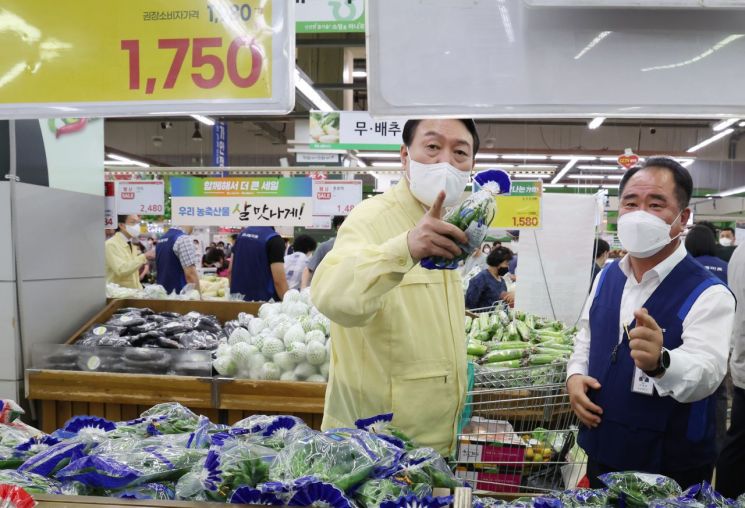 President Yoon Seok-yeol Checking the Price Tag
(Seoul=Yonhap News) Reporter Ahn Jung-won = On the 11th, President Yoon Seok-yeol checked the price tags while inspecting the vegetable price situation at Hanaro Mart Yangjae Branch in Yangjae-dong, Seocho-gu, Seoul. On the right is Shin Young-ho, CEO of Nonghyup Distribution. 2022.8.11
jeong@yna.co.kr
(End)
<Copyright(c) Yonhap News Agency, Unauthorized reproduction and redistribution prohibited>
[Asia Economy Sejong=Reporter Lee Jun-hyung] The government is caught in a dilemma between high inflation and Korea Electric Power Corporation (KEPCO). To reduce KEPCO's deficit, which has fallen into a 'negative margin swamp,' electricity rates must be raised significantly, but this could also increase inflationary pressures. As KEPCO posted a record deficit exceeding 14.3 trillion won in the first half of this year alone, the government's concerns are deepening.
According to related ministries on the 13th, KEPCO recorded a deficit of 6.5164 trillion won in the second quarter of this year. This figure exceeds the securities market consensus (forecast) of 5.3712 trillion won by more than 1 trillion won. Combined with the record-largest deficit of 7.7869 trillion won posted in the first quarter, KEPCO's operating loss for the first half of this year reached 14.3033 trillion won. This operating loss is 2.4 times the entire deficit of last year (about 5.9 trillion won), which was the largest on an annual basis in the past six months.
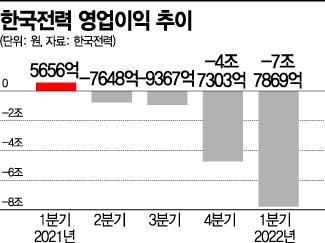
Entrenchment of 'Negative Margin' Structure... Loss of 58.9 Won per kWh
The reason KEPCO's deficit has snowballed is simple. Fuel costs such as international oil prices surged, but electricity rates did not rise in time. The government introduced a fuel cost linkage system last year that allows quarterly adjustments of electricity rates based on fuel cost fluctuations, but it failed to function effectively. The only time the government raised electricity rates in line with the fuel cost linkage system was in the third quarter of this year, increasing by 5 won per kWh. Even this was only about 15% of the 33.6 won increase KEPCO requested.
As a result, the 'negative margin' structure, where KEPCO sells electricity at a loss, has become entrenched. The electricity wholesale price (SMP), which is the price KEPCO pays to power producers, rose to 169.3 won per kWh in the first half of this year, up 117.1% from 78 won in the same period last year. Meanwhile, the electricity sales price, which KEPCO charges households and factories, increased only from 104.9 won to 110.4 won per kWh, a rise of 5.5 won. From KEPCO's perspective, it sold electricity at a loss of 58.9 won per kWh.
In fact, the only solution is to raise electricity rates. KEPCO analyzed that if the fuel cost adjustment unit price had been raised by 3 won and 5 won per kWh in the first and second quarters respectively, electricity sales revenue in the first half of this year would have increased by about 1.1 trillion won. If other supply costs incurred last year, such as facility investments, had also been reflected in this year's electricity rates, electricity sales revenue would have increased by 4.9 trillion won.
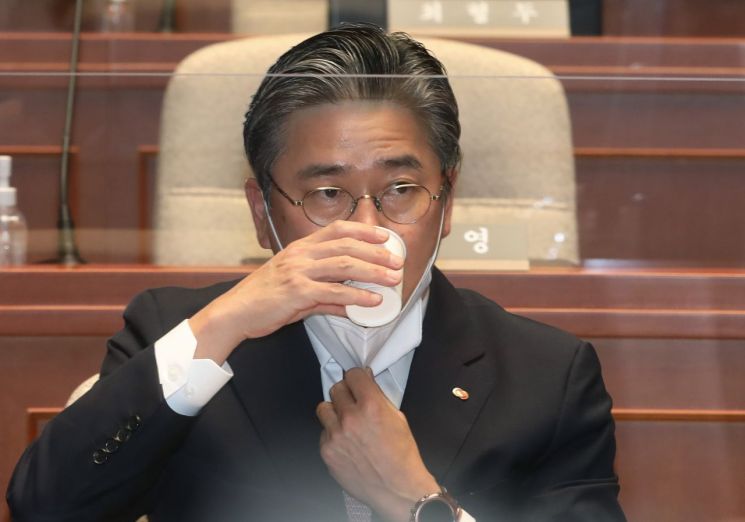 Jeong Seung-il, President of Korea Electric Power Corporation, Drinking Water
(Seoul=Yonhap News) Reporter Baek Seung-ryeol = Jeong Seung-il, President of Korea Electric Power Corporation, is drinking water while attending the People Power Party Policy Members' Meeting held at the National Assembly in Yeouido, Seoul, on the afternoon of June 27. The meeting was organized to discuss nuclear phase-out and electricity rate hikes. 2022.6.27 [Photo by National Assembly Press Photographers]
srbaek@yna.co.kr
(End)
<Copyright(c) Yonhap News Agency, Unauthorized reproduction and redistribution prohibited>
The Government's Repeated Deliberation... Emphasis on Price Stability
However, the government is repeatedly deliberating over the electricity rate hike card. Last month, the consumer price inflation rate reached 6.3%, marking the highest level since the 1998 financial crisis, and the high inflation situation continues. With President Yoon Seok-yeol's approval rating lingering in the 20% range, a significant increase in electricity rates could intensify inflationary pressures and lead to public backlash, which is a burdensome issue.
Accordingly, the Ministry of Trade, Industry and Energy, the main ministry in charge, recently expressed a cautious stance on electricity rate hikes. Minister Lee Chang-yang said at a recent press briefing, "Since people's livelihoods are difficult, the government should minimize the electricity rate increase within the scope of cooperation," and added, "If possible, we should stabilize prices."
KEPCO insists that raising electricity rates in line with fuel cost fluctuations is urgent. KEPCO explains that internal self-help measures such as asset sales alone are insufficient to resolve the deficit. A KEPCO official stated, "KEPCO is in a critical crisis," and added, "(KEPCO's deficit) is not just a matter of individual corporate management deterioration and survival but poses a threat to the national power ecosystem."
There is also analysis that the Yoon Seok-yeol administration's economic policy is being put to the test. This is because the government's economic philosophy of respecting market logic conflicts with the national goal of prioritizing price stability. A government official said, "We are not unaware of the necessity of raising electricity rates," but added, "However, since the price authorities also have concerns, whether electricity rates will be raised in the fourth quarter of this year depends on the inflation situation."
© The Asia Business Daily(www.asiae.co.kr). All rights reserved.



















