[Asia Economy Reporter Yoo In-ho] Concerns are emerging that South Korea-China relations have become uncertain due to the THAAD (Terminal High Altitude Area Defense) issue.
This is because China’s insistence on the ‘3 No’s and 1 Limit’ regarding THAAD is fueling tensions between the two countries.
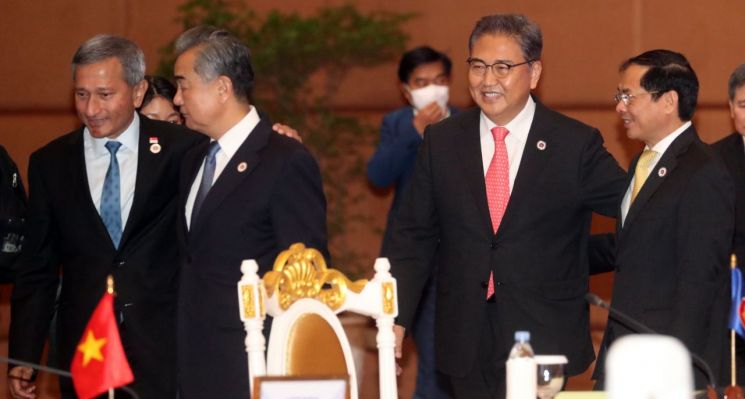
The governments of both countries addressed the THAAD issue as a major agenda item during the South Korea-China Foreign Ministers’ meeting held on the 9th in Qingdao, China.
In this regard, Foreign Minister Park Jin stated at a press briefing on the 10th, the day after the meeting, “Regarding the THAAD issue, we clearly mentioned that the response to North Korea’s nuclear and missile threats is a self-defensive measure and a matter of our security sovereignty.”
Minister Park also said that after the South Korea-China Foreign Ministers’ meeting, the Chinese Ministry of Foreign Affairs issued a separate document on the THAAD discussions, emphasizing security concerns and requesting appropriate handling of the issue.
A senior official from the Ministry of Foreign Affairs, speaking to reporters on site, explained that Minister Park told Wang Yi, “The so-called 3 No’s are not binding on us,” and “We also reminded them once again that those who negotiated THAAD during the previous administration said the same.”
However, the Chinese government took a hardline stance on THAAD after the meeting. At a regular briefing on the 10th, the day after the meeting, the Chinese Ministry of Foreign Affairs mentioned not only the THAAD 3 No’s (no additional THAAD deployment, no participation in the U.S. missile defense system, and no trilateral military alliance among South Korea, the U.S., and Japan) but also the ‘1 Limit,’ which refers to restricting the operation of THAAD deployed in South Korea, thereby increasing pressure on South Korea.
Wang Wenbin, spokesperson for the Chinese Ministry of Foreign Affairs, said at the regular briefing that regarding THAAD, “The deployment of THAAD by the U.S. in South Korea clearly harms China’s strategic security interests, and China has repeatedly expressed concerns to the South Korean side.”
Wang added, “The South Korean government has formally pledged the ‘3 No’s and 1 Limit’ policy externally, and China values this position of the South Korean government. Based on mutual understanding, China and South Korea have handled the THAAD issue smoothly and step by step.”
The THAAD 3 No’s mean no additional THAAD deployment, no participation in the U.S. missile defense (MD) system, and no trilateral military alliance among South Korea, the U.S., and Japan.
South Korea’s government stance was also firm. South Korea argued that the THAAD 3 No’s announced during the Moon Jae-in administration were not an official agreement or promise between governments, and since it is a matter related to our security sovereignty, it is difficult to fully accept China’s demand that “it must be observed under any circumstances.”
In response, the Chinese government stated on the 12th, “The THAAD missile defense system deployed by the U.S. in South Korea harms China’s strategic security, and China cannot overlook this.”
This is interpreted as China viewing the THAAD issue from the perspective of U.S.-China strategic competition.
An expert in diplomatic circles said, “As U.S.-China confrontation intensifies and South Korea strengthens cooperation with the U.S. in military and economic security fields, China is beginning full-scale containment,” and added, “Our government should pursue a China diplomacy strategy based on mutual respect and prioritizing national interests.”
© The Asia Business Daily(www.asiae.co.kr). All rights reserved.
!["The Woman Who Threw Herself into the Water Clutching a Stolen Dior Bag"...A Grotesque Success Story That Shakes the Korean Psyche [Slate]](https://cwcontent.asiae.co.kr/asiaresize/183/2026021902243444107_1771435474.jpg)
















