Consumer Price Inflation Rate at 6.3%... Highest in 23 Years and 8 Months
Frozen Pizza Market Size Up 30% Since 2020
Under 10,000 Won Mart Chicken Also Popular
Consumers Seeking Convenience Foods and Last-Minute Discounted Products
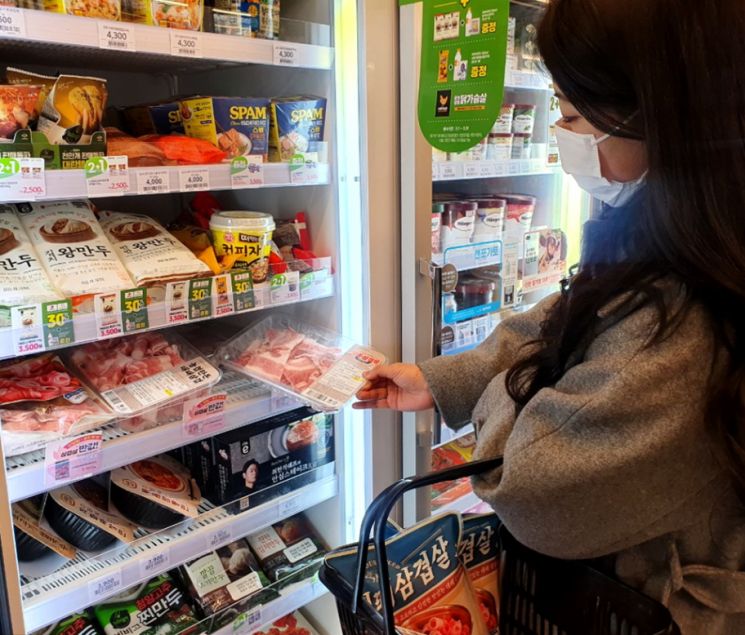 As the cost of dining continues to rise daily, demand for alternative foods such as relatively inexpensive frozen foods, supermarket chicken, and end-of-day discounted items is increasing. The photo is not related to the specific content of the article.
[Asia Economy Reporter Kim Jung-wan] #. Hwang (32), an office worker in Yongsan-gu, Seoul, recently stops by a large supermarket near his home after work to buy frozen foods or ready meals. He felt that ordering delivery food was a luxury due to the widespread rise in prices. Hwang said, "Since even vegetable prices have gone up, it's more convenient and cheaper to buy ready meals than to cook at home."
As food prices soar, more consumers are seeking products that can replace traditional foods. Relatively affordable substitute foods such as frozen pizza, supermarket chicken, and last-minute discounted items are gaining popularity.
According to Statistics Korea's 'July Consumer Price Trends' released on the 13th, the consumer price index last month was 108.74 (2020=100), up 6.3% compared to the same month last year. This rate of increase is the highest in 23 years and 8 months since November 1998 (6.8%). From January to July this year, consumer prices rose 4.9%, and concerns are emerging that the annual inflation rate will exceed 5% due to vegetable price hikes caused by the Chuseok holiday and heavy rains.
Not only the prices of ingredients such as vegetables but also dining-out costs have surged, triggering a red alert on the 'meal table prices' for ordinary citizens. According to the Korea Agro-Fisheries & Food Trade Corporation (aT)'s Agricultural Products Distribution Information System (KAMIS), as of the 11th, the wholesale price of 4kg of spinach rose 23.4% from the previous week to 47,980 won, cucumbers (10kg, 35,000 won) increased by 54.5%, and zucchinis (20 pieces, 37,460 won) rose 48.8%, with all field crops showing a sharp upward trend. The price of dining out in July rose 8.4% compared to a year ago, marking the highest increase since October 1992 (8.8%).
Due to these circumstances, consumers seeking affordable 'substitute foods' such as frozen pizza and supermarket chicken have increased. According to market research firm Kantar, the frozen pizza market has steadily grown from 19.8 billion won in 2016 to 88 billion won in 2017 and 98.1 billion won in 2018. As of March this year, the frozen pizza market size reached 126.7 billion won, a significant increase of over 30% compared to 2020.
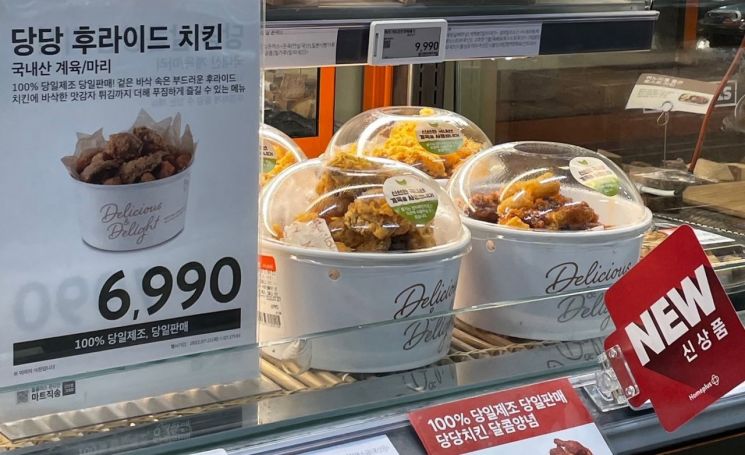 Starting with Homeplus's 'Dangdang Chicken,' affordable supermarket chicken priced under 10,000 won is gaining popularity.
Supermarket chicken, characterized by prices under 10,000 won and cheaper than franchise chicken, is also gaining popularity. Since June, Homeplus has introduced 'Dangdang Chicken,' priced at 6,990 won for one fried chicken and 9,990 won for two, selling over 260,000 pieces as of the 2nd. In response, Emart launched '5-Minute Chicken' priced at 9,980 won last month, and Lotte Mart has been selling 'Whole Chicken' at 8,800 won?a 7,000 won discount from the original price?for a week starting from the 11th.
The number of consumers using last-minute discounted foods has also increased. Last month, sales of Seven Eleven's 'Last Order' (products near expiration discounted by 20-30%) rose 30% compared to the same period last year. During the same period, CU's last-minute discount service usage increased by 19.7%.
Demand for ready meals at large supermarkets is also rising. Emart announced that sales of ready meals priced between 4,000 and 5,000 won, such as sandwiches and gimbap, increased by 25% compared to the same period last year through July. Homeplus also reported that lunch-time sales at its deli corner, which sells instant cooked foods, rose 49% year-on-year from June 18 to July 17.
Meanwhile, on the 11th, President Yoon Suk-yeol chaired the 5th Emergency Economic and Livelihood Meeting at Yangjae Hanaro Mart, stating, "Due to high inflation and heavy rain damage, people's livelihoods are more difficult than ever," and added, "We must control holiday grocery prices so that citizens can feel the relief directly." He also pledged to promptly support flood recovery and pest prevention to prevent instability in agricultural product prices caused by flood damage.
© The Asia Business Daily(www.asiae.co.kr). All rights reserved.


















