"Please point out the specific issues instead of emotional political slogans"
"Why are we told not to investigate gangsters, drugs, voice phishing, and false accusation cases that torment ordinary people?"
"This does not apply to cases already under investigation, such as Lee Jae-myung, forced repatriation to North Korea, and the West Sea killed public official"
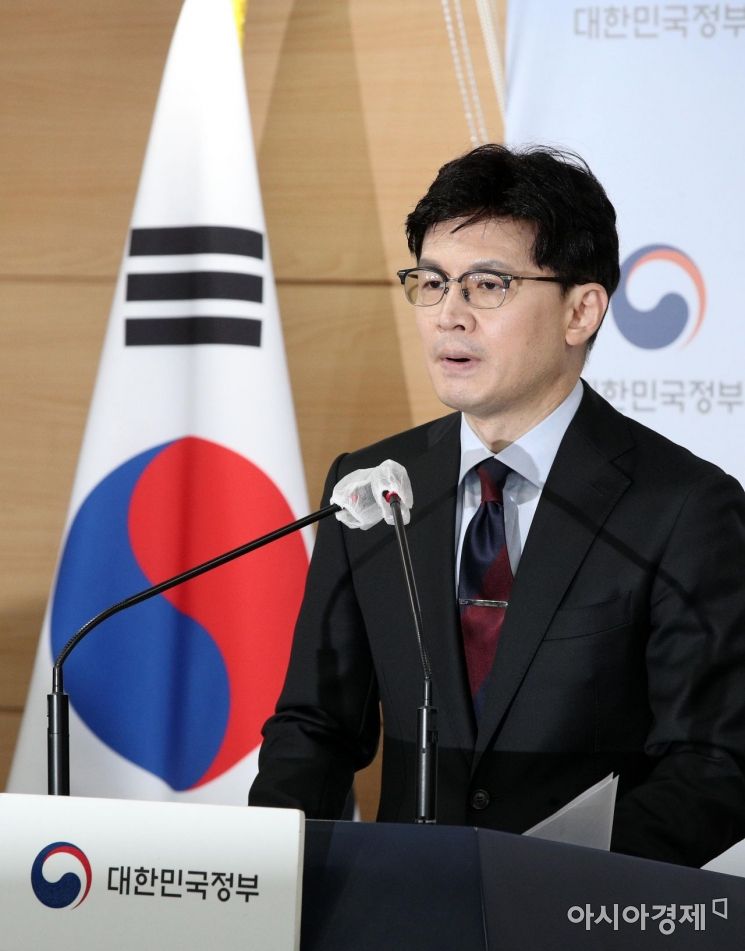 Minister of Justice Han Dong-hoon is announcing the recipients of the Yoon Seok-yeol administration's first special pardon, the '8.15 Liberation Day Special Pardon,' at the Government Seoul Office in Jongno-gu, Seoul, on the 12th. Photo by Kim Hyun-min kimhyun81@
[Asia Economy Reporter Choi Seok-jin, Legal Affairs Specialist] Amid fierce criticism from opposition parties over the Ministry of Justice's plan to revise the presidential decree expanding the scope of prosecutors' direct investigations, Minister of Justice Han Dong-hoon strongly rebutted on the 12th, stating, "This enforcement decree does not deviate in the slightest from the scope of delegation set by the law enacted by the National Assembly."
Minister Han made this statement through additional explanatory materials related to the proposed revision of the investigation commencement regulations (enforcement decree) distributed by the Ministry of Justice on the same day.
The day before, the Ministry of Justice announced that it would give public notice of a partial amendment to the presidential decree titled 'Regulations on the Scope of Crimes for Prosecutors' Investigation Commencement' ahead of the implementation on October 10 of the so-called 'Prosecutorial Authority Complete Abolition Act (amended Prosecution Service Act and Criminal Procedure Act)', which reduces the scope of prosecutors' direct investigations.
The proposed amendment prepared by the Ministry of Justice reclassifies crimes previously categorized as public official crimes, such as 'abuse of authority' and 'forgery of official documents,' as well as election crimes like 'bribery and inducement' and 'donation acts,' as corruption crimes that prosecutors can still initiate investigations into even after the implementation of the Prosecutorial Authority Complete Abolition Act.
Additionally, crimes related to drug distribution and organized crimes for economic purposes, such as violent organizations, corporate-style gangs, and voice phishing, are defined as 'economic crimes,' while false accusation and perjury are defined as 'crimes undermining judicial order,' allowing prosecutors to commence investigations accordingly.
Opposition parties and legal circles outside the government have criticized the Ministry of Justice's push to revise the enforcement decree, claiming it "nullifies the legislative authority of the National Assembly and aims to complete a prosecutorial republic."
In response, Minister Han stated on the same day, "The government intends to implement exactly as prescribed by the law enacted by the National Assembly, and to set the enforcement standards transparently and publicly by revising the enforcement decree without arbitrariness," adding, "This enforcement decree does not deviate in the slightest from the scope of delegation set by the law enacted by the National Assembly."
Minister Han appealed, "It is an established Supreme Court precedent that the wording of the law is the fundamental standard for legal interpretation. Instead of emotional political slogans like 'enforcement decree politics' or 'disregard for the National Assembly,' it would be appreciated if you could specifically point out which part of the enforcement decree deviates from the delegation of that law."
He retorted, "The law enacted by the National Assembly clearly states 'important crimes as defined by the presidential decree,' so how can this be considered disregarding the National Assembly?" and emphasized, "The government has no intention whatsoever to ignore the National Assembly."
Since Article 4, Paragraph 1, Subparagraph 1, Item (a) of the amended Prosecution Service Act, passed by the opposition, explicitly states that the scope of crimes for which prosecutors can initiate investigations includes 'corruption crimes, economic crimes, and other important crimes as defined by the presidential decree,' it implies that the presidential decree can specify the detailed scope of crimes.
Minister Han argued that the Democratic Party's intention to forcibly pass the Prosecutorial Authority Complete Abolition Act near the end of its term to reduce the prosecution's investigative powers was directly contrary to the public's will to protect citizens from crime. However, the wording of the law itself made it impossible to realize such intentions, which made this enforcement decree revision both possible and necessary.
He pointed out, "The public clearly witnessed that the attempt to pass the so-called Prosecutorial Authority Complete Abolition Act by ignoring constitutional procedures with majority power was intended to prevent investigations into important crimes," adding, "However, the amended law itself prevents even those 'intentions and motives' from being realized."
Minister Han asserted, "The government merely created the enforcement decree as prescribed by the law enacted by the National Assembly," and "The government's standard is to thoroughly investigate important crimes to protect the public from criminal harm."
He continued, "Moreover, since those 'intentions and motives' are directly opposed to the public's will to protect citizens from crime, asking the government to ignore the legal text and follow those 'intentions and motives' is neither reasonable nor lawful," emphasizing, "If the government were to neglect crime response, it would be dereliction of duty."
Regarding the constitutional complaint currently under review by the Constitutional Court related to the Prosecutorial Authority Complete Abolition Act, Minister Han said, "The so-called Prosecutorial Authority Complete Abolition Act has significant constitutional issues in its amendment procedures and content, but until the Constitutional Court's ruling, the government's duty is to protect the public from crime and minimize gaps in crime response in preparation for the law's enforcement," adding, "The Ministry of Justice will do its best in the constitutional court as well."
He also rebutted claims that the enforcement decree revision was made with specific investigations, such as those related to Democratic Party lawmaker Lee Jae-myung, in mind.
Minister Han stated, "This enforcement decree revision applies only to cases where investigations commence after September 10, and does not apply to specific political cases where investigations have already begun," adding, "Therefore, claims that this is a ploy targeting investigations into former government officials, forced repatriation of North Korean fishermen, suspicions of defection in the West Sea killing of a public official, or specific political cases are clearly false."
He also said, "If called by the National Assembly regarding the enforcement decree, I will always go and sincerely explain to the public."
Minister Han concluded by asking, "Lastly, I want to ask just one thing: Why should investigations into gangsters harassing ordinary citizens, drug trafficking, voice phishing, abuse of public office, and false accusations not be conducted?"
© The Asia Business Daily(www.asiae.co.kr). All rights reserved.
![A Woman Who Jumps Holding a Stolen Dior Bag... The Mind-Shaking, Bizarre Con of a "Human Knockoff" [Slate]](https://cwcontent.asiae.co.kr/asiaresize/183/2026021902243444107_1771435474.jpg)
















