First Confirmed Case to Reinfection Shortened by About 2 Months
Health Authorities Emphasize '4th Vaccination' but Virtually No Incentives Available
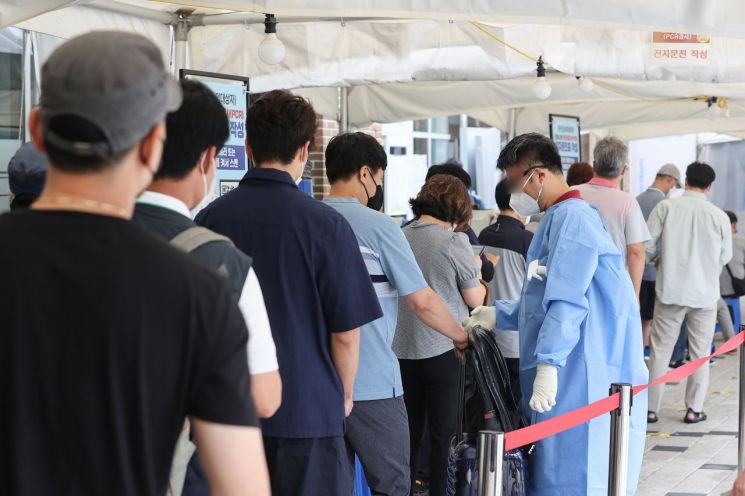 On the morning of the 11th, citizens visiting the COVID-19 screening clinic at Mapo-gu Public Health Center in Seoul are waiting for testing. [Image source=Yonhap News]
[Asia Economy Reporter Yoon Seul-gi] As the spread of COVID-19 continues, reinfection rates have also significantly increased. In particular, the time required for reinfection shortened by about two months as of July. Reinfection cases were notably prominent among those aged 17 and under and the unvaccinated group. Health authorities are emphasizing the importance of the fourth vaccination. However, with research results suggesting that menstrual disorders, previously not recognized as causally related to vaccination, might be side effects, more people are expected to hesitate about additional vaccinations.
According to the recent analysis of reinfection (second infection) estimated cases released by the Korea Disease Control and Prevention Agency’s Central Disease Control Headquarters (CDCH), the number of reinfection cases among people previously confirmed with COVID-19 has increased. The estimated cases for the 3rd to 4th week of July were 56,679, with a cumulative total of 142,513. The proportion of reinfections among weekly confirmed cases rose to around 5-6%, with 2.94% in the 4th week of June, 6.59% in the 3rd week of July, and 5.43% in the 4th week of July.
The average time from the initial COVID-19 infection to reinfection is also trending shorter. For reinfection cases in June, the average duration was 229 days, but for July cases, it shortened to an average of 154 to 165 days, about two months less.
Reinfections accounted for about half among those aged 17 and under and the unvaccinated group. Among the estimated reinfection cases in July, 49.2% were 17 years old or younger. Compared to the proportion of those aged 17 and under among all confirmed cases since COVID-19 first appeared in Korea in January 2020 (23.1%), this is more than double in the past month. Approximately 50% of the estimated reinfection cases in July were unvaccinated. Although the unvaccinated group makes up about 12% of the total population, they accounted for about half of the reinfection cases.
The increase in reinfections is due to a sharp rise in cumulative confirmed cases (initial infections) and the dominance of BA.5, which has strong transmissibility and immune evasion. Additionally, immunity formed through natural infection or vaccination has waned over time, contributing to the rise in reinfections.
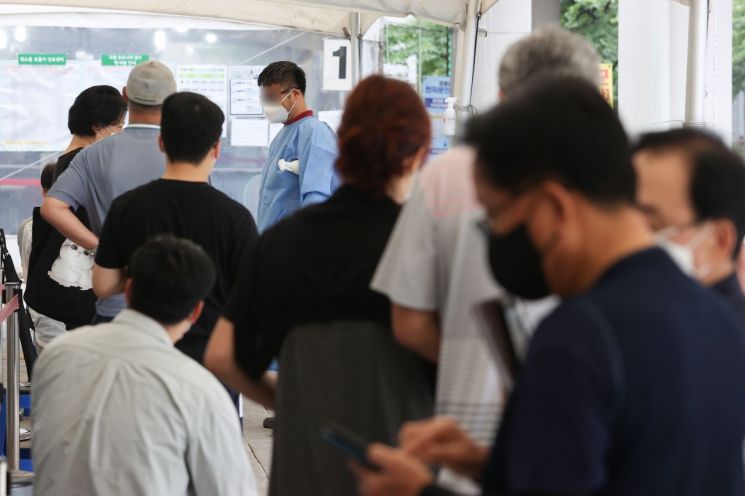 On the morning of the 11th, the COVID-19 screening clinic at Mapo-gu Public Health Center in Seoul is bustling with citizens waiting for tests. [Image source=Yonhap News]
The government is emphasizing the fourth vaccination to block the spread of infection or reduce the fatality rate. However, there are concerns that vaccination rates will not increase significantly due to the lack of effective incentives. Although the government repeatedly urges the fourth vaccination, the vaccination rate has not risen substantially. As of the 12th, the COVID-19 vaccination rates relative to the domestic population are 87.8% for the first dose, 87.0% for the second dose, 65.2% for the third dose, and 12.6% for the fourth dose.
Recently, the COVID-19 Vaccine Safety Committee of the Korean Academy of Medical Sciences stated that if symptoms such as increased menstruation frequency or heavy uterine bleeding occur after receiving the COVID-19 vaccine, the vaccination could be the cause. However, until now, health authorities have neither recognized a causal relationship between menstrual abnormalities and vaccination nor included them in compensation coverage. As more people report vaccine side effects, menstrual disorder adverse reactions have been classified under the "Other - Menstrual Disorders" category for data collection.
Kim Du-kyung, president of the COVID-19 Vaccine Victims Family Association (Kovakhoe), criticized, "From the previous government to the current one, recognizing vaccine causality is harder than a camel passing through the eye of a needle," adding, "Although a national responsibility system for vaccine side effects was announced, nothing has changed. In this situation, emphasizing the fourth vaccination?how can any citizen trust this?"
© The Asia Business Daily(www.asiae.co.kr). All rights reserved.
![Clutching a Stolen Dior Bag, Saying "I Hate Being Poor but Real"... The Grotesque Con of a "Human Knockoff" [Slate]](https://cwcontent.asiae.co.kr/asiaresize/183/2026021902243444107_1771435474.jpg)

















