Effectively Withdraw Enrollment for Age 5 and Propose 'Strengthening National Education Responsibility System' Policy
Teacher Organizations Demand Policy Withdrawal Over Workload Concerns
Disagreement on Care Work Management: Local Governments vs Education Offices Responsibility
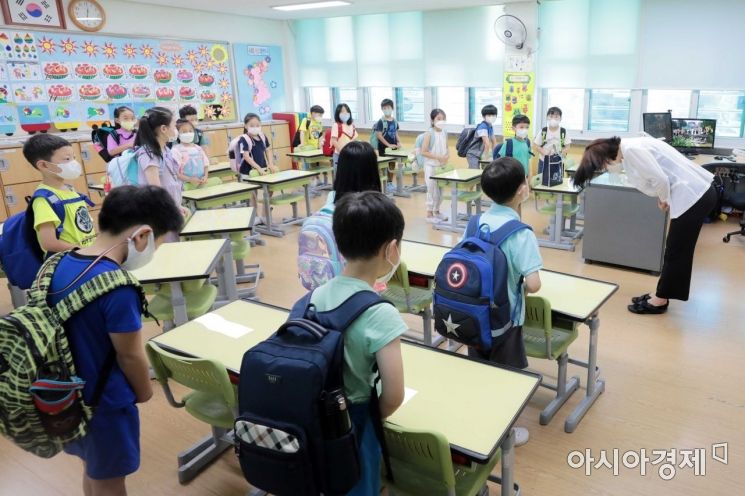 On the 15th, when frontline elementary schools began their summer vacation, students at an elementary school in Seoul greeted their teachers after the closing ceremony./Photo by Jinhyung Kang aymsdream@
[Asia Economy Reporter Han Jinju] The Ministry of Education has withdrawn the 'mandatory enrollment at age 5' policy and introduced plans to expand full-day elementary schools and extend after-school care classrooms until 8 p.m., but teacher organizations are strongly opposing these moves.
On the 9th, during a report to the National Assembly's Education Committee, the Ministry of Education announced that from 2025, full-day elementary schools will be expanded to all elementary schools. The plan also includes gradually extending the operating hours of after-school care classrooms to 7 p.m. starting this year and to 8 p.m. from next year.
Full-day elementary schools refer to expanding after-school programs that students want, with public institutions such as education office support centers or local governments taking full responsibility for operating programs inside and outside the school. Along with extending the operating hours of after-school care classrooms, there are plans to expand after-school linked care classrooms as well.
The Ministry of Education has set a plan in its national agenda implementation plan to pilot full-day elementary schools from next year and support the placement of dedicated personnel at support centers and schools. After-school care classrooms will be expanded step-by-step considering regional conditions and demand, with the policy to operate care classrooms mainly staffed by care specialists.
Teacher organizations oppose the operation of full-day elementary schools and the extension of after-school care classrooms, arguing that these are not educational for children and increase the workload of teachers. They point out that after-school programs' subjects are decided based on profitability and the physical conditions of schools, and that the administrative burden of care work is excessive, causing teachers to avoid these duties.
The Korean Teachers and Education Workers Union stated, "Full-day elementary schools are a non-educational child abuse policy that does not consider children's happiness at all," adding, "Elementary school facilities designed for education are not suitable to guarantee students' care and rest. In areas with high care demand, there are many overcrowded or large schools, so care-combined classrooms should be increased, but this would infringe on the regular curriculum and lead to a decline in the quality of after-school activities and care."
The Korean Federation of Teachers' Associations also said, "Even if education offices or separate public institutions are designated as dedicated agencies, schools and teachers cannot be removed from the operation responsibility and cannot fully focus on student education," and argued, "If administrative personnel are assigned to reduce teachers' administrative workload, conflicts with other public service workers may intensify. Therefore, it should be named an after-school center rather than a full-day elementary school and operated by local governments."
The National Education Public Officials Headquarters, composed of school non-regular workers, also opposed extending after-school care classroom hours, stating, "Having children stay at school until 8 p.m. in a darkened school is not care but mere accommodation," and "Extending after-school care classrooms until 8 p.m. is excessive."
The Ministry of Education recommended that from this year, after-school care classrooms be extended to 7 p.m., allowing schools and metropolitan/provincial education offices to decide based on demand. The Seoul Metropolitan Office of Education plans to extend elementary after-school care classrooms until 8 p.m. from March next year if there is demand.
Dual-income parents and others are in favor of expanding after-school care classrooms. According to the '2022 Government-wide All-day Care Demand Survey' conducted by the Ministry of Education from September to November last year targeting parents, 48.38% of parents wished for all-day care, an increase from 45.21% the previous year. Among parents of lower grades, the percentage wishing for care ranged from 52.25% (3rd grade) to 73.34% (1st grade).
The most requested care time by parents was until 5 p.m. (68.66%). The next were ▲5?6 p.m. (13.88%) ▲7 a.m. until before class (8.22%) ▲6?7 p.m. (7.48%) ▲7?9 p.m. (1.76%). The most preferred care type was elementary after-school care classrooms (56.16%), followed by school care centers (20.99%). Lower-grade parents preferred elementary after-school care classrooms and school care centers, while higher-grade parents preferred regional children's centers and youth after-school academies.
Conflicts are inevitable over the operation entities of full-day elementary schools and care duties. The Ministry of Education plans to operate dedicated agencies such as education offices or separate public institutions to minimize teachers' administrative work. Teacher organizations advocate for transferring responsibility to local governments, while education public officials groups composed of care specialists express concerns that employment instability may increase if entrusted to local governments.
The Korean Federation of Teachers' Associations stated, "It is impossible to expect expansion or quality improvement of after-school programs if schools and teachers, who should focus on regular education, are burdened with additional care and after-school program operations. Even if education (support) offices operate dedicatedly, schools will not be free from burdens," and argued, "Operation should be unified under local governments, establishing a system dedicated to care and after-school programs."
The National Education Public Officials Headquarters commented, "To establish national responsibility for public care and improve care quality, the operational responsibility of education institutions such as education offices must be clearly established first. Operating separate dedicated agencies with unclear substance is also unreliable," adding, "There are concerns that this might provide an excuse for local governments to outsource to the private sector, and detailed implementation plans should be developed through close consultation with relevant parties."
© The Asia Business Daily(www.asiae.co.kr). All rights reserved.
!["The Woman Who Threw Herself into the Water Clutching a Stolen Dior Bag"...A Grotesque Success Story That Shakes the Korean Psyche [Slate]](https://cwcontent.asiae.co.kr/asiaresize/183/2026021902243444107_1771435474.jpg)
















