First Trial Verdict Scheduled for the 25th
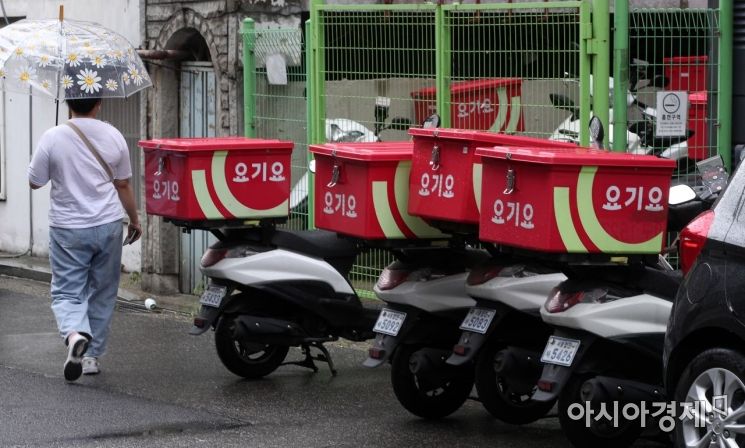 A delivery motorcycle is parked in front of a Yogiyo store in downtown Seoul. Photo by Hyunmin Kim kimhyun81@
[Asia Economy Reporter Kim Daehyun] Is the demand for 'lowest price guarantee' from franchise delivery restaurants an abuse of power by delivery platforms? The delivery app 'Yogiyo' operator, Woowa Brothers (formerly Delivery Hero Korea), and the prosecution engaged in intense legal battles over allegations of violating the Fair Trade Act in court.
Earlier, the Korea Fair Trade Commission (KFTC) issued a corrective order and imposed a fine of approximately 460 million KRW on Woowa Brothers in June 2020. This was because Woowa Brothers, from July 2013 to December 2016, through its own monitoring and consumer reports, identified 144 restaurants that did not comply with the lowest price guarantee system, demanding price reductions on orders, price increases on other delivery apps, or changes in delivery fees. Among them, 43 restaurants that did not comply were found to have had their contracts terminated.
Subsequently, the prosecution applied charges of violating the Fair Trade Act (abuse of superior bargaining position) and brought Woowa Brothers to criminal trial. The current Fair Trade Act prohibits acts that unfairly use a superior bargaining position to harm fair trade with the counterparty.
At 5 p.m. on the 11th, Judge Joo Jin-am of the Seoul Central District Court Criminal Division 15 presided over the final hearing of this case. The first trial began in April last year, about 1 year and 4 months ago.
On this day, Woowa Brothers' defense attorney argued for acquittal, stating that it should be seen as a 'non-discrimination policy' rather than a 'lowest price guarantee system.' The attorney said, "They only requested not to discriminate in terms of price and other conditions compared to other apps," adding, "They did not interfere with which app, Yogiyo or others, would adjust the price." Furthermore, they explained that "It protected consumer trust that delivery food prices would not differ and lowered food prices for consumers."
They also added that the delivery app market has grown rapidly in recent years due to the spread of COVID-19, and at the time the lowest price guarantee system was implemented, restaurants' dependence on Yogiyo was not high enough for Woowa Brothers to be in a position to abuse their bargaining power.
Moreover, they emphasized that without the lowest price guarantee system, it would have been difficult for the Yogiyo service to survive in its early business stage. The defense stated, "Since fees to Yogiyo occur only when consumers place orders, if orders did not happen because prices were higher than other apps, restaurants might have only enjoyed advertising effects on the app without paying fees." They continued, "This increased consumer ordering convenience, expanding the delivery food market size. It increased the number of registered restaurants, thereby increasing consumers, which in turn increased the number of partner restaurants and led to sales growth." They added, "As a result, it promoted competition among delivery apps and revitalized the delivery food market, positively impacting consumers and restaurants."
On the other hand, the prosecutor requested Judge Joo to impose a '50 million KRW fine.' Since Woowa Brothers is the second-largest operator in the rapidly growing delivery app market, maintaining over 25% market share, restaurants highly dependent on transactions would have found it difficult to refuse related demands.
The prosecutor argued, "(The legislative intent of the Fair Trade Act provision) is to prohibit business owners in relatively superior positions from abusing that position to impose disadvantages on the counterparty in transactions." They added, "Price determination is the most important and core decision-making matter in restaurant management. Restaurants have the freedom to decide food prices and service items considering cost differences by sales channel on the day." Furthermore, "At that time, unlike competitors, Yogiyo separately charged fees, which made it necessary for restaurants to set higher prices," the prosecutor pointed out. Judge Joo concluded all proceedings and set the sentencing date for the 25th.
Meanwhile, a Yogiyo representative explained, "(The lowest price guarantee system) was a policy implemented in various e-commerce markets at the time, and since the delivery app market was not yet fully developed, it was more about consumer protection." They added, "After the KFTC investigation began, the policy was immediately discontinued in 2016."
© The Asia Business Daily(www.asiae.co.kr). All rights reserved.

















