Steel Industry's Sheet Metal Price Increase Makes "Car Price Hike Inevitable"
"Car Prices Likely to Keep Rising Until Semiconductor Supply Shortage Eases"
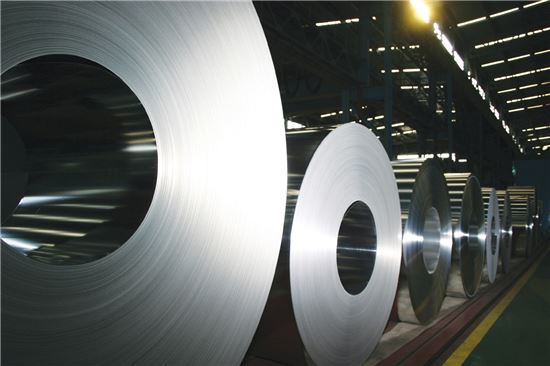 Cold-rolled steel sheets, which are actively subject to import regulations overseas.
 [Asia Economy Reporter Kiho Sung] Car prices, which require more than a year of waiting even after purchasing a new vehicle, are showing signs of rising again. This is due to disruptions in mass vehicle production caused by soaring raw material prices and semiconductor supply shortages, leading to a backlog of demand that supply cannot keep up with. Additionally, with the steel industry planning to raise prices for automotive steel sheets, further price increases are expected to be inevitable.
Experts say that as the automobile market is being reorganized around consumers, a relay of price hikes is continuing, and this trend is expected to persist until the end of this year or early next year, when semiconductor supply issues are anticipated to be resolved.
According to the steel industry on the 15th, major steelmakers such as POSCO and Hyundai Steel plan to raise prices for automotive steel sheets in the second half of the year and will enter negotiations with the automobile industry.
Um Ki-cheon, head of POSCO's Marketing Strategy Office, stated during the Q2 conference call, "We will raise prices for domestic automakers in the second half of the year." Kim Won-bae, head of Hyundai Steel's Hot and Cold Rolled Business Division, also said, "We will conduct negotiations to raise automotive steel sheet prices reflecting raw material price increases in the first half of the year."
The reason the steel industry is raising automotive steel sheet prices is analyzed to be because automotive steel sheet prices have so far increased less than other steel products. Automotive steel sheet prices rose by 50,000 KRW and 120,000 KRW per ton in the first and second halves of last year, respectively. In the first half of this year, they increased by 150,000 KRW. During the same period, shipbuilding steel plate prices increased by 100,000 KRW, 400,000 KRW, and 100,000 KRW, respectively.
The automobile industry expects vehicle prices to be adjusted upward in a chain reaction following the steel sheet price increase. An industry insider explained, "About 1 ton of steel sheet is used per vehicle," adding, "Even if cost reductions are attempted in other areas, price increases are inevitable."
Experts point out that due to current delays in new vehicle deliveries, automakers have no reason not to reflect raw material price increases in vehicle prices. This is because the 'can't sell enough due to lack of supply' situation continues, with popular models taking up to 18 months to be delivered even if ordered now.
Professor Lee Ho-geun of Daeduk College's Department of Automotive Studies said, "Due to the shortage of vehicle semiconductors causing delays in vehicle deliveries, the new car market has been reorganized from being consumer-centered to supplier-centered," adding, "In this environment, automakers have no reason not to actively reflect costs in vehicle prices."
In fact, car prices have been continuously rising recently. Hyundai Motor and Kia, which released five model year changes last month, raised prices mainly for electric and hybrid vehicles. The K5 Hybrid increased by up to 1.67 million KRW, the Tucson Hybrid rose by 2.09 million KRW, and the Ioniq 5 jumped by 4.3 million KRW in just one year.
Price increases are not limited to Korea. According to major foreign media, Ford resumed orders for the new F-150 Lightning last week and raised prices by about 7-18% depending on the model, amounting to approximately $6,000 to $8,500 (7.81 million to 11.06 million KRW).
Tesla appears to be leading the car price hikes, having raised prices six times this year alone, citing raw material price increases as a factor. General Motors (GM) also recently raised the price of its electric Hummer pickup truck by $6,250.
Experts predict that car price increases will continue until the end of this year or early next year when the vehicle semiconductor supply shortage somewhat eases. Lee Hang-gu, a research fellow at the Korea Automotive Technology Institute, said, "In a situation where supply falls short of demand, price competition is unlikely," adding, "Vehicle prices will stabilize only after the semiconductor supply issue is somewhat resolved."
© The Asia Business Daily(www.asiae.co.kr). All rights reserved.
















