Financial Supervisory Service Loses in DLF First and Second Trial
"Decided to Carefully Appeal to the Supreme Court"
To Enhance Internal Controls Across the Financial Sector
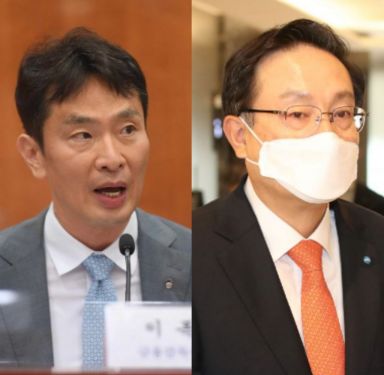 Lee Bok-hyun, Governor of the Financial Supervisory Service (left), and Sohn Tae-seung, Chairman of Woori Financial Group
[Asia Economy Reporter Song Seung-seop] The Financial Supervisory Service (FSS) announced on the 11th that it will appeal to the Supreme Court regarding the disciplinary action cancellation lawsuit against former Woori Financial Group Chairman Sohn Tae-seung.
The FSS issued a "reprimand warning" to Chairman Sohn, who was the bank president at the time, citing incomplete sales during the launch and sale of overseas interest rate-linked derivative-linked funds (DLF) at Woori Bank. Chairman Sohn filed an administrative lawsuit against the FSS in March 2020, requesting the cancellation of the disciplinary action. He won in both the first trial in August last year and the second trial last month.
Regarding the reason for the appeal, the FSS explained, "Beyond responding to individual lawsuits, there is a need to establish a legal and institutional foundation to enhance the level of internal control across the Korean financial industry in the future," adding, "This consideration is due to the increased importance of internal control following a series of recent financial accidents."
It also stated, "To enforce and operate matters related to internal control under the Governance Act more effectively and consistently, it is necessary to resolve legal uncertainties through the Supreme Court's final ruling," and argued, "Without the Supreme Court's final ruling establishing the legal principles regarding the obligation to prepare internal control standards, legal uncertainties will inevitably persist." Currently, Ham Young-joo, Chairman of Hana Financial Group (then Hana Bank President), is also undergoing trial related to DLF. Unlike Chairman Sohn, Ham Young-joo lost in the first trial, resulting in differing legal interpretations and rulings.
The FSS particularly focused on the fact that the disputed 'Article 11, Paragraph 1, Appendix 2 of the Financial Company Governance Supervision Regulations' was recognized as an effective judgment criterion. This regulation sets necessary matters when the Financial Services Commission conducts supervision. The first trial court for Chairman Sohn stated, "Appendix 2 does not add statutory matters but other necessary matters," and viewed it as difficult to use as grounds for punishment. In contrast, the second trial recognized Appendix 2 as a judgment criterion.
The FSS added, "To ensure that legal uncertainties and management instability of financial companies caused by the continuation of the lawsuit are resolved as early as possible, we will actively participate in the trial so that the Supreme Court's ruling can be delivered promptly," and mentioned, "After the ruling, we plan to promote institutional improvements together with the Financial Services Commission and related ministries to clarify matters related to internal control."
© The Asia Business Daily(www.asiae.co.kr). All rights reserved.
![Clutching a Stolen Dior Bag, Saying "I Hate Being Poor but Real"... The Grotesque Con of a "Human Knockoff" [Slate]](https://cwcontent.asiae.co.kr/asiaresize/183/2026021902243444107_1771435474.jpg)
















