Health Authorities Urge Focused Quarantine Response for Infection-Vulnerable Facilities
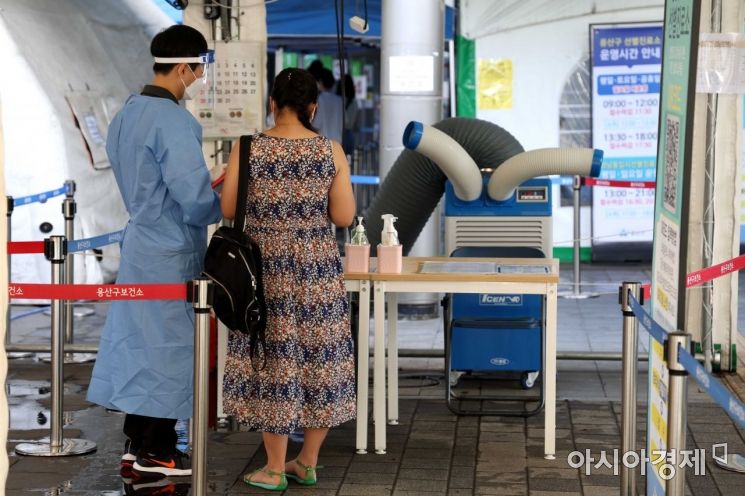 On the 10th, as the spread of COVID-19 continued, citizens were getting tested at the screening clinic of Yongsan-gu Public Health Center in Seoul. The Korea Disease Control and Prevention Agency Central Disease Control Headquarters announced that as of midnight, there were 151,792 new confirmed cases. Photo by Moohnam Moon munonam@
As the number of new COVID-19 cases exceeded 150,000 per day and deaths increased to 50 per day, the government decided to further strengthen management of infection-vulnerable facilities such as nursing hospitals. The peak size of this summer's resurgence, initially expected to be around 150,000 cases, has risen sharply to well over 200,000.
"Reducing Cluster Outbreaks in Vulnerable Facilities Lowers Severe Cases and Fatality Rates"
According to the Central Disease Control Headquarters on the 11th, a total of 116 cluster infection cases involving 2,445 people occurred in infection-vulnerable facilities such as nursing hospitals, psychiatric hospitals, and facilities for the disabled over the past four weeks.
About 30% of COVID-19 deaths have occurred in infection-vulnerable facilities, which is affecting the overall fatality rate, according to health authorities.
Earlier, from January to April, among approximately 1.4 million confirmed cases in Daegu and Gyeongbuk, about 2.5%, or 35,000 cases, were related to infection-vulnerable facilities. Notably, among the roughly 2,000 deaths during this period, about 600 were reported from vulnerable facilities.
The Central Disease Control Headquarters explained that, based on an analysis of exemplary cluster infection responses in nursing hospitals, psychiatric hospitals, and other facilities nationwide from early 2020 to last year, facilities with excellent responses commonly had designated infection control managers and ensured sufficient spacing between beds.
These facilities also minimized additional infections by installing physical partitions in multi-bed rooms when cases occurred and strictly separating movement paths of confirmed and non-confirmed individuals. They reduced room sizes, circulated air through natural and mechanical ventilation, and conducted simulation drills, systematizing infection control measures to block further cluster infections.
Lee Ki-il, the 1st Chief Coordinator of the Central Disaster and Safety Countermeasures Headquarters (Vice Minister of Health and Welfare), said yesterday, "We will continue targeted quarantine focusing on infection-vulnerable facilities such as nursing hospitals where elderly people live, and conduct intensive inspections of vulnerable facilities through dedicated response organizations in each local government."
Jeong Ki-seok, Chairman of the National Infectious Disease Crisis Response Advisory Committee, emphasized, "The fact that one-third of deaths come from infection-vulnerable facilities means that if management of these facilities is made more thorough, the current fatality rate of 0.04% can be significantly lowered. To maintain daily life, including lifting social distancing measures, vulnerable facilities must be prioritized for protection."
'Peak of Confirmed Cases' Prediction Revised Upward
Meanwhile, according to the "COVID-19 Epidemic Forecast Analyzed by Mathematical Modeling" released yesterday by the National Institute for Mathematical Sciences, multiple research teams expect the number of confirmed cases to reach the mid-to-high 200,000 range by the end of this month.
The research team led by Kwon Oh-gyu at the National Institute for Mathematical Sciences forecasted that daily confirmed cases will peak around 230,000 between the 24th and 31st of this month and then gradually decline.
Professor Shim Eun-ha's team at Soongsil University predicted nearly 300,000 domestic confirmed cases by the end of this month. They analyzed that domestic cases will increase to 208,810 on the 17th and 280,779 on the 24th, with total confirmed cases reaching 220,487 and 296,478 respectively during the same period.
Professor Lee Chang-hyung's team at Ulsan National Institute of Science and Technology (UNIST) estimated that, reflecting the recent reproduction number (1.2191), new confirmed cases will be 131,461 on the 17th and 136,859 on the 24th. If the reproduction number drops to 0.8, new cases would decrease to 120,391 on the 17th and 97,852 on the 24th; if it rises to 1.6, cases would increase to 151,726 and 223,425 respectively.
Professor Jung Eun-ok's team at Konkuk University projected that, if current trends continue, daily confirmed cases will reach 226,074 in two weeks and 220,071 in four weeks, with severe cases reaching 672 and 919 respectively. However, assuming the transmission rate increases by 1.1 times, daily confirmed cases would be 285,801 in two weeks and 254,309 in four weeks, with severe cases at 764 and 1,105.
Previously, last month, health authorities predicted the resurgence peak would form between mid and late August at around 280,000 cases. However, as the 'doubling' phenomenon?where new cases doubled weekly?eased from the end of last month, the forecast was lowered to around 200,000. At the beginning of this month, considering the variant spread was slower than initially expected, the estimate was further reduced to 150,000.
© The Asia Business Daily(www.asiae.co.kr). All rights reserved.

![Clutching a Stolen Dior Bag, Saying "I Hate Being Poor but Real"... The Grotesque Con of a "Human Knockoff" [Slate]](https://cwcontent.asiae.co.kr/asiaresize/183/2026021902243444107_1771435474.jpg)















