Equipped with Automatic Discharge System and Waterproof Equipment for Safety
Parts May Be Damaged... "Must Get Inspected"
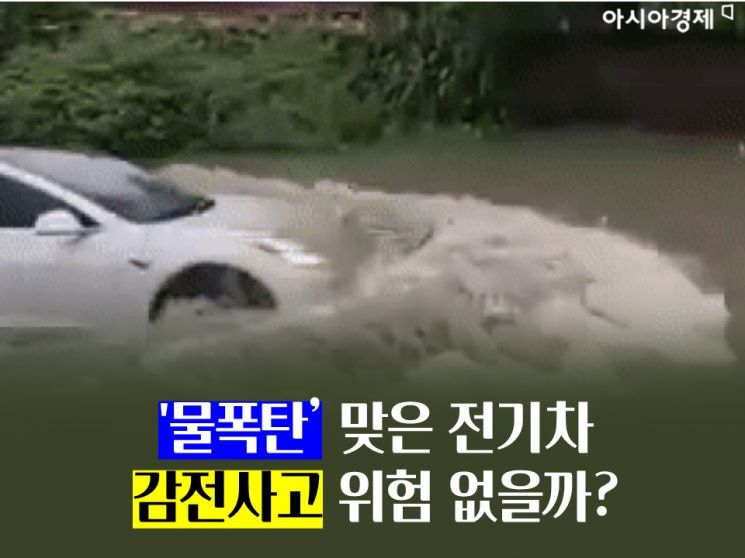 On the 9th, heavy rain in Seoul and the central region caused thousands of vehicles to be flooded, raising concerns about electric vehicle short-circuit accidents. / Photo by Song Hyundo, Asia Economy intern reporter
[Asia Economy Reporter Lim Juhyung, Intern Reporter Song Hyundo] Amid the record-breaking heavy rain that struck the central region on August 9, flooding thousands of vehicles, concerns about electric vehicle safety are also growing. This is due to widespread anxiety that wet wires or batteries inside vehicles could lead to electric leakage accidents. Is it really possible for electric shock accidents to occur because of flooded electric vehicles? Experts explain that thanks to the waterproof functions of electric vehicles, the risk of electric shock itself is low.
According to the Korea Insurers Association's compilation on the 10th of reports related to vehicle flood damage received by 12 non-life insurance companies, 6,853 damaged vehicles had been reported as of that morning. The estimated damage amount is 85.59 billion KRW.
Due to the heavy rain that swept through Seoul and the central region the previous day, nearly 7,000 vehicles suffered flood damage. Notably, among the vehicles that were submerged or had water intrusion during this heavy rain, many electric vehicles were also included.
 On the 8th, a citizen sitting on a submerged vehicle near Gangnam Station. / Photo by Online Community Capture
On social networking services (SNS) and online car-related cafes, concerned reactions poured in such as "I don't know if it's safe to touch a flooded electric vehicle," and "Is it okay to approach a car submerged in water?"
◆ High waterproof performance and electric shock prevention system... Battery doubly protected
Typically, electric vehicle batteries are installed at the lower part of the vehicle. If rainwater starts to rise, the battery area is inevitably submerged first, making concerns about electric shock accidents seem plausible at first glance.
However, experts explain that the possibility of electric shock from a flooded electric vehicle is very low. Electric vehicles are equipped with a protection system that automatically cuts off the current when water enters the vehicle interior. All electric vehicles have a Battery Management System (BMS), which acts as the 'brain' of the battery. When the BMS detects water intrusion into the vehicle body, it activates the protection module to cut off the current flowing outside the vehicle and discharges the current flowing inside, fundamentally eliminating the risk of electric shock.
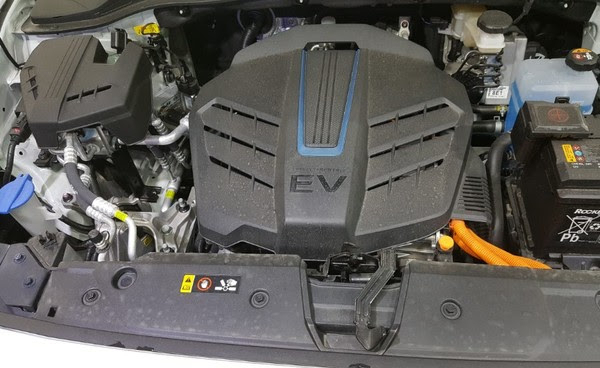 Electric vehicle battery packs have high waterproof performance. / Photo by Automobile 10 Years Driving Citizens' Coalition
That's not all. Electric vehicle batteries possess strong waterproof performance in preparation for flooding accidents. Generally, the waterproof rating of battery packs for electric vehicles corresponds to the International Electrotechnical Commission (IEC) international dust and waterproof rating IP67. This rating means the battery pack can operate normally even when submerged in water at a depth of 1 meter for 30 minutes.
◆ Less component damage than internal combustion engine vehicles
In fact, electric vehicles are safer than internal combustion engine vehicles when it comes to flood damage. If foreign substances like rainwater enter fuel inlets or exhaust outlets of internal combustion engine vehicles, the engine can be damaged because these parts are all connected.
On the other hand, electric vehicles operate by supplying electric power to the motor through the battery, so the possibility of foreign substances entering from outside to inside the vehicle is low. Also, due to the use of high-voltage electricity, waterproof sealing is thoroughly applied not only to the battery pack but also to converters, connectors, and all parts of the vehicle, resulting in high durability against rainwater.
◆ Cannot say flood damage is completely absent... Vehicle inspection essential
However, electric vehicles are not completely free from flood damage. If rainwater enters the vehicle, there is always a possibility of long-term damage to vehicle components. Therefore, electric vehicles that have suffered flood damage, such as being submerged in rainwater, require thorough vehicle inspection before driving. Experts especially recommend coolant replacement and component drying.
Kim Woonsub, Senior Engineer at Kia Motors (Automotive Master), said, "Since there are about 300,000 electric vehicles currently distributed in the domestic market, attention to maintenance is necessary. If rainwater contaminates the coolant, its conductivity increases, which can cause battery overheating." He advised, "It is good to separate various wiring and connectors and apply lubricant." He added, "If the electric vehicle is submerged up to the top of the wheels, it should be considered that the drive system has suffered flood damage. If such damage is observed, first exit the vehicle, do not start the engine, and be sure to bring it to a service center for maintenance."
© The Asia Business Daily(www.asiae.co.kr). All rights reserved.
![Clutching a Stolen Dior Bag, Saying "I Hate Being Poor but Real"... The Grotesque Con of a "Human Knockoff" [Slate]](https://cwcontent.asiae.co.kr/asiaresize/183/2026021902243444107_1771435474.jpg)













