Ministry of Agriculture, Food and Rural Affairs New Government Work Report
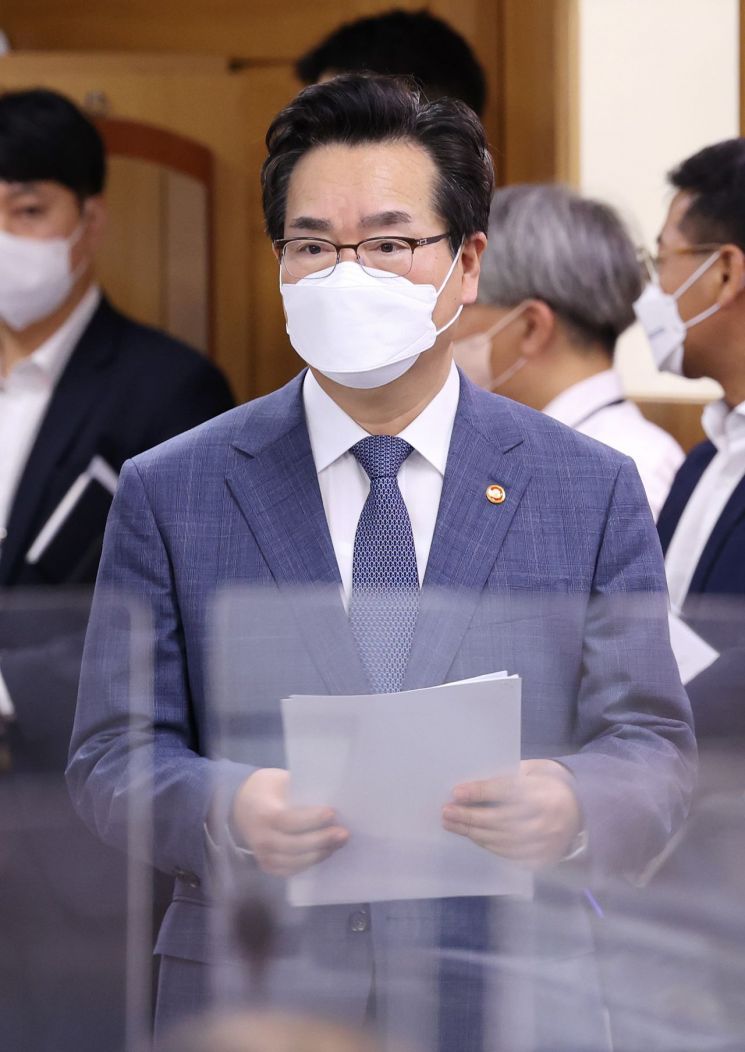 Jeong Hwang-geun, Minister of Agriculture, Food and Rural Affairs, is entering the Government Sejong Complex in Sejong City on the 10th to give a preliminary briefing on the main contents of the presidential work report. 2022.8.10 Photo by Yonhap News
[Asia Economy Sejong=Reporter Son Seon-hee] Jeong Hwang-geun, Minister of Agriculture, Food and Rural Affairs, said on the 10th, "We expect prices in the agriculture and food sector to shift to a downward trend, peaking around Chuseok." Regarding the food self-sufficiency rate, which remains below 50%, he emphasized, "The Yoon Seok-yeol administration will make an upward U-turn for the first time."
Minister Jeong held a pre-briefing on the first government work report of the new administration at the Government Complex Sejong on the same day, stating, "We will prioritize stabilizing agricultural and food prices and securing food sovereignty in the second half of the year."
The five key tasks presented by the Ministry of Agriculture, Food and Rural Affairs during the work report are ▲ price stabilization ▲ food security ▲ future industrialization ▲ attractive rural areas ▲ animal welfare.
This year, prices have risen comprehensively, and especially due to early heatwaves and monsoon rains, agricultural production has been poor, putting price management on high alert. Minister Jeong said, "We will devote all efforts to stabilizing agricultural and food prices in the second half of the year," adding, "Because Chuseok is unusually early this year, we have selected 14 major seasonal items and are on emergency duty not only at the Ministry of Agriculture, Food and Rural Affairs but also at the Korea Rural Economic Institute, local governments, and frontline agricultural cooperatives."
He continued, "We will significantly increase the supply of major seasonal products compared to normal times by utilizing government reserves, slaughter fees support, and contract farming with agricultural cooperatives, and expand support for agricultural and livestock product discount coupons to alleviate perceived prices. To expand the supply of items with potential supply instability such as cabbage and radish, we will strengthen disaster preparedness and growth management during the summer, and if price instability worsens due to supply shortages, we will also consider supplementary imports."
The government also plans to secure cultivation areas by converting some of the wildfire-affected areas in Gangwon Province into highland vegetable cultivation sites to prevent agricultural product supply instability in the mid to long term. Support for agricultural materials such as fertilizers and feed, as well as production cost reduction support such as slaughter fees, will also be reviewed.
Regarding the task of 'securing food sovereignty,' Minister Jeong stated, "The food self-sufficiency rate, which was over 70% in 1990, has fallen to 45.8% (as of 2020)," and declared, "The Yoon Seok-yeol administration will make an upward U-turn." To this end, the government has set a goal to replace 10% of imported wheat flour demand by 2027 by promoting the use of broken rice (rice flour). Additionally, the government plans to expand public stockpiles of wheat and soybeans and pursue the installation of new dedicated wheat storage facilities.
Regarding the future industrialization of agriculture, the government plans to announce a 'young farmer cultivation' plan next month. The plan aims to increase added value by combining digital technology and food tech with agriculture. Ultimately, the government will promote agricultural and food exports beyond the domestic market to overseas markets. Minister Jeong explained, "We plan to expand agricultural and food exports to $15 billion by 2027 and to industrialize upstream and downstream agricultural industries such as smart farms and food tech as export industries."
Alongside this, tasks related to animal welfare have also been established. Punishments and sanctions for animal abuse and abandonment will be strengthened to the level of advanced countries, and to prevent dog bite accidents, which have recently become a social issue, mandatory aggression assessments for dangerous dogs and a system for import notification and breeding permits for dangerous dogs will be introduced from April 2024.
Regarding the issue of dog meat consumption, social consensus procedures are still ongoing. Minister Jeong said, "Because there are differing opinions on the dog meat issue, it is best for the committee, which was originally formed for this purpose, to mediate and derive the best direction and measures," adding, "We will focus on social consensus by continuing discussions a bit more."
© The Asia Business Daily(www.asiae.co.kr). All rights reserved.
![Clutching a Stolen Dior Bag, Saying "I Hate Being Poor but Real"... The Grotesque Con of a "Human Knockoff" [Slate]](https://cwcontent.asiae.co.kr/asiaresize/183/2026021902243444107_1771435474.jpg)















