"Insufficient Snowfall and Record Heatwave"
Popular Alpine Trails Partially Closed
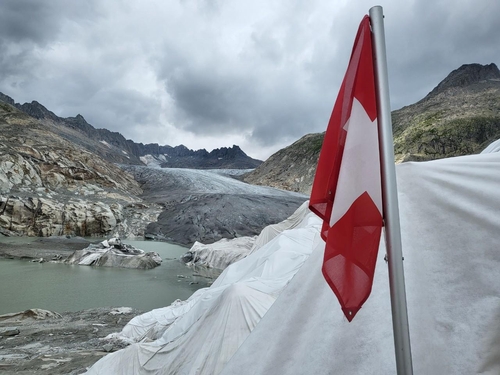 On the 30th of last month (local time), white tarps were covering the Rhone Glacier in the Valais region of the Swiss Alps to reflect sunlight and prevent ice loss. [Image source=Yonhap News]
[Asia Economy Reporter Park Hyun-joo] As the Swiss Alps glaciers rapidly melt due to abnormal high temperatures, human remains and airplane wreckage buried for over half a century have been discovered one after another.
According to the British daily The Guardian on the 9th (local time), local police recovered human remains found on the H?schen Glacier in the Valais canton of southern Switzerland on the 3rd. These remains were discovered by two French climbers passing near a climbing route that had been abandoned about 10 years ago. The Guardian estimated that the owner of these remains died in the 1970s or 1980s.
Recently, human remains and wreckage from crashed airplanes have been found in the Alps glaciers. On the 28th of last month, nearly intact human remains were also found on the Stokki Glacier near Zermatt. Police have begun DNA analysis to identify these remains.
Additionally, earlier this month, wreckage of a light aircraft model 'Piper Cherokee' was discovered by a climbing guide on the Aletsch Glacier near the Jungfrau peak. This light aircraft crashed while flying with three people on board, departing from Zurich on June 30, 1968. Although the victims' remains were found at the time of the accident, this is the first time the wreckage has been discovered.
In this regard, climate experts attribute the rapid melting of glaciers to insufficient snowfall last winter and record-breaking heatwaves this summer.
Meanwhile, as glaciers melt, some popular hiking trails on the Alps' most famous peaks, Matterhorn (4,478 m) and Mont Blanc (4,809 m), have been closed. This is because the increased risk of landslides and avalanches makes it impossible to guarantee the safety of visitors.
Professor Maylin Zachmart, who studies glacier and mountain hazards at ETH Zurich, warned in an interview with The Guardian on the 31st of last month, "The more meltwater created by melting glaciers, the more complicated the situation becomes and the greater the risk." She explained that as meltwater flows more beneath the glaciers, the glaciers themselves move faster, increasing the risk of landslides and avalanches.
© The Asia Business Daily(www.asiae.co.kr). All rights reserved.

















