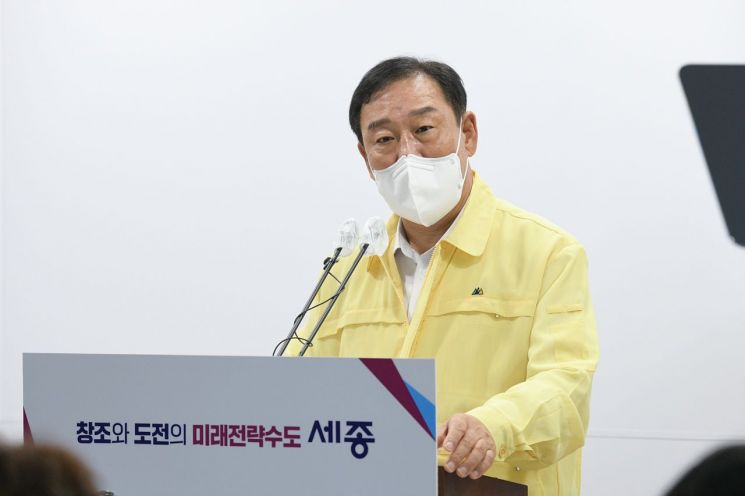
 Sejong Mayor Choi Min-ho is announcing measures to resolve the vacancy issue of local stores during a briefing at Sejong City Hall on the 10th. Photo by Sejong City
[Asia Economy (Sejong) Reporter Jeong Il-woong] Sejong City has decided to take direct action to resolve the issue of vacant commercial spaces. As this has emerged as a pressing local issue, the city is rolling up its sleeves to untangle the complicated situation.
On the 10th, Mayor Choi Min-ho held a briefing at Sejong City Hall and announced measures to minimize vacant commercial spaces within the region.
The measures proposed by Mayor Choi include easing the permitted uses of commercial businesses and supporting changes in use, postponing the annex building expansion project of the city hall, adjusting the supply of commercial land, and restricting commercial spaces within multi-family housing complexes.
First, the city will relax the permitted uses for commercial spaces on the third floor and above in the BRT station area, where vacancies are severe, as well as for the riverside commercial spaces along the Geumgang River.
Since the establishment of the district unit plan in December 2007, the permitted uses for commercial businesses have been restricted. The city plans to review allowing all types of businesses?including restaurants and charging stations?in addition to academies, hospitals, and office facilities on the third floor and above of commercial buildings near the station area.
Additionally, the city will consider lifting restrictions that limited riverside commercial spaces along the Geumgang River to only restaurants, retail stores, and performance halls, allowing general office facilities such as bookstores, study rooms, publishers, and offices to move in.
The city plans to have these changes to permitted uses officially announced by October.
The timing of the city hall annex building expansion project will also be tentatively postponed. The city has been operating external leased offices due to a shortage of office space in the city hall, and based on the resulting organizational dispersion and administrative inefficiency, it has been promoting the annex expansion project.
However, the city’s assessment is that the recent triple hardship of rising prices, interest rates, and exchange rates has increased the difficulties faced by ordinary citizens and heightened the need for fiscal austerity. Above all, there is concern that expanding the city hall annex could worsen the vacancy problem as organizations currently housed in private buildings would move out.
Therefore, the city plans to maintain the current leased private office spaces, achieving budget savings and preventing excessive commercial vacancies by delaying the annex expansion.
Furthermore, the 2.7 billion KRW design budget allocated this year for the annex expansion will be reallocated as a budget to share the burden of citizens’ livelihood difficulties, thereby securing the city’s fiscal soundness.
In addition, the city plans to improve the overly restrictive front setback management regulations to allow small business owners to operate outdoors and will adjust supply by postponing sales or reducing the area of remaining unsold commercial land within the jurisdiction.
Mayor Choi said, "We will strive to ensure that the measures to minimize commercial vacancies are implemented without any setbacks," adding, "We will also do our best to simultaneously revitalize commercial spaces and the local economy through the creation of specialized streets, linking cultural and tourism programs, and expanding convenience facilities."
© The Asia Business Daily(www.asiae.co.kr). All rights reserved.
![Clutching a Stolen Dior Bag, Saying "I Hate Being Poor but Real"... The Grotesque Con of a "Human Knockoff" [Slate]](https://cwcontent.asiae.co.kr/asiaresize/183/2026021902243444107_1771435474.jpg)
















