Dr. Yong-Sam Kim's Team at Korea Research Institute of Bioscience and Biotechnology
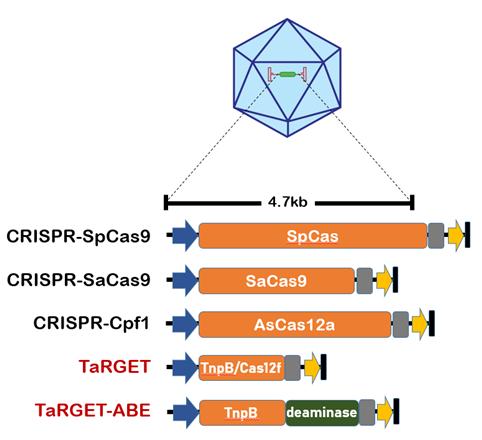 Figure 1. Ultra-small Gene Scissors and Base Editing Technology
The difficulty of adeno-associated virus delivery due to the large size of conventional gene scissors (CRISPR-Cas9) and the ultra-small gene scissors technology (TaRGET)* that overcomes this, as well as the ultra-small base editing technology (TaRGET-ABE) successfully developed using this technology.
* CRISPR-Cas12f GE system developed by the research team last year (Nature Biotechnology, 2021.9)
[Asia Economy Reporter Kim Bong-su] Domestic researchers have developed an ultra-small base editing gene scissors that can be delivered to various organs in the body.
The Korea Research Institute of Bioscience and Biotechnology announced on the 10th that Dr. Kim Yong-sam's gene editing research team succeeded in developing ultra-small gene scissors technology that significantly improves editing efficiency.
Gene scissors technology recognizes specific base sequences in the genome containing genetic information and removes, inserts, or replaces DNA at the targeted site. The CRISPR technology, which won the Nobel Prize in Chemistry in 2020, is the most representative example.
CRISPR-based gene scissors mainly consist of guide RNA that indicates the target site to be cut and an enzyme that actually cuts the DNA. These are loaded into delivery vehicles to transport them to the required location for gene editing. Delivery vehicles include Adeno Associated Virus (AAV) and Lipid Nano Particle (LNP). While AAV delivery vehicles can deliver genetic material to various organs in the body, there have been technical limitations in delivering CRISPR gene editing tools due to the large size of gene scissors developed so far. LNPs can be used as delivery vehicles for large genes but have the significant limitation of being able to reach only a very limited organ, mainly the liver. Despite the rapid growth of gene scissors technology, hailed as a revolution in gene therapy, limitations remain in editing success rates and safety.
To overcome these drawbacks and secure technology that meets efficiency and accuracy, various studies are underway worldwide, one of which is the Base Editor gene scissors. Conventional cut-based gene scissors were difficult to apply to the correction of point mutations, which are known to account for 50% of genetic disease causes. Point mutations involve a change in a single base in the gene sequence that causes genetic diseases, and base editing, which changes the base rather than removing the gene, is more effective for treatment.
The research team developed gene scissors technology that significantly improves gene editing efficiency, enabling base editing while using Adeno Associated Virus as the delivery vehicle. They discovered the applicability of a protein called TnpB as a gene editing tool, utilized it as a DNA-cutting enzyme, and combined it with previously developed guide RNA to create gene scissors small enough to be loaded into AAV. This overcame the previously problematic limited delivery size and enabled gene editing without DNA cutting. By allowing the use of two guide RNAs, multiple targets can be base edited simultaneously, and editing efficiency was greatly enhanced for the same target.
This technology was confirmed to be deliverable via AAV in actual animal models and capable of editing at desired sites, increasing the applicability for treating genetic diseases caused by base mutations that were previously inaccessible with conventional gene scissors. By developing base editing gene scissors technology that can edit without causing DNA breaks, a highly efficient CRISPR gene scissors technology has been secured.
Dr. Kim Yong-sam stated, “We have developed ultra-small gene scissors technologies that are the most suitable for gene therapy development, and especially the ultra-small base editing gene scissors developed this time can correct single base mutations that account for more than 50% of genetic disease causes,” adding, “We hope this will become an important technology contributing to therapeutic development as one of various gene scissors technologies for gene therapy.”
The research results were published online on the 2nd in the world-renowned bio journal 'Nature Chemical Biology (IF 16.174)'.
© The Asia Business Daily(www.asiae.co.kr). All rights reserved.
![From Bar Hostess to Organ Seller to High Society... The Grotesque Con of a "Human Counterfeit" [Slate]](https://cwcontent.asiae.co.kr/asiaresize/183/2026021902243444107_1771435474.jpg)
















