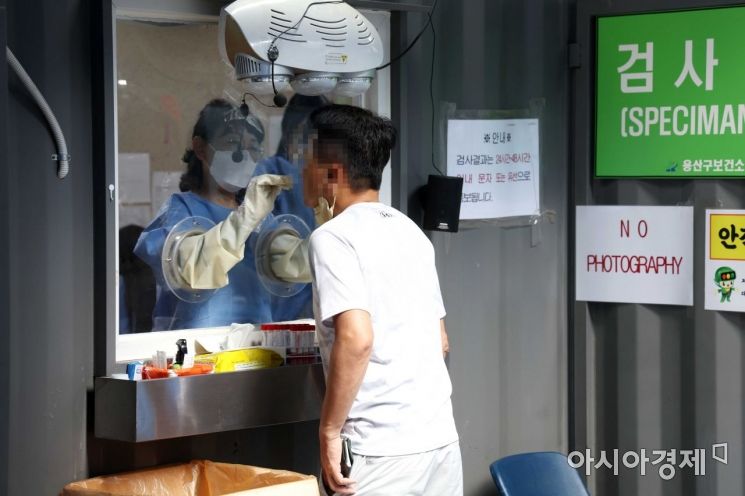
 On the 10th, as the spread of COVID-19 continued, citizens were getting tested at the screening clinic of Yongsan-gu Public Health Center in Seoul. The Korea Disease Control and Prevention Agency Central Disaster and Safety Countermeasures Headquarters announced that as of midnight that day, there were 151,792 new confirmed cases. / Photo by Moon Honam munonam@
[Asia Economy Reporter Kim Young-won] The government will analyze best practices in infection-vulnerable facilities to strengthen inspections and management. Targeted quarantine focusing on high-risk groups will also continue to be promoted.
On the 10th, the Central Disaster and Safety Countermeasures Headquarters announced that it discussed infection spread management measures through analysis of cluster outbreak cases in infection-vulnerable facilities. According to the headquarters, a total of 116 cluster infection cases involving 2,445 people occurred in nursing hospitals and facilities over the past four weeks.
As a result of analyzing the response best practices of hospitals where cluster infections occurred, these hospitals had designated infection managers during normal times, secured sufficient distance between beds, installed physical partitions in multi-bed rooms when confirmed cases occurred, and thoroughly separated movement paths of confirmed and non-confirmed patients to minimize confirmed cases.
In the cases of improvements, it was analyzed that additional cluster infections were prevented by reducing the number of beds in inpatient rooms, circulating air through natural and mechanical ventilation, and conducting mock drills within the hospital.
Such excellent response cases will be distributed to each facility and hospital. The headquarters asked infection-vulnerable facilities to refer to these cases and cooperate in infection spread management. Additionally, the government plans to enhance on-site response capabilities by conducting infection control education and scenario-based mock drills for caregivers and infection managers.
Lee Ki-il, the first chief coordinator of the Central Disaster and Safety Countermeasures Headquarters (Vice Minister of Health and Welfare), said in his opening remarks that "cluster infection cases commonly lack designated infection managers during normal times, fail to secure distance between beds, and have insufficient separation of movement paths between confirmed and non-confirmed patients," adding, "We will strengthen inspections and management of infection-vulnerable facilities such as nursing hospitals and facilities."
Jung Ki-seok, chairman of the National Infectious Disease Crisis Response Advisory Committee, urged the activation of infection disease manager education in this regard. Chairman Jung said, "Although the government has made various efforts to manage infection-vulnerable facilities, what the committee sees as lacking is the proper designation of infectious disease managers in each facility," and added, "Even though they are designated now, the completion rate of their education is only 17.3%."
Furthermore, the government explained the current status of the transition to a general medical system that activates outpatient care centered on local clinics and hospitals. The one-stop treatment institutions, which aimed for 10,000 locations, have currently achieved 97%, and 1,574 beds have been secured, exceeding the target (1,435 beds) by 110%.
However, as confirmed cases aged 60 and over, who have a high risk of severe illness and death, increase, bed occupancy rates are rising. The overall bed occupancy rate on this day was about 48%. Park Hyang, head of the Central Accident Response Headquarters' quarantine team, said, "We are closely monitoring the increasing proportion of elderly people aged 60 and over and high-risk groups," and explained, "If a confirmed case occurs within a facility, rapid medication and isolation between confirmed and non-confirmed patients will be promptly carried out within the facility."
Park added, "Regarding beds, since some regions do not have nursing hospitals or dedicated nursing hospitals, we will first transfer patients to existing base dedicated hospitals, and we are also considering securing additional base dedicated hospitals as needed depending on the situation."
© The Asia Business Daily(www.asiae.co.kr). All rights reserved.

![Clutching a Stolen Dior Bag, Saying "I Hate Being Poor but Real"... The Grotesque Con of a "Human Knockoff" [Slate]](https://cwcontent.asiae.co.kr/asiaresize/183/2026021902243444107_1771435474.jpg)















