KAIST Department of Materials Science and Engineering Professor Jang Jaebeom's Research Team
Utilizes Specific Protein Structures of Multicellular Organisms as Templates
Successfully Overcomes Limitations of Existing Biomaterial Templating Methods
Broadly Applicable and Adaptable to Various Life Forms
Expected Applications in Synthesized Biomaterial Catalysts, Electrochemistry, Biosensors, and More
[Asia Economy Reporter Kim Bong-su] The Korea Advanced Institute of Science and Technology (KAIST) announced on the 10th that Professor Jang Jae-beom's research team from the Department of Materials Science and Engineering has developed a novel concept of biomimetic molding method utilizing specific protein assemblies found in multicellular organisms for the first time.
The biomimetic molding method is a technique that uses the complex and sophisticated structures optimized for specific functions in living organisms over long periods as molds to create inorganic structures that imitate them. This method has been applied in fields such as energy, optics, and microrobotics.
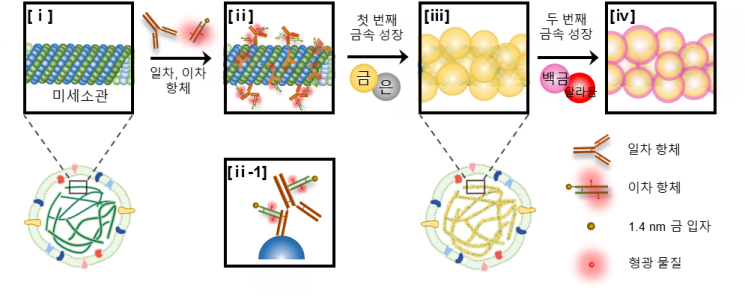
The research team, inspired by the antigen-antibody reaction, targeted specific proteins with antibodies and then grew various metal particles from 1.4-nanometer (nm) gold particles attached to the antibodies, successfully synthesizing metal structures that mimic specific protein assemblies. Since the developed biomimetic molding method is based on the general antigen-antibody reaction and metal particle growth techniques, it is expected to be widely applicable to various living organisms.
Various structures optimized for specific functions in living organisms are based on complex and hierarchical architectures, making them difficult to replicate through artificial synthesis methods. Therefore, biomimetic molding methods have been developed to synthesize inorganic structures with the same shapes using these biological structures as molds, and the synthesized biomaterials have been widely used in catalysts, energy storage and production, sensors, and more.
However, among the developed biomimetic molding methods, cases using specific protein assemblies as molds are rare, and those that do exist have only utilized specific protein assemblies from unicellular organisms such as viruses or yeast.
The biomimetic molding method utilizing specific protein assemblies of living organisms has the advantage of being able to use only the desired biological structures and select proteins suitable for the intended purpose of the synthesized biomaterial.
To overcome the limitations of existing biomimetic molding methods, the research team applied the antigen-antibody reaction, commonly used for imaging specific proteins, to the biomimetic molding method.
The antibodies used by the research team were attached to 1.4-nanometer (nm) gold particles, which serve as seeds for metal particle growth, allowing various metal particles to be grown from antibodies targeting specific proteins.
The team succeeded in growing gold particles only on specific proteins present in microtubules, mitochondria, nuclei, cell membranes, and cytoplasm inside human cells, and demonstrated that the developed method could be applied not only at the cellular level but also at the tissue level in mouse brain, kidney, and heart.
Furthermore, the research team synthesized not only gold particles but also silver, gold-platinum, and gold-palladium particles along the intracellular microtubule structures, proving that the synthesized cells can be used as catalysts for liquid-phase reactions. They also showed that iron particles grown on the cell surface can be controlled by magnets, indicating the possibility of controlling these metal particle-grown cells or implementing collective behaviors in the future.
The novel biomimetic molding method developed by the research team is expected to be applicable not only to multicellular organisms but also to organisms such as plants, fungi, and viruses that can be antibody-stained, enabling the synthesis of biomaterials mimicking various biological structures.
Changwoo Song, a doctoral candidate and the first author, said, "This study is the first case of synthesizing metal structures mimicking specific structures of multicellular organisms that could not be realized by existing biomimetic molding methods, expanding the range of biological structures that can be utilized by biomimetic molding methods." He added, "The synthesized biomaterials are expected to be used not only as catalysts shown in this study but also in electrochemistry and biosensors."
This research was published online on the 7th of last month in the international journal Advanced Materials (Paper title: Multiscale Functional Metal Architectures by Antibody-Guided Metallization of Specific Protein Assemblies in Ex Vivo Multicellular Organisms).
© The Asia Business Daily(www.asiae.co.kr). All rights reserved.
![Clutching a Stolen Dior Bag, Saying "I Hate Being Poor but Real"... The Grotesque Con of a "Human Knockoff" [Slate]](https://cwcontent.asiae.co.kr/asiaresize/183/2026021902243444107_1771435474.jpg)
















