Employment Trends in July
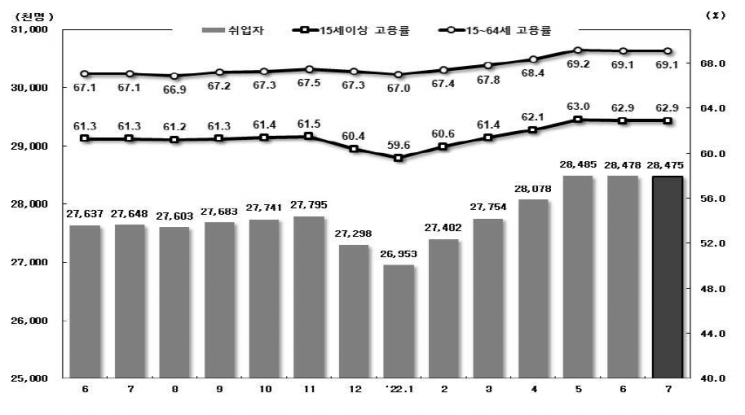
[Asia Economy Sejong=Reporters Kim Hyewon and Son Seonhee] The increase in new employment has slowed for two consecutive months. Although the number of employed people last month increased the most in 22 years for the same month, about 60% of the newly created jobs were for elderly workers aged 60 and over. Negative forecasts are gaining weight that the employment recovery trend will weaken due to additional base rate hikes in the second half of this year and economic contraction caused by the resurgence of COVID-19.
According to the 'July Employment Trends' announced by Statistics Korea on the 10th, the number of employed people last month was 28.475 million, an increase of 826,000 compared to the same period last year. This is the largest increase for the same month since July 2000 (1.03 million). The employment rate for those aged 15 and over was 62.9%, the highest for the same month since monthly statistics began in 1982.
However, more than half of the new jobs were for elderly workers aged 60 and over, highlighting limitations in terms of employment quality. The number of employed people aged 60 and over last month was 479,000, accounting for 58% of total employment. This was followed by those in their 50s (194,000), 20s (95,000), and 30s (62,000), while the number of employed people in their 40s, considered the "backbone" of the labor market, actually decreased by 1,000.
By industry, manufacturing employment increased the most by 176,000. This is the largest increase since November 2015 (182,000), and manufacturing employment, which had been sluggish after COVID-19, has continued to rise for nine consecutive months since November last year. Employment also increased in health and social welfare services (130,000) and information and communication (95,000). Financial and insurance industries decreased by 21,000, marking seven consecutive months of decline. Mi-sook Gong, Director of the Social Statistics Bureau at Statistics Korea, explained, "Employment is increasing centered on manufacturing, and the number of unemployed and economically inactive people is decreasing, showing a sustained increase in employment."
However, looking at the monthly trend, the number of employed people has decreased for two consecutive months following 935,000 in May and 841,000 in June. Although the employment recovery trend has continued for 17 consecutive months, the momentum has weakened. The Ministry of Economy and Finance diagnosed, "In the second half of the year, the base effect acts as a negative factor, while downside risks such as interest rate hikes, the spread of COVID-19, and weakened household and corporate sentiment persist. Next year, the slowdown in the increase will expand due to the normalization of direct jobs, concerns about economic slowdown, and population decline." They added, "We will maximize private sector job creation capacity through regulatory innovation, tax reform, and fostering new industries, moving away from fiscal support jobs."
© The Asia Business Daily(www.asiae.co.kr). All rights reserved.

















