Research on Natural Disasters (Floods, Earthquakes, Typhoons) and Housing Prices
"Frequent Disasters Recognized by Market Participants... Already Reflected in Prices"
Greater Impact in Case of Man-Made Disasters... Pohang Earthquake 3-Year Price Decline Case
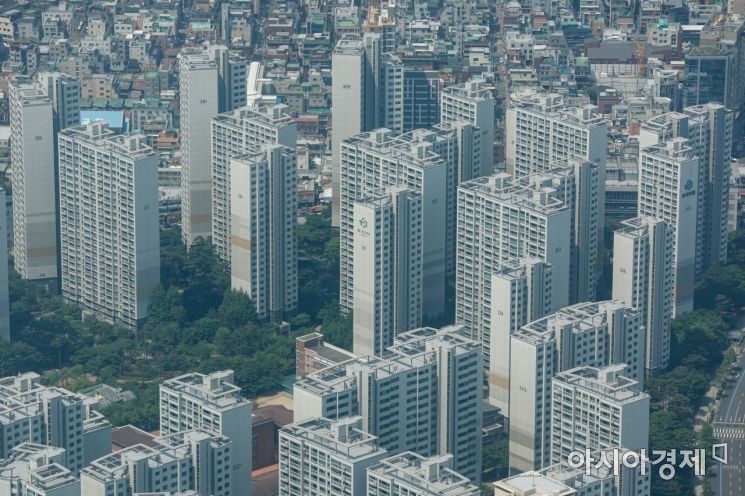
As natural disasters caused by climate change become more frequent, interest in their impact on housing prices is also growing. Overseas, there have been various studies on the correlation between different types of natural disasters such as earthquakes, typhoons, and floods and housing prices.
According to the Central Disaster and Safety Countermeasures Headquarters (CDSCH) as of 6 a.m. on the 10th, about 2,670 houses and commercial buildings were flooded due to heavy rain concentrated in the central region. Among them, 2,419 cases were mostly in Seoul, with damage concentrated in the Gangnam area, a low-lying area where rainwater accumulated. Underground parking lots of high-end apartments in Gangnam and underground parking lots of high-end villas around Bangbae-dong were flooded, and commercial buildings around Gangnam Station also suffered significant damage. According to statistics from the Ministry of the Interior and Safety, Gangnam-gu has experienced flooding seven times over the past 10 years since 2010. This is the highest among all autonomous districts in Seoul, with the Seoul average being 4.04 times.
As the flooding of high-end apartments in the Gangnam area became known, real estate communities commented, "Flooding has controlled Gangnam housing prices that various regulations over the past five years could not." However, experts believe that such flooding and housing prices are not closely related.
Lee Chi-joo, a research fellow at the Construction Economy and Industry Research Institute, said, "Based on overseas research cases, it can be argued that 'unpredictable natural disasters affect housing prices,' but this is difficult to establish for disasters that occur annually or frequently." He explained, "Market participants are already aware of the risk that 'natural disasters can occur,' so in areas like Gangnam where flooding is frequent, such factors are already reflected in housing prices." He added that housing prices are determined by a combination of factors including supply and demand, interest rates, transportation, and school districts, in addition to natural disasters.
In fact, looking at past cases such as 2010 and 2011 when flooding in the Gangnam area was severe, there were no notable changes in housing price fluctuation rates. According to KB statistics, the apartment sale price in Gangnam-gu in 2010 decreased by -1.61% compared to the end of the previous year, but this was a smaller decline compared to Seoul's overall -2.19%. In 2011, Gangnam-gu recorded -0.37%, while Seoul recorded -0.44%.
 On the 9th, vehicles that were submerged due to heavy rain in front of Jinheung Apartment in Seocho-gu, Seoul, are emerging as the water recedes. Photo by Jang Jin-hyung aymsdream@
However, in the case of disasters caused by human factors rather than repetitive and natural disasters, the impact on housing prices can be significant. A report titled "The Impact of Earthquake Disasters on Regional Housing Markets" published by the Korea Research Institute for Human Settlements in July analyzes the impact of the 2017 earthquake disaster in Buk-gu, Pohang-si, Gyeongsangbuk-do on housing prices in Buk-gu and Nam-gu.
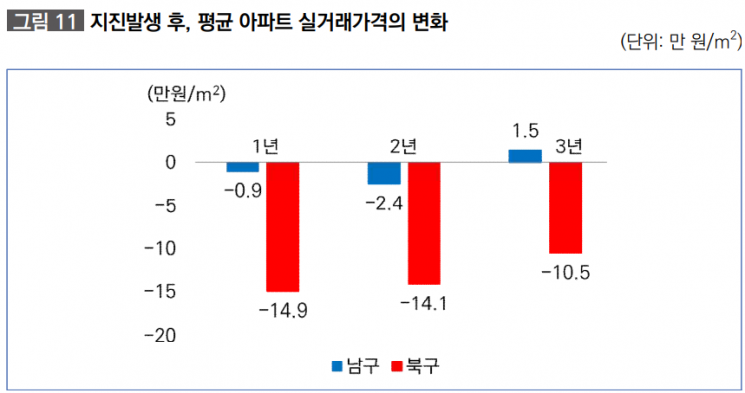
The report shows that before the earthquake, the average actual transaction price of houses in Buk-gu, Pohang-si was higher than in Nam-gu. After the earthquake, the decline in actual transaction prices in Buk-gu was greater than in Nam-gu. Especially after the government announced that "the Pohang earthquake was a triggered earthquake caused by a human-made disaster," the downward trend in apartment transaction prices in Buk-gu increased significantly compared to Nam-gu.
Assuming the regional housing market recovered when the apartment transaction prices in Buk-gu became higher than those in Nam-gu again, the damage lasted for about three years after the earthquake occurred in November 2017. Lee explained, "This is because the risk of recurrence of disasters caused by human factors is perceived as greater and more serious than unpredictable and naturally occurring earthquakes."
Research on the relationship between natural disasters and housing prices has mainly been conducted overseas, and the results generally summarize that "the impact of natural disasters on housing prices exists but is mostly short-term, lasting about one year."
▲A study showing that the stronger the intensity of an earthquake, the greater the decline in housing prices (Cheung et al., 2018), ▲A study indicating that housing prices decrease when tornadoes and hurricanes occur but the period is short, about one month (Ewing et al., 2007), ▲A study analyzing housing price changes in flood-affected areas found that the lower the housing price, the greater the decline, and that the impact on housing prices lasted only during the one year after the flood (Zhang, 2016).
© The Asia Business Daily(www.asiae.co.kr). All rights reserved.



















