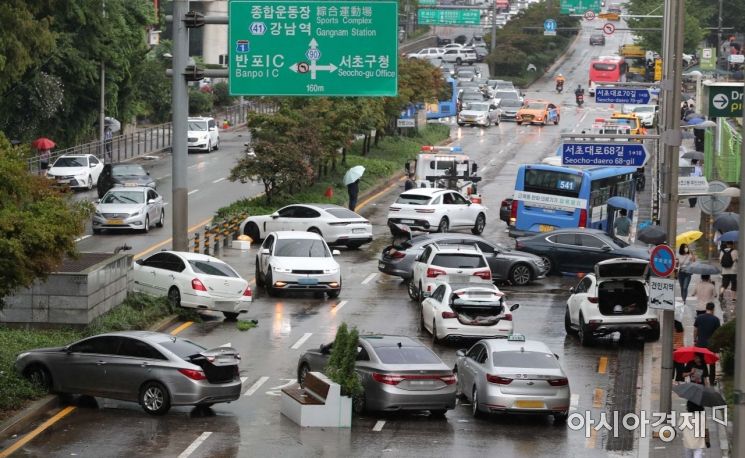
 On the 9th, vehicles that were submerged due to heavy rain in front of Jinheung Apartment in Seocho-gu, Seoul, are emerging as the water recedes. Photo by Jinhyung Kang aymsdream@
[Asia Economy Reporter Kim Daehyun] As heavy rain poured down in the Seoul metropolitan area causing continuous human and material damage, voices demanding compensation responsibility from the government and local governments are increasing.
According to the legal community on the 10th, it is difficult to hold the state liable for compensation even if a claim is made for damages caused by heavy rain at the level of an unpredictable ‘natural disaster.’ According to Supreme Court precedents, public facilities related to people and property cannot be deemed to have installation or management defects under the State Compensation Act solely because they have ‘functional defects.’
Earlier, in July 2020, in the case of Mr. A, a dementia patient who drowned while walking through an underground passage during heavy rain in Daejeon, the court dismissed the bereaved family’s claim for about 100 million won in damages against the local government in April.
Judge Jang Minha of Civil Division 21, Daejeon District Court, said, "At the time of the accident, the inside of the underground passage was flooded over 2 meters high, with floating debris visible, making the risk of accident very high to the naked eye, and there were control lines and lava cones indicating entry was prohibited at the entrance," adding, "(The local government) could not have anticipated that Mr. A would lift the control line and walk inside."
In October 2016, 316 residents of an apartment in Ulju-gun, Ulsan City, also filed a lawsuit claiming about 1.4 billion won in damages against the local government due to flooding damage caused by Typhoon Chaba’s heavy rain, but lost in the appellate court. The residents claimed, "The apartment’s main gate was flooded due to the nearby river overflowing, one resident died, and hundreds of parked vehicles were submerged."
The Civil Division 2-1 of the Busan High Court (Presiding Judge Kim Jaehyung) stated, "It cannot be recognized that the local government neglected the duties related to disaster forecast and information text message requests stipulated by law or failed to fulfill disaster prevention and preparedness obligations." It also considered that Ulsan City had established a disaster response plan for natural disasters in the summer of that year and requested each district office to strengthen safety measures against Typhoon Chaba.
The case of a freshwater fish production and sales company in Yangsan City, Gyeongnam, whose fish farm facilities were damaged due to a nearby embankment collapse caused by Typhoon Chaba, was similar. At that time, Company B, which received about 10 million won in disaster relief funds, claimed 50 million won from the local government, arguing that "the duty of care regarding the installation and management of the river embankment was not fulfilled."
Judge Kim Jeongseok of Civil Division 13, Ulsan District Court, ruled against the company, stating, "It was an extraordinary heavy rain that far exceeded the planned flood level per hour." He also cited Supreme Court precedents, saying, "Rivers naturally exist in a state that contains risks, not as installations chosen by the management authority," and "The river improvement work targeted by the state or river management authority requires enormous budgets and long periods to complete, which is a special characteristic of management."
However, there are cases where local governments were recognized as failing to fulfill their duty of care or where the cause was deemed ‘man-made.’ On September 4, 2019, Mr. B experienced flood damage while driving a foreign car on a road in Pyeongtaek City, Gyeonggi Province. Due to heavy rain from the northward approach of Typhoon Lingling, water entered the vehicle’s exhaust pipe and engine, causing the engine to stall. The road was at a low elevation compared to the surrounding area, and the drainage outlet was found to be blocked by branches and soil.
Mr. B’s insurance company claimed that the local government "did not properly fulfill the obligation to prevent flooding accidents through sufficient drainage facilities and road control," and filed a subrogation claim of about 18 million won against the local government. Last year, the Civil Division 5 of Suwon District Court (Presiding Judge Ha Hyunguk) overturned the first trial ruling in the appellate court, recognizing the local government’s liability for compensation, stating, "They did not take appropriate measures such as blocking or restricting passage at impassable points." However, the court also noted, "It must have been difficult to manage due to the heavy rain falling all at once," and ordered payment of 10 million won.
The 2011 ‘Umyeonsan landslide’ incident in Seocho-gu, Seoul, which caused dozens of casualties, is also a representative case recognizing local government responsibility. The court ruled that "there was a duty of care to issue warnings and evacuate residents in landslide risk areas by all possible means, but there was negligence in failing to fulfill this," ordering compensation of about 100 million won to the bereaved families.
© The Asia Business Daily(www.asiae.co.kr). All rights reserved.
![Clutching a Stolen Dior Bag, Saying "I Hate Being Poor but Real"... The Grotesque Con of a "Human Knockoff" [Slate]](https://cwcontent.asiae.co.kr/asiaresize/183/2026021902243444107_1771435474.jpg)
















