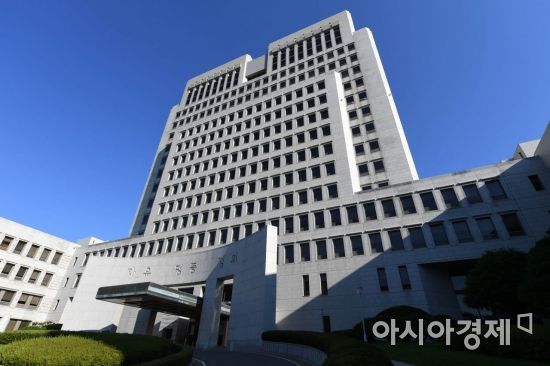
[Asia Economy Reporter Choi Seok-jin, Legal Affairs Specialist] The Supreme Court has ruled that a sports instructor who has been sentenced to a suspended prison term of one year or more and is still within the suspension period, even if granted a special pardon, must have their qualification as a sports instructor revoked under the National Sports Promotion Act.
Considering the legal system and legislative intent, the requirement for disqualification of a sports instructor under the National Sports Promotion Act means "the occurrence of a disqualifying fact as stipulated by law," and it does not require that such disqualifying fact be maintained until the time of the qualification cancellation.
The Supreme Court's Third Division (Presiding Justice Lee Heung-gu) announced on the 10th that it overturned the lower court's ruling in favor of the plaintiff, Mr. Choi, who filed an appeal against the Minister of Culture, Sports and Tourism regarding the cancellation of his sports instructor qualification, and remanded the case to the Seoul High Court.
The court stated, "Since the plaintiff no longer falls under the disqualification clause No. 3 of Article 11-5 of the former National Sports Promotion Act, the cancellation of the sports instructor qualification based on the fact that he was sentenced to a suspended prison term of one year or more is illegal. The lower court erred in interpreting Article 12, Paragraph 1, Clause 4 of the former National Sports Promotion Act, which affected the judgment," explaining the reason for the reversal and remand.
At the time Mr. Choi received the cancellation order from the Minister of Culture, Sports and Tourism in June 2020, Article 11-5, Clause 3 of the former National Sports Promotion Act stipulated that "a person sentenced to a suspended prison term of one year or more and still within the suspension period" is a disqualification for sports instructors.
Also, Article 12, Paragraph 1, Clause 4 of the law at that time was a mandatory provision requiring the Minister of Culture, Sports and Tourism to cancel the qualification of sports instructors who fall under such disqualifications.
Mr. Choi, who held three sports instructor qualifications under the National Sports Promotion Act, including Boccia Class 2 Paralympic sports instructor, Badminton, and Bodybuilding Class 2 lifestyle sports instructor, was sentenced in May 2019 to one year and six months imprisonment with a three-year suspension for violating the Special Act on the Treatment of Traffic Accidents. However, he was pardoned and reinstated by a special presidential pardon order in December of the same year.
Nevertheless, the Minister of Culture, Sports and Tourism issued a cancellation order in June 2020 for the three sports instructor qualifications held by Mr. Choi pursuant to Article 12, Paragraph 1, Clause 4 of the former National Sports Promotion Act.
Mr. Choi filed a lawsuit to cancel the qualification cancellation order, arguing that since the effect of the sentence was nullified by the special pardon, he did not fall under the disqualification of "a person sentenced to a suspended prison term of one year or more and still within the suspension period" as stipulated by law.
The first and second trials ruled in favor of Mr. Choi, stating that since the disqualification was resolved by the special pardon and reinstatement, the sports instructor qualification could not be canceled.
The judgment was that the disqualifying fact stipulated by law must be maintained until the time of the qualification cancellation order under the National Sports Promotion Act.
However, the Supreme Court's judgment differed.
The court said, "Articles 12, Paragraph 1, Clause 4 and 11-5, Clause 3 of the former National Sports Promotion Act aim to protect public trust in the sports instructor qualification system by canceling the qualification when a sports instructor is sentenced to a suspended prison term of one year or more. Therefore, if a sports instructor is sentenced to such a suspended prison term, it is consistent with the legislative intent to cancel the qualification regardless of whether the disqualification as a sports instructor continues to exist."
Furthermore, the court added, "The phrase 'cases corresponding to any of the subparagraphs of Article 11-5' in Article 12, Paragraph 1, Clause 4 of the former National Sports Promotion Act should be interpreted as 'cases where any of the disqualifying facts in Article 11-5 have occurred.' Therefore, when a sports instructor is sentenced to a suspended prison term of one year or more, the administrative agency must, in principle, cancel the qualification, and even if the disqualification is resolved before the cancellation order due to the expiration of the suspension period or other reasons, this does not change the principle."
Although Mr. Choi no longer falls under the disqualification under the National Sports Promotion Act due to the special pardon and reinstatement, the fact that he was sentenced to a suspended prison term of one year or more does not disappear. The legal requirement for qualification cancellation is the occurrence of such a fact, not that it must be maintained until the cancellation order is issued. Therefore, the Minister of Culture, Sports and Tourism's cancellation of Mr. Choi's sports instructor qualification after the special pardon was lawful.
© The Asia Business Daily(www.asiae.co.kr). All rights reserved.
![Clutching a Stolen Dior Bag, Saying "I Hate Being Poor but Real"... The Grotesque Con of a "Human Knockoff" [Slate]](https://cwcontent.asiae.co.kr/asiaresize/183/2026021902243444107_1771435474.jpg)
















