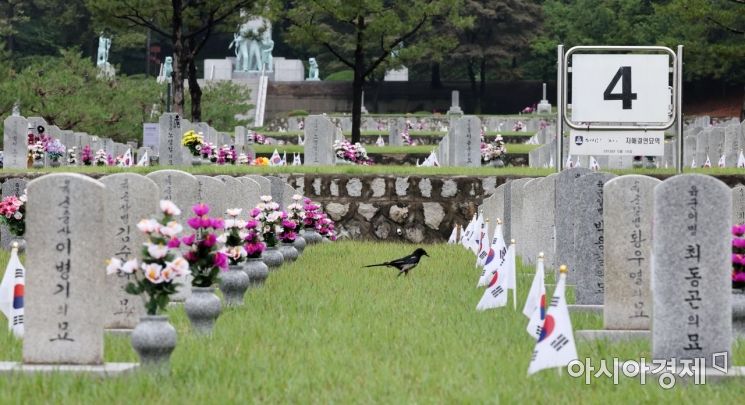
 On the 24th, one day before the 72nd anniversary of the Korean War, a magpie appears to be on guard duty in the burial area of the National Seoul Memorial Cemetery in Dongjak-gu, Seoul. Photo by Hyunmin Kim kimhyun81@
[Asia Economy Yang Nak-gyu, Military Specialist Reporter] The remains of 17 independence fighters buried in the Suyu-ri Liberation Army Joint Tomb will be reinterred at the National Seoul National Cemetery. This marks 77 years since liberation.
According to the Ministry of Patriots and Veterans Affairs on the 10th, the exhumation and transfer process, including opening the tomb and collecting the remains, will take place over three days from the 11th to the 14th.
On the first day, starting at 6 a.m. on the 11th with the Sansinje (Mountain Spirit Ritual) and memorial service, the tomb will be opened, remains collected, and the small coffin containing the remains will be wrapped with the Taegeukgi (Korean national flag). After the work is completed, in the afternoon, Park Min-sik, head of the Ministry of Patriots and Veterans Affairs, along with the Defense Ministry honor guard, will personally transport the flag-wrapped coffin from the joint tomb to a vehicle prepared in front of the Suyu branch of Bukhansan National Park.
The transport vehicle will depart at 3 p.m., escorted by police, passing through Gwanghwamun Square and arriving at the National Seoul National Cemetery. This site is the resting place of 41 independence fighters including General Ji Cheong-cheon, the Commander-in-Chief of the Liberation Army, and General Lee Beom-seok, Chief of Staff.
The remains will be temporarily placed in the Hyeonchung Hall at Seoul National Cemetery and, after the national memorial and visitation period ends on the 13th, will be jointly reinterred at the National Daejeon National Cemetery on the 14th. Even after the transfer of the Suyu-ri Liberation Army independence fighters, a marker stone will be installed at the Suyu-ri Liberation Army Joint Tomb to maintain it as a symbolic site of the Liberation Army.
The Suyu-ri Joint Tomb was established in 1961 when independence activists, who had been temporarily interred at places like Jogyesa Temple due to the absence of a separate national cemetery for patriotic martyrs after liberation, were buried in Suyu-ri. The joint tomb was created beneath the former Suyu-ri tomb of General Ji Cheong-cheon, who passed away in 1957 (his remains were moved to Seoul National Cemetery in 1994), and burials continued until 1981. Currently, 17 independence fighters are buried together in one mound.
Among the 17 patriotic martyrs in the joint tomb, 13?Kim Yu-shin (1991, Order of Merit for National Foundation), Kim Chan-won (1991, Order of Merit for National Foundation), Baek Jeong-hyun (1991, Order of Merit for National Foundation), Lee Hae-soon (1991, Order of Merit for National Foundation), Hyun Yi-pyeong (1995, Order of Merit for National Foundation), Kim Soon-geun (1990, Order of Patriotism), Kim Seong-ryul (1991, Order of Patriotism), Kim Un-baek (1991, Order of Patriotism), Moon Hak-jun (1991, Order of Patriotism), Ahn Il-yong (1991, Order of Patriotism), Jeon Il-muk (1991, Order of Patriotism), Jeong Sang-seop (1991, Order of Patriotism), Han Hwi (2022, Order of Patriotism scheduled), Lee Han-gi (1990, Order of Patriotism), and Lee Do-sun (1990, Order of Patriotism)?died in the course of independence activities in China.
Four others?Lee Han-gi (1990, Order of Patriotism), Lee Do-sun (1990, Order of Patriotism), Dong Bang-seok (1990, Order of Patriotism), and Jo Dae-gyun (1990, Order of Patriotism)?passed away domestically or elsewhere after liberation.
Although they were awarded independence merits sequentially after 1990, most died young and had no descendants, so their remains were not transferred to national cemeteries for over 70 years.
© The Asia Business Daily(www.asiae.co.kr). All rights reserved.

















