Google, Apple, and One Store Face Potential Violation of In-App Payment Ban Law
Plan to Launch Fact-Finding Investigation After On-Site Inspection
Market Expects 3-6 Months for Resolution
IT and Content Industries Criticize Delayed Enforcement
Expectations for Effective Measures Remain
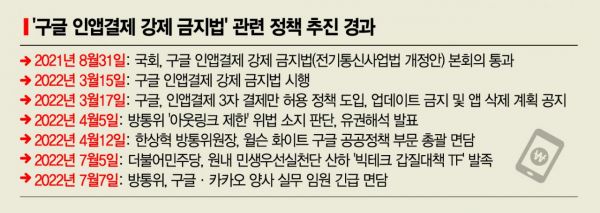
[Asia Economy reporters Minyoung Cha and Seungjin Lee] The Korea Communications Commission (KCC) has determined that the three app market operators?Google, Apple, and One Store?violated the so-called 'In-App Payment Mandate Prohibition Act (Amendment to the Telecommunications Business Act)' and will escalate from a compliance inspection to a fact-finding investigation. The IT and content industries criticized the move as already overdue, coming four months after Google's in-app payment policy was implemented, and expressed hopes for effective countermeasures.
KCC to Launch Investigation of Three Companies on the 16th
According to the KCC and the IT industry on the 10th, the KCC will begin a fact-finding investigation on the three app market operators (Google, Apple, and One Store) starting on the 16th to verify violations of prohibited acts such as forcing specific payment methods. If violations are confirmed, the commission will issue corrective orders or impose fines after deliberation and resolution. Market observers expect the investigation to take approximately three to six months.
The KCC conducted a compliance inspection of the three companies starting May 17 and concluded that all three likely violated prohibited acts. It was found that the three companies only allow certain payment methods (internal payments) under restrictive conditions and refuse app registration or renewal for app developers using other payment methods (external payments), which may constitute forcing a specific payment method. Additionally, there were indications that Google and Apple did not notify app developers of app review periods or specific reasons for review delays.
In the market, the conflict between Google and KakaoTalk over outlinks in early July is seen as the decisive factor for escalating from a compliance inspection to a fact-finding investigation. Kakao opposed Google's in-app payment policy implemented in April, leading Google to delay KakaoTalk's app update review. Although the two companies reached a final agreement through KCC mediation, it was difficult to secure concrete evidence of violations due to developers' caution toward app market operators. The exposure of Google's abusive behavior provided the government with grounds for investigation.
Mixed and Complex Reactions from the IT Industry

The IT industry showed mixed reactions to the KCC's actions. App developers find it difficult to assert themselves clearly in front of the regulatory body while also being cautious of app market operators like Google, which holds over 70% market share. An IT industry insider lamented, "Despite clear violations of current laws as seen in cases like KakaoTalk, it is regrettable that the KCC is only now initiating an investigation."
The content industry, which has suffered from increased fees due to Google's forced in-app payments, expressed similar sentiments. A content industry representative said, "We hope this becomes an opportunity to clearly expose Google's illegal activities," adding, "We expect effective measures to be taken based on the investigation results." Another industry insider noted, "Since the in-app payment mandate, fees have risen, causing usage fees to increase across the board, but many small and medium-sized companies could not raise their fees due to price competitiveness issues," and added, "Even if an investigation is conducted, practical measures like fee reductions will be realistically difficult."
Experts highlighted that the KCC's investigation allows for clarifying whether the in-app payment mandate violates current laws. It also provides an opportunity to supplement the in-app payment mandate prohibition law established last year. Professor Seongyeop Lee of Korea University Graduate School of Technology Management stated, "During the investigation, violations can be corrected, and the current law may be amended by the National Assembly to enable enforcement," adding, "Even if our companies agreed to the app market operators' policies, if the consent was coerced, the act itself is considered a violation of the law, making restoration possible, which is significant."
There is also a possibility that multinational big tech companies like Google will file administrative lawsuits against the KCC. It is anticipated that Google will not allow outlinks circumventing in-app payments only in Korea to avoid setting a precedent when KCC sanctions become serious. Attorney Taeun Koo of Law Firm Lin said, "If a ruling finds Google's current practices illegal, they are likely to appeal and proceed with litigation," adding, "It will likely go through administrative appeals or lawsuits, but since Korea is a country governed by the rule of law and precedents accumulate, this will be a step forward."
© The Asia Business Daily(www.asiae.co.kr). All rights reserved.


















