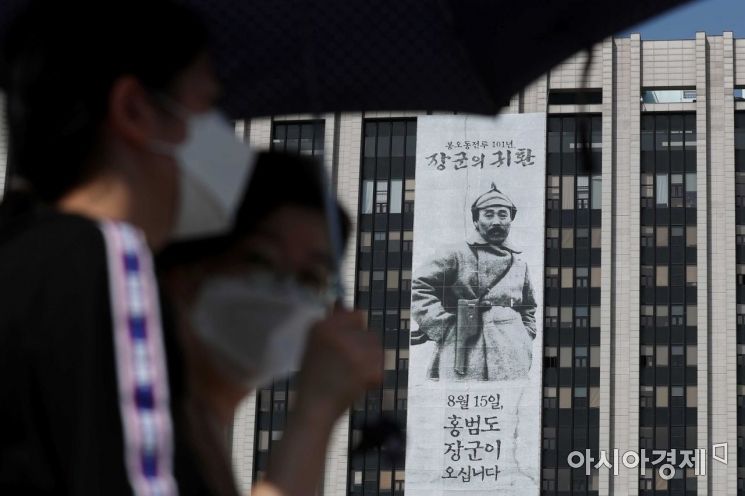
 On the last day of the Liberation Day holiday, the 16th, a memorial banner for General Hong Beom-do is hung on the outer wall of the Government Seoul Office Building. The Ministry of Patriots and Veterans Affairs posted the banner with the slogan "The General's Return" to remember and honor General Hong Beom-do's remains together with the public. / Photo by Moon Ho-nam munonam@
[Asia Economy Yang Nak-gyu, Military Specialist Reporter] A new integrated national veterans registration card that consolidates the national merit certificates will be introduced. The aim is to unify the current 15 types of national merit certificates into a new "National Veterans Registration Card" and have it recognized as an official identification card, thereby establishing respect and honor for those in uniform.
On the 9th, the Ministry of Patriots and Veterans Affairs reported this plan as part of the new government’s work agenda to President Yoon Suk-yeol. The ministry announced it will pursue four core tasks and 11 policy tasks: establishing national identity, resolving inconveniences and difficulties faced by those who sacrificed for the country, protecting the values of liberal democracy, and supporting the social reintegration of mandatory service members and early discharged soldiers.
The first policy task is the creation of a "Republic of Korea Symbolic Space" to commemorate sacrifices and contributions to the nation. A plaza symbolizing the Republic of Korea will be established in Yongsan Park, Seoul, to honor those who devoted themselves to the country and to reflect on the meaning of national defense and veterans affairs.
The Ministry of Patriots and Veterans Affairs stated, "We plan to create a National Defense and Veterans Park in Yongsan Park, which is being comprehensively developed by the Ministry of Land, Infrastructure and Transport, as a symbolic plaza of the Republic of Korea to commemorate those who dedicated themselves to the nation and to reflect on the significance of national defense and veterans affairs," and that they are in consultation with the Ministry of Land, Infrastructure and Transport.
The National Defense and Veterans Park is expected to take a form similar to the "National Mall" in Washington D.C., USA. The National Mall includes monuments such as the World War II Memorial and the Korean War Veterans Memorial and attracts 24 million visitors annually.
The ministry is also promoting the establishment of a memorial park at the North Port pier in Busan, which was the gateway for dispatching troops to the Vietnam War, and is considering acquiring and utilizing the "Lane Victory" ship, the only remaining transport ship that participated in the civilian evacuation during the Hungnam evacuation operation.
Plans include holding concerts within national cemeteries. Additionally, to inherit and develop the spirit of the independence movement, the ministry will actively pursue the repatriation of the remains of independence patriots who passed away abroad while dedicating themselves to the restoration of national sovereignty. They are working on repatriating the remains of patriot Hwang Gi-hwan (Order of Merit for National Foundation), who lived a life similar to Eugene Choi (played by Lee Byung-hun) in the popular drama "Mr. Sunshine" (aired on tvN). Hwang, who devoted his entire body to Korean independence in Europe and the United States during the 1910s and 1920s and died prematurely at the age of 40, has had repatriation efforts underway since 2019 but they have not yet been realized. Currently, his remains are interred at Mount Olivet Cemetery in Flushing, Queens, New York, USA.
Furthermore, the ministry plans to rationally establish veterans review standards to sufficiently reflect sacrifice and contribution. For example, they will actively recognize the work-relatedness of diseases that are difficult to directly prove but strongly related to public service, such as illnesses occurring after long-term hazardous duties or self-harm by mandatory service members.
To this end, the government plans to more than double the current approximately 1,000 annual government-led fact-finding investigations by 2026.
They are also promoting a plan to replace physical examinations at veterans hospitals with disability certificates issued by tertiary general hospitals. The disability grade system is currently under study to improve the lowest grade, grade 7, to better reflect reality.
The veterans compensation system will be built to correspond to sacrifice and contribution, and support for low-income veterans will be strengthened. Considering similar domestic and international benefits such as industrial accident compensation, they plan to rationally adjust compensation imbalances by category, including grade 7 compensation, veterans honor allowances, and new allowances for children inheriting benefits from the Korean War.
To strengthen support for low-income veterans, the dependency obligation criteria for the living adjustment allowance will be gradually abolished by 2025. In the mid to long term, they also plan to reform the support system for low-income veterans to guarantee a minimum income level higher than that of the general public.
Additionally, in response to the aging of veterans, they will expand the veterans, medical, and nursing care infrastructure with the opening of a nursing hospital in Gwangju in the second half of this year, and by creating an additional 200,000 burial plots through new construction at Yeoncheon National Cemetery and the Gangwon region National Cemetery to meet the demand for interment in national cemeteries. The ministry will also strengthen solidarity with allied countries to protect the values of liberal democracy and will promote a nationwide commemorative project next year to mark the 70th anniversary of the Korean War armistice and the Korea-U.S. alliance.
In particular, they plan to posthumously award a medal to the late General Richard Whitcomb (1894-1982), who served as the Busan Logistics Base Commander during the Korean War and devoted himself to caring for war orphans, and to establish the "Whitcomb Award." General Whitcomb was assigned as commander of the U.S. 2nd Logistics Base in Busan and dedicated his life to restoring the Republic of Korea, which was devastated by the Korean War, and caring for war orphans.
Also, on July 27 next year, the 70th anniversary of the armistice, a summit meeting of leaders from 22 participating countries will be held to strengthen cooperation in veterans and defense fields and to serve as an opportunity to announce a future vision for the Korean Peninsula.
To strengthen social responsibility for mandatory service members, the current "Veterans Act" will be amended to establish grounds for support from the state and local governments for young people who have fulfilled their military service obligations. In addition, through collaboration with related ministries, they will continue to promote the introduction and strengthening of preferential systems commensurate with military service. Such preferential systems include counting military service periods as work experience, recognizing academic credits earned during military service, and expanding the subscription period for the national pension.
They will also promote measures to support employment and entrepreneurship for early discharged soldiers.
Park Min-sik, head of the Ministry of Patriots and Veterans Affairs, stated, "The traditional role of veterans affairs, centered on compensation and honor, must be reset through a paradigm shift befitting the status of an advanced country. Through this, we will contribute to national integration and the establishment of national identity, thereby contributing to the Republic of Korea’s leap forward."
© The Asia Business Daily(www.asiae.co.kr). All rights reserved.

















